Question
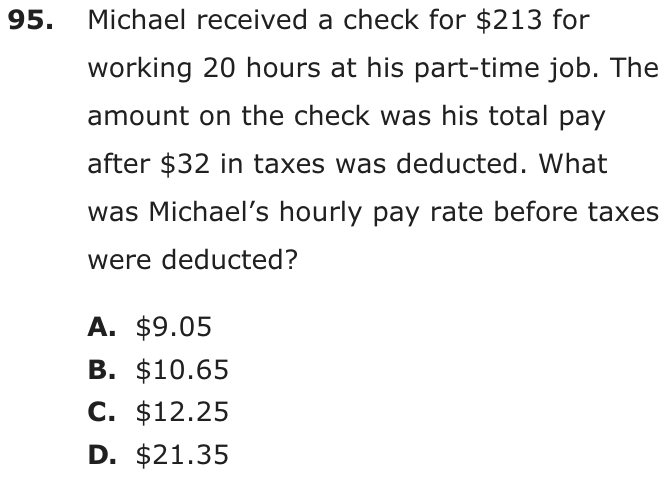
Michael received a check for $213 for working 20 hours at his part-time job. The amount on the check was his total pay after $32 in taxes was deducted. What was Michael’s hourly pay rate before taxes were deducted?
- A$9.05
- B$10.65
- C$12.25
- D$21.35
Show the answer
Correct answer: C
Add the taxes to the amount of the check to find Michael’s total pay before taxes were deducted:
Divide the total pay by the number of hours to find the hourly pay rate:
Question analysis
Michael's paycheck shows what he earned for 20 hours after taxes were taken out, and the tax amount is given. Students find his hourly pay rate before taxes. It tests unit rates in a money word problem, where students must decide what to do with the tax that was deducted.
- Grade level
- Grade 6 content, by NYS standard
- Compared with grade 7
- Below grade 7 Unit rate problems are grade 6 content, and this one needs one addition and one division with a decimal result. It is easier than typical grade 7 work, apart from deciding which amount is the pay before taxes.
- Estimated difficulty
- Straightforward: two steps or one careful reading.
- Thinking it demands
- Depth of knowledge 2, skills and concepts · mainly apply
- What makes it hard
- Turning words into math minor
- Solution
- 2 steps
- Reading level
- Question and choices: about grade 5, 36 words.
- Students, last 30 days
- Not enough answers yet to show (it takes 10).
Why it is hard, traps and wrong answers (shows the answer)
Why it is hard
Two operations in the right order, adding the tax back and dividing by the hours, are all this takes. The danger is the word deducted, which pulls students toward subtracting the $32 a second time, and the phrase before taxes, which rules out the take-home rate from dividing the check alone. Checking that $12.25 × 20 − $32 gives back $213 confirms the answer.
Turning words into math minor Understanding the question
"The amount on the check was his total pay after $32 in taxes was deducted" makes $213 what remained, so the $32 is added back, not taken away. (Hegarty, Mayer & Monk, 1995; Koedinger & Nathan, 2004)
Strategy: Rebuild Michael's pay before taxes from the check and the tax that was taken out, then divide that total by the 20 hours worked.
Traps
- Follows a key word: Picks the operation from a single word rather than the situation: "removed" so subtract, "of" so multiply, "more" so add, when the situation needs something else.
- Answers a different question: A choice is right for another quantity: the other unknown, the rest instead of the part, the part instead of the whole.
The wrong answers, classified
A Follows a key word (Hegarty, Mayer & Monk, 1995)
Follows the word deducted and subtracts the $32 from the $213 check again, (213 − 32) ÷ 20 = 9.05, instead of adding it back.
B Answers a different question (King et al., 2004; Hegarty, Mayer & Monk, 1995)
Divides the $213 check by 20 hours, which gives Michael's hourly pay after taxes rather than before.
D Little reason to choose it (Haladyna & Downing, 1993; Rodriguez, 2005)
No standard working gives $21.35, which equals 32 − 10.65; dividing $213 by 10 hours instead of 20, $21.30, comes closest, so it mostly draws guesses.
Worked solution, step by step
Formulas used
- Hourly pay rate
- rate is the pay for one hour. total pay is the money earned for all the hours. hours is the time worked. Dividing shares the total pay equally among the hours. Use it when the pay for each hour is the same.
Sort out the question
Michael’s check was for $213. That is what was left after $32 in taxes was deducted, which means taken away. He worked 20 hours.
You need his hourly pay before taxes. So first find his full pay before the $32 was taken out.
Add the taxes back
The $32 was taken away from his full pay to leave $213. To undo taking away, add it back.
His pay before taxes was $245. Watch out: The word “deducted” tempts you to subtract again. That gives , choice A.
Divide by the hours
He earned $12.25 for each hour before taxes. Watch out: Dividing the $213 check by 20 gives $10.65, choice B. That is his pay for each hour after taxes.
So the answer is C, $12.25.
Check your answer
Work forward. , so 20 hours pay $245. Take away $32 in taxes: . That is the amount on the check.
More questions like this
The original DOE question