Question
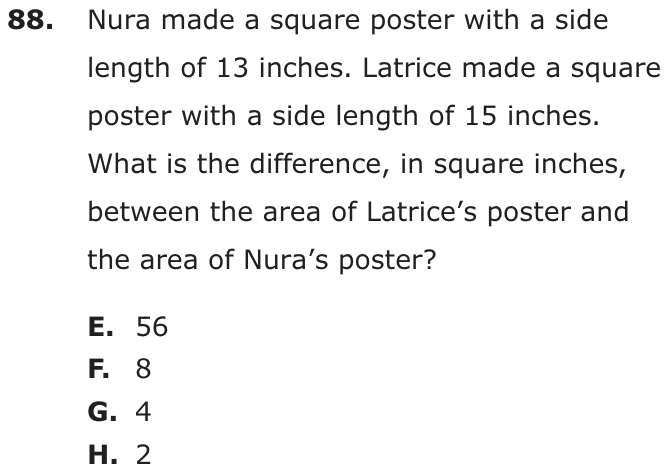
Nura made a square poster with a side length of 13 inches. Latrice made a square poster with a side length of 15 inches. What is the difference, in square inches, between the area of Latrice’s poster and the area of Nura’s poster?
- A56
- B8
- C4
- D2
Show the answer
Correct answer: A
Nura’s poster is square, so all the side lengths are 13 inches. The area, in square inches, is
Latrice’s poster is square, so all the side lengths are 15 inches.
Subtract to determine the difference between the areas.
The difference, in square inches, is 56.
Question analysis
This area word problem compares two square posters, one 13 inches on a side and one 15 inches on a side, and asks for the difference between their areas in square inches. Students square each side length and subtract. Working with the difference in the sides, or with perimeters, instead of the areas is the easy mistake.
- Grade level
- Grade 6 content, by NYS standard
- Compared with grade 7
- Below grade 7 Area of a square is elementary content, and squaring 13 and 15 is grade 6 exponent work. Typical grade 7 area problems involve circles, composite shapes or scale drawings; this one has two familiar areas and a subtraction.
- Estimated difficulty
- Straightforward: two steps or one careful reading.
- Thinking it demands
- Depth of knowledge 2, skills and concepts · mainly apply
- What makes it hard
- Solution
- 3 steps
- Reading level
- Question and choices: about grade 5, 41 words.
- Students, last 30 days
- Not enough answers yet to show (it takes 10).
Why it is hard, traps and wrong answers (shows the answer)
Why it is hard
The method is short, but the question invites a shortcut: the sides differ by 2, so it feels as if the areas should differ by 2 squared. Two choices reward working with the side lengths and one rewards perimeters. Squaring each side before subtracting avoids all three, and a sketch of the 13-inch square inside the 15-inch one shows the gap is an L-shaped strip, far more than 4 square inches.
Something you must already know minor Working it out
The area of a square, side times side, is not given; students must square 13 and 15 themselves rather than work with the side lengths. (Anderson & Krathwohl, 2001)
Error-prone arithmetic minor Working it out
Squaring 13 and 15 by hand gives 169 and 225, and the subtraction 225 − 169 needs a borrow, where an arithmetic slip creeps in. (Brown & Burton, 1978; Junker & Sijtsma, 2001)
Strategy: Find each poster's area by squaring its side length, then subtract the smaller area from the larger; work with the areas, not the side lengths.
Traps
- Wrong formula: Uses a related but wrong formula: perimeter for area, diameter for radius, area for volume, or a misremembered one.
- A faulty procedure: A systematic but wrong procedure: adding fractions straight across, applying an exponent to each term of a sum, dropping a sign when moving a term.
- Answers a different question: A choice is right for another quantity: the other unknown, the rest instead of the part, the part instead of the whole.
The wrong answers, classified
B Wrong formula (King et al., 2004)
Compares perimeters instead of areas, 4 × 15 − 4 × 13 = 60 − 52 = 8, a difference in inches, not square inches.
C A faulty procedure (Brown & Burton, 1978; Tatsuoka, 1983)
Subtracts the sides first and squares the difference, (15 − 13)² = 4, as if 15² − 13² equaled (15 − 13)².
D Answers a different question (King et al., 2004; Hegarty, Mayer & Monk, 1995)
Gives the difference in side lengths, 15 − 13 = 2, a length rather than a difference in area.
Worked solution, step by step
Formulas used
- Area of a square
- A is the area, the flat space inside the shape. s is the length of one side. All four sides of a square are equal, so the area is side times side. The small 2 means squared, or times itself. Area is measured in square units, here square inches.
Write down what you know
Nura’s poster is a square with sides of 13 inches. Latrice’s poster is a square with sides of 15 inches. You need the difference between their areas, in square inches. The difference is how much bigger one area is than the other. So find each area, then subtract.
Find the area of Nura’s poster
Use the area formula with the side of 13 inches.
Nura’s poster has an area of 169 square inches.
Find the area of Latrice’s poster
Use the same formula with the side of 15 inches.
Latrice’s poster has an area of 225 square inches.
Subtract the two areas
Take the smaller area away from the larger one.
The difference is 56 square inches.
Watch out: don’t subtract the sides first and then square. , choice C, is not the same as . The side difference, 2 inches, is choice D, a length. Comparing perimeters, the distance around, gives 8, choice B.So the answer is A, 56 square inches.
Check your answer
Picture Nura’s poster laid in a corner of Latrice’s. The extra part is an L-shaped strip 2 inches wide. One arm is 15 by 2 and the other is 13 by 2. , so the strip is 56 square inches. That matches.
More questions like this
The original DOE question