Question
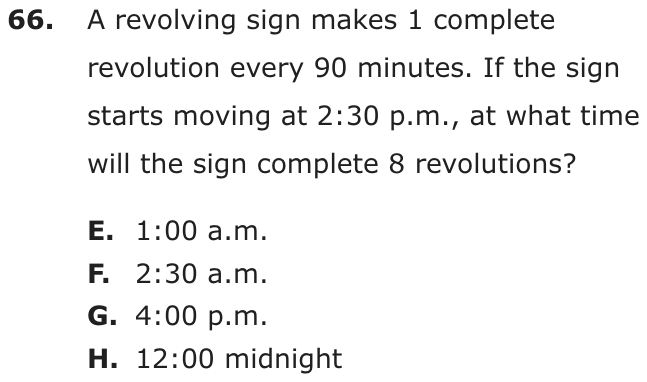
A revolving sign makes 1 complete revolution every 90 minutes. If the sign starts moving at 2:30 p.m., at what time will the sign complete 8 revolutions?
- A1:00 a.m.
- B2:30 a.m.
- C4:00 p.m.
- D12:00 midnight
Show the answer
Correct answer: B
First, use a proportion to find out how many minutes it will take the sign to complete 8 revolutions. Let x equal the total number of minutes:
Next, convert 720 minutes into hours and minutes:
Finally, 12 hours after 2:30 p.m. is 2:30 a.m.
Question analysis
A revolving sign turns once every 90 minutes and starts at 2:30 in the afternoon. Students find the clock time when it finishes 8 full revolutions. The question combines a rate with converting minutes to hours, and then adding the elapsed time to the starting time on a 12-hour clock.
- Grade level
- Grade 6 content, by NYS standard
- Compared with grade 7
- Below grade 7 A constant rate, a multiplication and a conversion from minutes to hours are grade 6 skills. The only step beyond routine work is adding the elapsed time to a starting clock time.
- Estimated difficulty
- Straightforward: two steps or one careful reading.
- Thinking it demands
- Depth of knowledge 2, skills and concepts · mainly apply
- What makes it hard
- Many steps minor
- Something you must already know minor
- Solution
- 3 steps
- Reading level
- Question and choices: about grade 4, 31 words.
- Students, last 30 days
- Not enough answers yet to show (it takes 10).
Why it is hard, traps and wrong answers (shows the answer)
Why it is hard
Each step is routine, so most points are lost in keeping elapsed time and clock time apart. The 12 hours is a duration, and the clock reading that ends it is 12 hours after 2:30 in the afternoon, not 12:00. A sense check helps: 12 hours after any time shows the same digits on the clock with a.m. and p.m. swapped.
Many steps minor Working it out
Three moves: 8 × 90 = 720 minutes, 720 ÷ 60 = 12 hours, then 12 hours counted on from the 2:30 start, which crosses midnight into the morning. (Daniel & Embretson, 2010; Enright, Morley & Sheehan, 2002)
Something you must already know minor Working it out
Counting hours past midnight means switching from p.m. to a.m. on a 12-hour clock, which the stem leaves to the student; the choices mix both halves of the day. (Anderson & Krathwohl, 2001)
Strategy: Multiply 90 minutes by 8 to get the total time, change it to hours, and then count that many hours forward from 2:30 p.m.
Traps
- Stops one step early: A choice is a number from partway through the solution.
- Counting the ends: Inclusive or exclusive ends, fence posts, consecutive numbers: an answer that is one too many or too few, or an endpoint drawn open where it belongs closed (or the reverse).
- Numbers taken from the question: Combines the numbers in the question without a model of the situation, or is simply a number that appears in the question.
The wrong answers, classified
A Counting the ends (Brown & Burton, 1978)
Counts only 7 revolutions, 630 minutes or 10½ hours, as if the first turn were already done at the start, and lands at 1:00 a.m.
C Numbers taken from the question (Hegarty, Mayer & Monk, 1995)
Adds a single revolution's 90 minutes to the 2:30 start, giving 4:00 in the afternoon, without multiplying by the 8 revolutions.
D Stops one step early (King et al., 2004; Gierl et al., 2017)
Finds that 8 revolutions take 12 hours and picks 12:00 midnight, reading the elapsed time as a clock time instead of counting on from 2:30.
Worked solution, step by step
Formulas used
- Total time
- Time for one is how long one revolution takes. How many is the number of revolutions. Each one takes the same time, so multiply to get the total time.
- Minutes to hours
- There are 60 minutes in 1 hour. So to change minutes to hours, divide by 60. Each group of 60 minutes makes 1 hour.
Sort out the question
The sign turns all the way around once every 90 minutes. One full turn is called a revolution. The sign starts at 2:30 p.m. You need the clock time when it finishes 8 revolutions.
Find the total time in minutes
Each revolution takes 90 minutes, and there are 8 of them.
The 8 revolutions take 720 minutes. Watch out: use all 8 revolutions. Counting only 7 gives 630 minutes and 1:00 a.m., choice A. Adding just one 90 minutes gives 4:00 p.m., choice C.
Change the minutes to hours
Clock times are easier to count in hours. There are 60 minutes in an hour.
The sign turns for 12 hours.
Count forward from 2:30 p.m.
Start at 2:30 p.m. and add 12 hours. When you pass midnight, p.m. changes to a.m. So 12 hours after 2:30 p.m. is 2:30 a.m. the next morning. Watch out: 12 hours is an amount of time, not a clock time. Reading it as 12:00 midnight gives choice D. So the answer is B, 2:30 a.m.
Check your answer
From 2:30 p.m. to 2:30 a.m. is one full trip around the clock, 12 hours. 12 hours is minutes. And , the number of revolutions in the question.
More questions like this
The original DOE question