Question
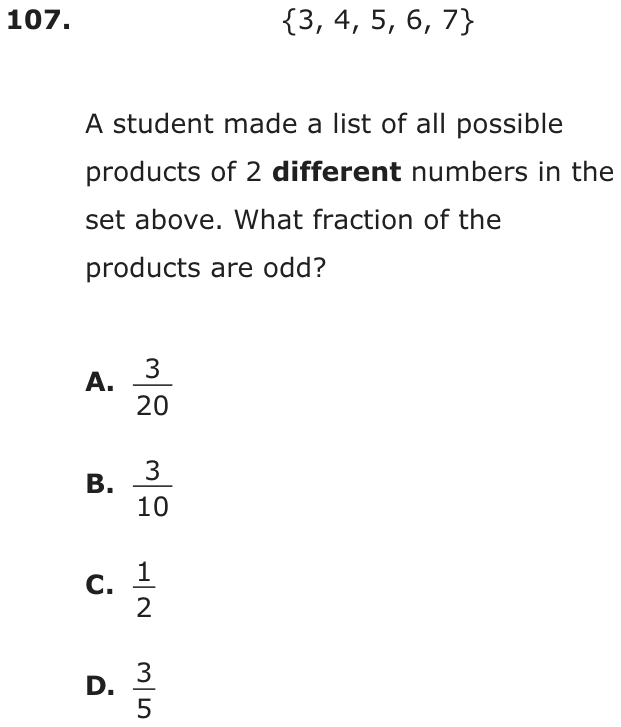
A student made a list of all possible products of 2 different numbers in the set above. What fraction of the products are odd?
- A
- B
- C
- D
Show the answer
Correct answer: B
First, list the products:
Of the 10 products, 3 are odd. The fraction is .
Question analysis
A student lists every product of two different numbers from the set 3, 4, 5, 6, 7. Students find what fraction of those products are odd. It tests listing outcomes systematically without counting a pair twice, and reasoning about odd and even numbers.
- NYS standards
- Grade level
- Grade 7 content, by NYS standard
- Compared with grade 7
- At grade 7 Organized lists of outcomes are grade 7 work. Here students list the products of pairs from five numbers, without repeating a pair or pairing a number with itself, then count the ones that fit.
- Estimated difficulty
- Moderate: several steps, or a close reading with one strong distractor.
- Thinking it demands
- Depth of knowledge 2, skills and concepts · mainly apply
- What makes it hard
- Much to keep track of moderate
- Something you must already know minor
- Solution
- 3 steps
- Reading level
- Question and choices: about grade 6, 28 words.
- Students, last 30 days
- Not enough answers yet to show (it takes 10).
Why it is hard, traps and wrong answers (shows the answer)
Why it is hard
The count of odd products is easy, since only 3, 5 and 7 can make one; the total is where students go wrong. Counting ordered pairs, 5 × 4 = 20, while listing odd products once mixes two kinds of counting. Writing the 10 pairs in order, 3 with each larger number, then 4, and so on, keeps the total honest.
Much to keep track of moderate Working it out
Listing the products of 2 different numbers from five means tracking 10 pairs, with no pair repeated in reverse order and no number paired with itself. (Sweller, 1988; Carpenter, Just & Shell, 1990)
Something you must already know minor Working it out
The shortcut, that a product is odd only when both factors are odd, cuts the work to counting pairs from 3, 5 and 7, but it must be known. (Anderson & Krathwohl, 2001)
Strategy: List each pair of different numbers once, then find each product, or use the fact that a product is odd only when both factors are odd, and count.
Traps
- Overlapping groups: Things in two groups at once are counted twice, or not subtracted.
- Misunderstands the concept: A wrong belief about a concept: that percents can be added, that area grows like length, that averages can be averaged, that a bigger denominator means a bigger fraction.
- Answers a different question: A choice is right for another quantity: the other unknown, the rest instead of the part, the part instead of the whole.
The wrong answers, classified
A Overlapping groups (King et al., 2004)
Counts ordered pairs for the total, 5 × 4 = 20, so each pair appears twice, but counts the odd products once, 3, giving 3/20.
C Misunderstands the concept (Smith, diSessa & Roschelle, 1993; De Bock et al., 1998; Ni & Zhou, 2005)
Assumes about half of all products are odd, as odd and even numbers come equally often, without listing the products or checking any.
D Answers a different question (King et al., 2004; Hegarty, Mayer & Monk, 1995)
Gives the share of the numbers in the set that are odd, 3 of 5, instead of the share of the products, never forming any products.
Worked solution, step by step
Formulas used
- Fraction of a list
- The top counts the products that are odd. The bottom counts all the products in the list. A product is the answer when you multiply. The fraction tells what share of the list is odd.
- Odd times odd
- An odd number can’t be split into pairs, like 3 or 7. An even number can, like 4. A product is odd only when both numbers are odd. If either number is even, the product is even, because it splits into pairs.
Sort out the question
The set has 3, 4, 5, 6 and 7. The student multiplies 2 different numbers, every possible way. A product is the answer to a multiplication. Each pair counts once, since 3 × 4 and 4 × 3 give the same product. You need the fraction of the products that are odd.
List every pair once
Pair 3 with each bigger number. Then pair 4 with each bigger number, and so on. This way no pair is counted twice.
3 × 4 = 12 3 × 5 = 15 3 × 6 = 18 3 × 7 = 21 4 × 5 = 20 4 × 6 = 24 4 × 7 = 28 5 × 6 = 30 5 × 7 = 35 6 × 7 = 42 There are 10 products.
Count the odd products
The odd products are 15, 21 and 35. That makes 3. They come from the only pairs where both numbers are odd: 3 and 5, 3 and 7, and 5 and 7.
Write the fraction
Use the fraction formula.
Watch out: Counting 4 × 3 as well as 3 × 4 makes 20 pairs. Then , choice A, mixes two ways of counting. And , choice D, is the share of the numbers that are odd, not the products.
So the answer is B, .
Check your answer
Count without listing. Each of the 5 numbers can pair with 4 others, which makes 20. But that counts every pair twice, so there are 20 ÷ 2 = 10 pairs. Only the odd numbers 3, 5 and 7 make odd products, and they form 3 pairs.
More questions like this
The original DOE question