Question
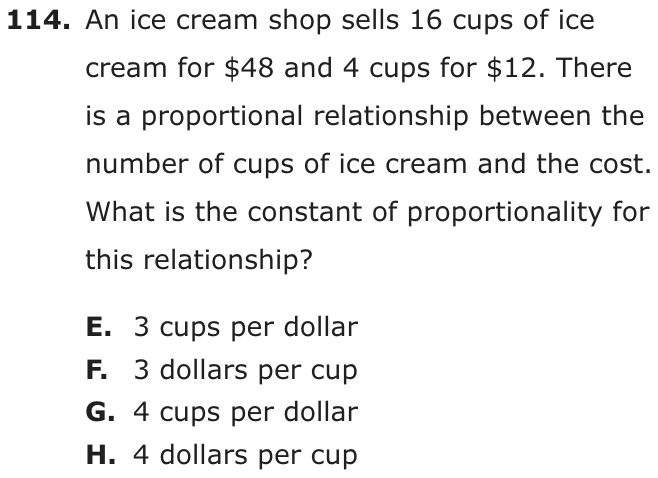
An ice cream shop sells 16 cups of ice cream for $48 and 4 cups for $12. There is a proportional relationship between the number of cups of ice cream and the cost. What is the constant of proportionality for this relationship?
- A3 cups per dollar
- B3 dollars per cup
- C4 cups per dollar
- D4 dollars per cup
Show the answer
Correct answer: B
There is a proportional relationship between the cost and the number of cups of ice cream.
Divide the cost by the number of cups of ice cream to find the constant of proportionality.
The constant is the cost per cup, 3 dollars.
Question analysis
An ice cream shop sells 16 cups for $48 and 4 cups for $12, and the cost is proportional to the number of cups. This proportional relationship question asks for the constant of proportionality, with its units. The choices pair two numbers with two kinds of units, so the units of the rate matter as much as the number.
- Grade level
- Grade 7 content, by NYS standard
- Compared with grade 7
- Below grade 7 Grade 7 students find constants of proportionality in tables, graphs and equations. Here one division gives the number, as in grade 6 unit pricing, and the real demand is attaching the right units to it.
- Estimated difficulty
- Straightforward: two steps or one careful reading.
- Thinking it demands
- Depth of knowledge 2, skills and concepts · mainly apply
- What makes it hard
- A very close wrong answer moderate
- Something you must already know minor
- Solution
- 2 steps
- Reading level
- Question and choices: about grade 4, 50 words.
- Students, last 30 days
- Not enough answers yet to show (it takes 10).
Why it is hard, traps and wrong answers (shows the answer)
Why it is hard
One division gives the number, so the question is really about units. The cost depends on the number of cups, and dividing $48 by 16 cups gives the dollars for each cup; reversing the label describes a shop where one dollar buys three cups. The second offer, 4 cups for $12, is a built-in check that the rate stays the same.
A very close wrong answer moderate Choosing the answer
Two choices carry the number 3, "3 cups per dollar" and "3 dollars per cup", so finding 48 ÷ 16 is not enough; the units decide. (Embretson & Wetzel, 1987; Gorin & Embretson, 2006; Ascalon et al., 2007)
Something you must already know minor Working it out
Students must know that dividing dollars by cups gives dollars per cup: a quotient's units read as the top quantity per the bottom one. (Anderson & Krathwohl, 2001)
Strategy: Divide one quantity by the other for one offer, check that the other offer gives the same quotient, and label it with the numerator's units per the denominator's units.
Traps
- Wrong operation: Adds instead of multiplying, divides the wrong way round, turns a ratio or rate upside down, or undoes a step in the wrong direction (subtracts what should be added back).
- Numbers taken from the question: Combines the numbers in the question without a model of the situation, or is simply a number that appears in the question.
The wrong answers, classified
A Wrong operation (Hegarty, Mayer & Monk, 1995; King et al., 2004)
Gets 3 from 48 ÷ 16 but labels it cups per dollar, turning the rate upside down; at these prices a dollar buys only 1/3 of a cup.
C Numbers taken from the question (Hegarty, Mayer & Monk, 1995)
Divides the two cup amounts, 16 ÷ 4 = 4, and attaches cups per dollar, a ratio of like quantities given made-up units.
D Numbers taken from the question (Hegarty, Mayer & Monk, 1995)
Divides the two costs, $48 ÷ $12 = 4, or the two cup counts, and calls the result dollars per cup.
Worked solution, step by step
Formulas used
- Constant of proportionality
- In a proportional relationship, y is always the same number, k, times x. Here x is the number of cups and y is the cost in dollars. So k is y divided by x. Its units are the top’s units per the bottom’s units: dollars per cup.
Sort out the question
16 cups cost $48, and 4 cups cost $12. The cost is proportional to the cups. That means the cost is always the same number times the number of cups. That number is the constant of proportionality. You need it with the right units.
Divide cost by cups
For each offer, divide the cost in dollars by the number of cups.
Both offers give 3. So the constant is 3.
Name the units
Dollars are on top and cups are on the bottom. So the units are dollars per cup. 3 dollars per cup means each cup costs $3. Watch out: two choices use 3. Choice A, 3 cups per dollar, flips the rate. Then 16 cups would cost only about $5, not $48.
Avoid the traps and answer
Watch out: dividing two costs, , or two cup counts, , gives 4. That compares like amounts, so it is not a cost for each cup. It leads to choice C or D.So the answer is B, 3 dollars per cup.
Check your answer
Multiply back. At 3 dollars per cup, 16 cups cost , which is $48. And 4 cups cost , which is $12. Both match the shop’s prices.
More questions like this
The original DOE question