Question
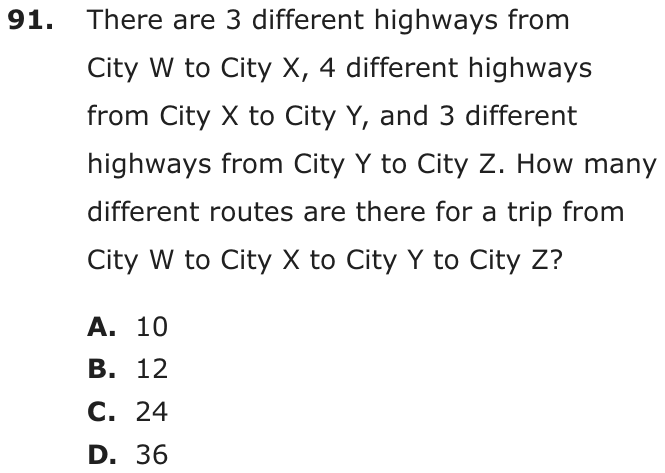
There are 3 different highways from City W to City X, 4 different highways from City X to City Y, and 3 different highways from City Y to City Z. How many different routes are there for a trip from City W to City X to City Y to City Z?
- A10
- B12
- C24
- D36
Show the answer
Correct answer: D
Multiply the numbers of highways between each pair of cities:
Question analysis
A counting question about highways: there are 3 highways from City W to City X, 4 from X to Y and 3 from Y to Z. Students count the different routes from W to Z through X and Y. It tests the counting principle, and deciding whether to add or multiply the numbers of highways is the key.
- NYS standards
- 7.SP.8b sample spaces for compound events
- Grade level
- Grade 7 content, by NYS standard
- Compared with grade 7
- Below grade 7 Grade 7 students build tree diagrams and lists for compound events. This item needs only the counting principle across three stages, with no restriction on the choices, which makes it shorter than typical grade 7 work.
- Estimated difficulty
- Routine: one familiar step, little to misread.
- Thinking it demands
- Depth of knowledge 2, skills and concepts · mainly apply
- What makes it hard
- Solution
- 1 step
- Reading level
- Question and choices: about grade 11, 48 words.
- Students, last 30 days
- Not enough answers yet to show (it takes 10).
Why it is hard, traps and wrong answers (shows the answer)
Why it is hard
Once a route is seen as one highway on each of three stretches, the count is a single product, 3 × 4 × 3. The wrong choices come from adding the counts, from stopping after two stretches, and from adding two-stretch products. A small tree for the first two stretches shows why the numbers multiply: each of the 3 highways to City X branches into 4.
Something you must already know minor Working it out
The counting principle, multiplying the 3, 4 and 3 highway choices because each route uses one highway on every stretch, is assumed; the stem never says to multiply. (Anderson & Krathwohl, 2001)
Strategy: A route uses one highway on each of the three stretches, so count the choices for each stretch and multiply; a small tree for two stretches shows why.
Traps
- Wrong operation: Adds instead of multiplying, divides the wrong way round, turns a ratio or rate upside down, or undoes a step in the wrong direction (subtracts what should be added back).
- Stops one step early: A choice is a number from partway through the solution.
The wrong answers, classified
A Wrong operation (Hegarty, Mayer & Monk, 1995; King et al., 2004)
Adds the highways, 3 + 4 + 3 = 10, counting the roads available rather than the ways to choose one road on each stretch.
B Stops one step early (King et al., 2004; Gierl et al., 2017)
Multiplies the first two stretches, 3 × 4 = 12 routes from City W to City Y, and stops before the 3 highways on to City Z.
C Wrong operation (Hegarty, Mayer & Monk, 1995; King et al., 2004)
Counts routes two stretches at a time, 3 × 4 = 12 for W to Y and 4 × 3 = 12 for X to Z, and adds them instead of multiplying all three.
Worked solution, step by step
Formulas used
- Counting principle
- a, b and c are the numbers of choices for the first, second and third parts of a task. Every choice for one part can go with every choice for the others. So you multiply. Use it when you make one choice at each stage and want to count all the ways.
Sort out the trip
A route goes from City W to X, then to Y, then to Z. It uses exactly one highway on each of three stretches:
- W to X: 3 highways
- X to Y: 4 highways
- Y to Z: 3 highways
You need to count all the different routes.
Count routes from W to Y
Start small. Pick any of the 3 highways to City X. From there, you can take any of the 4 highways to City Y. So each first highway leads to 4 routes.
There are 12 routes from City W to City Y.
Add the last stretch
Each of those 12 routes can end with any of the 3 highways to City Z. So multiply again. This is the counting principle with all three stretches.
There are 36 routes in all.
Avoid the common traps
Watch out: Adding 3 + 4 + 3 = 10 counts highways, not routes. That gives choice A. Stopping at 12 forgets the last stretch, choice B. Adding 12 + 12 = 24 mixes two partial counts, choice C. A route is built by choosing one highway after another, so you multiply.
So the answer is D, 36.
Check your answer
Picture one highway from W to X. After it, there are 4 × 3 = 12 ways to finish the trip. Each of the 3 highways from W to X gives 12 ways. That makes 12 + 12 + 12 = 36 routes.
More questions like this
The original DOE question