Question
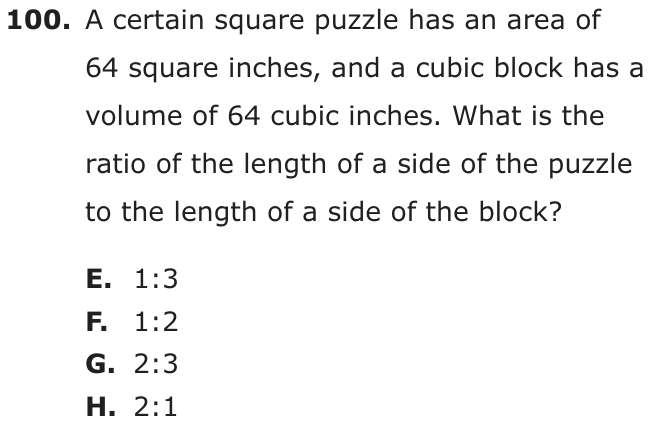
A certain square puzzle has an area of 64 square inches, and a cubic block has a volume of 64 cubic inches. What is the ratio of the length of a side of the puzzle to the length of a side of the block?
- A
- B
- C
- D
Show the answer
Correct answer: D
The length of one side of the puzzle is inches. The length of one side of the block is inches.
The ratio of the side of the puzzle to the side of the block is , which reduces to .
Question analysis
A square puzzle has an area of 64 square inches, and a cube-shaped block has a volume of 64 cubic inches. Students find the ratio of a side of the puzzle to a side of the block. Both figures are described by the number 64, but turning an area and a volume back into lengths takes different steps, and the order of the ratio matters.
- NYS standards
- Grade level
- Grade 8 content, by NYS standard
- Compared with grade 7
- Above grade 7 Grade 7 area and volume problems go from side lengths to an area or a volume. Going backward needs a square root and a cube root, and cube roots are grade 8 content, although 64 is both a perfect square and a perfect cube.
- Estimated difficulty
- Moderate: several steps, or a close reading with one strong distractor.
- Thinking it demands
- Depth of knowledge 2, skills and concepts · mainly apply
- What makes it hard
- Something you must already know moderate
- Combines ideas minor
- Solution
- 3 steps
- Reading level
- Question and choices: about grade 3, 46 words.
- Students, last 30 days
- Not enough answers yet to show (it takes 10).
Why it is hard, traps and wrong answers (shows the answer)
Why it is hard
Because 64 is both a perfect square and a perfect cube, the computation is easy once students know to undo squaring and cubing. The risk is at the end: with sides of 8 and 4 inches in hand, writing the block first turns the ratio upside down. Students who never find the side lengths are left with ideas such as two dimensions against three.
Something you must already know moderate Working it out
Neither formula is given: the puzzle’s side is the number whose square is 64 and the block’s edge the number whose cube is 64, and cube roots are grade 8 work. (Anderson & Krathwohl, 2001)
Combines ideas minor Working it out
A square and a cube share the number 64 in different units, so two different inverse operations feed one ratio, which must list the puzzle’s side first. (Embretson, 1998; Daniel & Embretson, 2010)
Strategy: Find the side of the square from its area and the edge of the cube from its volume by testing small whole numbers, then write the puzzle's side first and simplify.
Traps
- Wrong operation: Adds instead of multiplying, divides the wrong way round, turns a ratio or rate upside down, or undoes a step in the wrong direction (subtracts what should be added back).
- Numbers taken from the question: Combines the numbers in the question without a model of the situation, or is simply a number that appears in the question.
The wrong answers, classified
A Little reason to choose it (Haladyna & Downing, 1993; Rodriguez, 2005)
No common working gives 1 : 3; it makes the puzzle’s side the shorter one, the reverse of 8 and 4 inches, so it mostly draws guesses.
B Wrong operation (Hegarty, Mayer & Monk, 1995; King et al., 2004)
Finds both lengths correctly, 8 and 4 inches, but writes the block’s side first, turning the ratio upside down to 1 : 2.
C Numbers taken from the question (Hegarty, Mayer & Monk, 1995)
Matches the square to 2 and the cube to 3, the powers behind square inches and cubic inches, and writes 2 : 3 without finding any length.
Worked solution, step by step
Formulas used
- Area of a square
- A is the area, in square units. s is the length of one side. All sides of a square are equal, so the area is the side times itself. To find the side from the area, ask which number times itself gives the area.
- Volume of a cube
- V is the volume, the space inside, in cubic units. s is the length of one edge. A cube’s length, width and height are all equal, so the volume is the edge used three times. To go backward, ask which number used three times gives the volume.
Sort out the shapes
The puzzle is a square with an area of 64 square inches. The block is a cube with a volume of 64 cubic inches. A cube is a box with every edge the same length. You need the ratio of the puzzle’s side to the block’s side, with the puzzle first.
Find the puzzle’s side
Use the area formula backward. Which number times itself makes 64?
The puzzle’s side is 8 inches. This number is the square root of 64.
Find the block’s side
Use the volume formula backward. Which number used three times makes 64? Try small numbers. 3 × 3 × 3 = 27 is too small.
The block’s side is 4 inches. This number is the cube root of 64.
Write and simplify the ratio
Put the puzzle first, as the question asks. Then divide both parts by 4.
Watch out: Writing the block’s side first gives 1 : 2, choice B. The order in a ratio matters.
So the answer is D, 2 : 1.
Check your answer
Check both sides. 8 × 8 = 64 square inches, and 4 × 4 × 4 = 64 cubic inches. The puzzle’s side is longer, so its number in the ratio must be bigger. Only choice D puts the bigger number first.
More questions like this
The original DOE question