Question
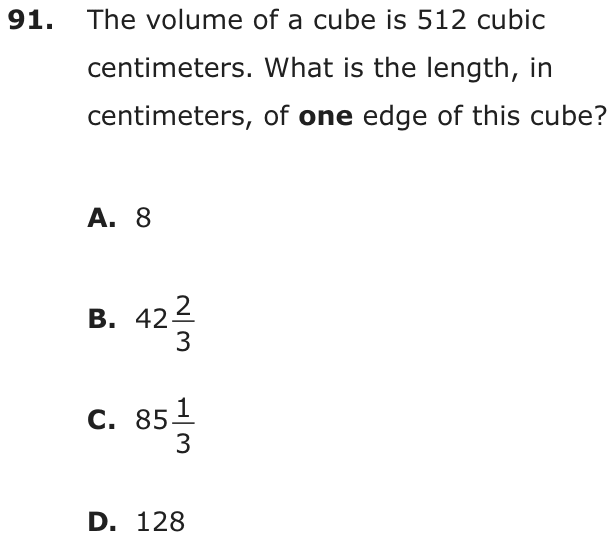
The volume of a cube is 512 cubic centimeters. What is the length, in centimeters, of one edge of this cube?
- A8
- B
- C
- D128
Show the answer
Correct answer: A
The volume of a cube is , where s is the length of one edge.
So , and .
If you are not sure how to find the cube root, you can estimate.
We know , so .
Since 512 is less than 1,000, the answer must be less than 10. The only given option less than 10 is 8. Double-check to make sure this is correct: .
Question analysis
A cube has a volume of 512 cubic centimeters, and students work backward to find the length of one edge. It tests the volume formula for a cube and the idea of a cube root. The tricky part is going from a volume to a length, the reverse of the usual volume problem.
- Grade level
- Grade 8 content, by NYS standard
- Compared with grade 7
- Above grade 7 Grade 7 volume work goes from edge lengths to a volume. Going backward needs a cube root, a grade 8 idea, and 512 is beyond the perfect cubes students are expected to know, though checking a guess by multiplying keeps it short.
- Estimated difficulty
- Straightforward: two steps or one careful reading.
- Thinking it demands
- Depth of knowledge 1, recall and reproduction · mainly apply
- What makes it hard
- Something you must already know moderate
- Solution
- 2 steps
- Reading level
- Question and choices: about grade 5, 22 words.
- Students, last 30 days
- Not enough answers yet to show (it takes 10).
Why it is hard, traps and wrong answers (shows the answer)
Why it is hard
This is a one-fact question: a cube's volume is its edge used three times as a factor. Students who remember that need only the number whose cube is 512, and the choices help, because only one is under 10 while 10 × 10 × 10 = 1,000. The wrong choices divide 512 by numbers tied to other measures of a cube or a square, so they catch students who do not recall the formula.
Something you must already know moderate Working it out
Neither V = s³ nor the cube root of 512 is given, so students must recall the formula and know, or find by trial, that 8 × 8 × 8 = 512. (Anderson & Krathwohl, 2001)
Strategy: Write the volume as edge × edge × edge, then find the number that, multiplied by itself three times, gives 512, and confirm it by multiplying.
Traps
- Wrong formula: Uses a related but wrong formula: perimeter for area, diameter for radius, area for volume, or a misremembered one.
- A formula you must know: Needs a formula the test does not give: area, circumference, volume, probability rules.
The wrong answers, classified
B Wrong formula (King et al., 2004)
Divides 512 by 12, the number of edges, as if the volume were the total length of all the edges, giving 42 2/3.
C Wrong formula (King et al., 2004)
Divides 512 by 6, the number of faces, mixing up volume with surface area, giving 85 1/3.
D Wrong formula (King et al., 2004)
Divides 512 by 4, as when a square's side is found from its perimeter, instead of finding the number whose cube is 512.
Worked solution, step by step
Formulas used
- Volume of a cube
- V is the volume, the space inside, in cubic units. s is the length of one edge. s³ means s × s × s. A cube’s length, width and height are all s, so length × width × height becomes s × s × s.
Sort out the question
The cube’s volume is 512 cubic centimeters. Volume is the space inside a solid. You need the length of one edge.
A cube has 12 edges, and they are all the same length. So one edge tells you all of them.
Write the volume formula
You need a number that gives 512 when you multiply it by itself three times. That number is called the cube root of 512.
Try numbers to find the edge
Start with an easy one: . That is too big, so the edge is less than 10. Try 8.
It works. Each edge is 8 centimeters.
Rule out the other choices
Watch out: The volume is not shared out among the faces or the edges. Dividing 512 by the 6 faces gives , choice C. Dividing by the 12 edges gives , choice B. Dividing by 4 gives 128, choice D.
So the answer is A, 8.
Check your answer
Test the biggest choice. is over 2 million, far more than 512. Only an edge less than 10 can work, and 8 is the only choice less than 10. And .
More questions like this
The original DOE question