Question
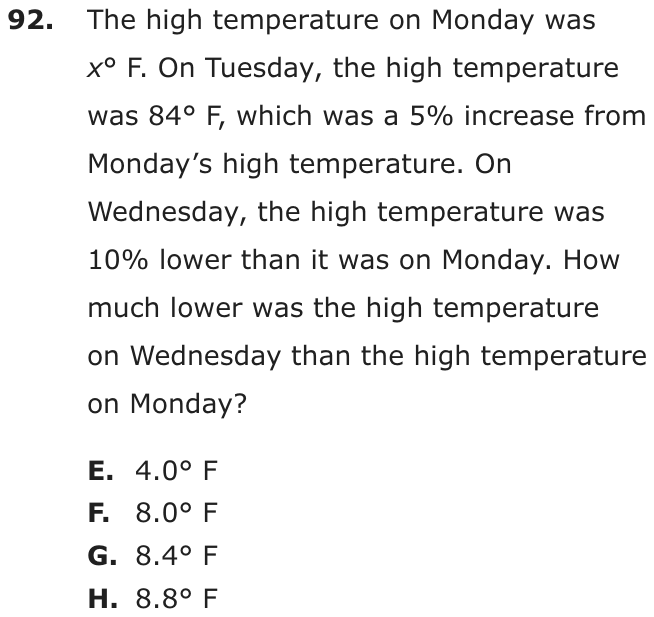
The high temperature on Monday was x° F. On Tuesday, the high temperature was 84° F, which was a 5% increase from Monday’s high temperature. On Wednesday, the high temperature was 10% lower than it was on Monday. How much lower was the high temperature on Wednesday than the high temperature on Monday?
- A4.0° F
- B8.0° F
- C8.4° F
- D8.8° F
Show the answer
Correct answer: B
The temperature on Tuesday was 84° F, which was 5% higher than the temperature on Monday.
This can be represented by the equation .
Dividing both sides of this equation by 1.05 gives .
Therefore, the temperature on Monday was 80° F.
Since the temperature on Wednesday was 10% lower than the temperature on Monday, the difference between the two temperatures would equal .
Question analysis
Tuesday's high temperature is given along with its percent increase over Monday's, and Wednesday's high is a percent below Monday's. Students find how many degrees cooler Wednesday was than Monday. It tests percent increase and decrease, and the difficulty is working back to Monday, the base for both percents, rather than starting from Tuesday's number.
- Grade level
- Grade 7 content, by NYS standard
- Compared with grade 7
- Above grade 7 Grade 7 percent problems usually apply a percent to a known amount. Here Monday's temperature must first be recovered from a percent increase and then a second percent applied to it, a reverse step most grade 7 students find unfamiliar.
- Estimated difficulty
- Moderate: several steps, or a close reading with one strong distractor.
- Thinking it demands
- Depth of knowledge 2, skills and concepts · mainly apply
- What makes it hard
- Turning words into math moderate
- A very close wrong answer moderate
- Much to keep track of minor
- Solution
- 3 steps
- Reading level
- Question and choices: about grade 5, 54 words.
- Students, last 30 days
- Not enough answers yet to show (it takes 10).
Why it is hard, traps and wrong answers (shows the answer)
Why it is hard
The question turns on noticing that both percents are measured from Monday, a temperature the stem never states. Students who take 10% of the only temperature given, 84, land on a listed choice just 0.4 degree off. Working back from 84 is forgiving: the exact 84 ÷ 1.05 = 80 and even the rougher 84 × 0.95 = 79.8 lead to the same choice, so the real test is not skipping Monday.
Turning words into math moderate Understanding the question
"84° F, which was a 5% increase from Monday’s high temperature" makes 84 the result of the increase, so Monday comes from solving 1.05x = 84, not from 5% of 84. (Hegarty, Mayer & Monk, 1995; Koedinger & Nathan, 2004)
A very close wrong answer moderate Choosing the answer
The choices 8.0, 8.4 and 8.8 lie within a degree of each other, so only the base of the 10%, Monday's 80 rather than Tuesday's 84, separates them. (Embretson & Wetzel, 1987; Gorin & Embretson, 2006; Ascalon et al., 2007)
Much to keep track of minor Working it out
Three days and two percents have to be kept apart: the 5% compares Tuesday with Monday, and the 10% compares Wednesday with Monday. (Sweller, 1988; Carpenter, Just & Shell, 1990)
Strategy: Let Monday's temperature be x, write Tuesday's 84 degrees as 1.05 times x and solve, then take 10 percent of Monday's value.
Traps
- Percent of the wrong amount: Finding the whole from a part, or a percent change measured from the wrong starting amount.
- Answers a different question: A choice is right for another quantity: the other unknown, the rest instead of the part, the part instead of the whole.
- Wrong operation: Adds instead of multiplying, divides the wrong way round, turns a ratio or rate upside down, or undoes a step in the wrong direction (subtracts what should be added back).
The wrong answers, classified
A Answers a different question (King et al., 2004; Hegarty, Mayer & Monk, 1995)
Finds Monday's 80° F and then gives the 4-degree rise from Monday to Tuesday, 84 − 80, instead of Wednesday's 10% drop.
C Percent of the wrong amount (Parker & Leinhardt, 1995)
Takes 10% of Tuesday's 84° F, getting 8.4, instead of first working back to Monday's temperature, the base for Wednesday's drop.
D Wrong operation (Hegarty, Mayer & Monk, 1995; King et al., 2004)
Undoes Tuesday's increase in the wrong direction, adding 5% to 84 to get 88.2° F for Monday, then takes 10% of it, about 8.8.
Worked solution, step by step
Formulas used
- Percent increase
- old is the starting amount. p is the percent it goes up. new is the amount after. The 1 keeps all of the old amount, and p over 100 adds the extra part. So a 5% rise means multiply by 1.05.
- Percent of a number
- The whole is the amount the percent is taken of. The percent tells how many out of every 100. The part is the piece you get, here a number of degrees.
Sort out the question
Monday’s high is unknown. Call it x degrees. Tuesday’s high was 84°F, which is 5% more than Monday. Wednesday’s high was 10% less than Monday.
You need how many degrees lower Wednesday was than Monday. Both percents compare with Monday. So find Monday first.
Write an equation for Tuesday
Tuesday is Monday plus 5% of Monday. That is 105% of Monday. Use the percent increase formula with p = 5.
Solve for Monday
Divide both sides by 1.05 to undo the multiplying.
Monday’s high was 80°F. Watch out: 84 is the result of the increase, not the start. Adding 5% to 84 gives about 88.2°F. Then 10% of that is about 8.8, choice D.
Find Wednesday’s drop
Wednesday was 10% lower than Monday. So the drop is 10% of Monday’s 80°F.
Wednesday was 8 degrees lower. Watch out: Taking 10% of Tuesday’s 84 gives 8.4, choice C. The 10% is of Monday’s high. Also, 84 − 80 = 4, choice A, is Tuesday’s rise, not Wednesday’s drop.
So the answer is B, 8.0°F.
Check your answer
Work forward from 80°F. 5% of 80 is 4, and 80 + 4 = 84. That matches Tuesday. Then 80 − 8 = 72, so Wednesday’s high was 72°F. That is 8 degrees below Monday.
More questions like this
The original DOE question