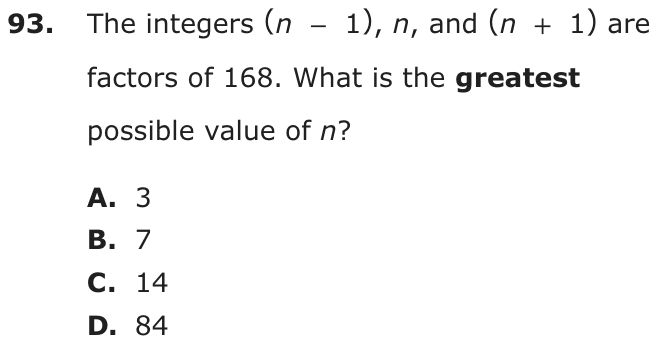
Question
The integers , n, and are factors of 168. What is the greatest possible value of n?
- A3
- B7
- C14
- D84
Show the answer
Correct answer: B
First, determine all possible factors of 168. One method of doing this is to use a table to list pairs of factors.
| Factors of 168 | |
|---|---|
| 1 | 168 |
| 2 | 84 |
| 3 | 56 |
| 4 | 42 |
| 6 | 28 |
| 7 | 24 |
| 8 | 21 |
| 12 | 14 |
Then determine the group of three sequential factors , n, and where n is as large as possible. This group is 6, 7, and 8, where .
Question analysis
Three consecutive integers, written as n − 1, n and n + 1, must all be factors of 168, and students find the greatest possible value of n. It tests factors and consecutive integers. The catch is that a number can be a factor while its neighbors are not, so every member of the run needs checking.
- NYS standards
- 6.NS.4 common factors and multiples
- Grade level
- Grade 6 content, by NYS standard
- Compared with grade 7
- At grade 7 Listing factors is grade 6 work, but here students must read n − 1, n and n + 1 as three consecutive integers and search the factor list for the largest such run. Pairing algebraic notation with factors matches grade 7 demand.
- Estimated difficulty
- Straightforward: two steps or one careful reading.
- Thinking it demands
- Depth of knowledge 2, skills and concepts · mainly apply
- What makes it hard
- Solution
- 2 steps
- Reading level
- Question and choices: about grade 7, 17 words.
- Students, last 30 days
- Not enough answers yet to show (it takes 10).
Why it is hard, traps and wrong answers (shows the answer)
Why it is hard
Once the factors of 168 are listed in order, 1, 2, 3, 4, 6, 7, 8, 12 and up, the runs of three in a row stand out, and the last of them is 6, 7, 8. Students lose points by stopping at the first run they see or by checking only n itself. Testing each choice with its two neighbors, starting from the largest, settles it in under a minute.
Variables instead of numbers minor Understanding the question
The stem names the numbers only as (n − 1), n and (n + 1), which has to be read as three whole numbers in a row that all divide 168. (Koedinger & Nathan, 2004; Enright, Morley & Sheehan, 2002)
Much to keep track of minor Working it out
Each candidate must pass three divisibility tests at once, for itself and for both neighbors, while the search continues for the greatest such n. (Sweller, 1988; Carpenter, Just & Shell, 1990)
Strategy: List the factor pairs of 168 in order, then look along the list for three whole numbers in a row; or test each choice together with its two neighbors.
Traps
- Misreads the question: Misses or misreads a condition or a word in the question: "at least", "each", "remaining", "not".
- Stops one step early: A choice is a number from partway through the solution.
The wrong answers, classified
A Stops one step early (King et al., 2004; Gierl et al., 2017)
Finds the run 2, 3, 4 among the small factors and stops searching, missing the later run 6, 7, 8 that 168 also contains.
C Misreads the question (Hegarty, Mayer & Monk, 1995)
Checks only that 14 divides 168, since 12 × 14 = 168, without testing its neighbors; neither 13 nor 15 is a factor.
D Misreads the question (Hegarty, Mayer & Monk, 1995)
Takes the largest factor below 168 itself, 84, for the greatest n, ignoring that 83 and 85 would also have to divide 168.
Worked solution, step by step
Formulas used
- Factor pair
- a and b are whole numbers. If a times b equals 168, then a and b are both factors of 168. A factor divides a number with no remainder. Listing every pair, from small a upward, finds every factor.
Sort out the question
A factor of 168 divides 168 with no remainder. The numbers n − 1, n and n + 1 are three whole numbers in a row, such as 6, 7 and 8. The middle one is n.
All three must be factors of 168. You need the greatest n that works.
List the factor pairs of 168
Try each whole number from 1 up. When it divides 168, write it with its partner. Stop when the pairs meet, after 12 and 14.
Small factor Partner 1 168 2 84 3 56 4 42 6 28 7 24 8 21 12 14 Look for three in a row
Here are all the factors in order:
1, 2, 3, 4, 6, 7, 8, 12, 14, 21, 24, 28, 42, 56, 84, 168
The runs of three in a row are 1, 2, 3, then 2, 3, 4, then 6, 7, 8. No other three factors sit side by side.
Pick the greatest middle number
The middle numbers of the runs are 2, 3 and 7. The greatest is 7, so n = 7.
Watch out: Stopping at the run 2, 3, 4 gives 3, choice A. Keep looking. Also, 14 and 84 are factors, but their neighbors are not. Neither 13 nor 15 divides 168, so 14, choice C, fails. For 84, choice D, neither 83 nor 85 is a factor.
So the answer is B, 7.
Check your answer
Divide 168 by each number in the run: , and . All three are whole numbers, so 6, 7 and 8 are all factors.
More questions like this
The original DOE question