Question
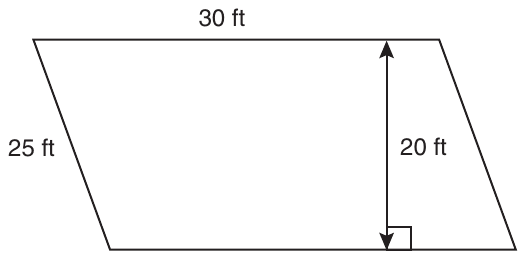
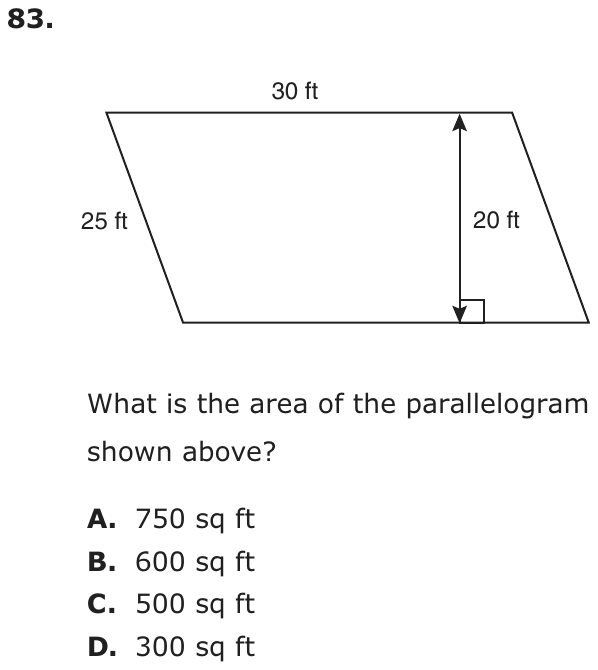
What is the area of the parallelogram shown above?
- A750 sq ft
- B600 sq ft
- C500 sq ft
- D300 sq ft
Show the answer
Correct answer: B
To find the area of a parallelogram, multiply the length of a side by the altitude for that side.
One property of parallelograms is that opposite sides are the same length.
So the bottom side of the parallelogram is 30 feet long and has an altitude of 20 feet.
Therefore, the area of the parallelogram, in square feet, is .
Question analysis
A geometry question with a figure: a parallelogram is labeled with a 30-foot top side, a 25-foot slanted side and a 20-foot height drawn at a right angle. Students find its area. The figure gives one length that is not needed, so students must pick the base and height that belong together.
- NYS standards
- 6.G.1 area of polygons
- Grade level
- Grade 6 content, by NYS standard
- Compared with grade 7
- Below grade 7 Area of a parallelogram is grade 6 content, and this is a one-step use of the formula. It is easier than typical grade 7 area work, which involves composite figures, circles or scale drawings.
- Estimated difficulty
- Routine: one familiar step, little to misread.
- Thinking it demands
- Depth of knowledge 1, recall and reproduction · mainly apply
- What makes it hard
- Solution
- 1 step
- Reading level
- Question and choices: about grade 2, 17 words.
- Students, last 30 days
- Not enough answers yet to show (it takes 10).
Why it is hard, traps and wrong answers (shows the answer)
Why it is hard
This is a one-step formula question with whole numbers, made slightly harder by one length too many. A student who multiplies the two side lengths, as for a rectangle, or brings in a triangle's one half, finds a listed choice. Matching the base to the height marked with a right angle is all it takes.
Reading a figure, table or graph minor Understanding the question
The figure labels three lengths, but only the 30-foot side and the 20-foot height drawn at a right angle to it belong together; the slanted 25-foot side is extra. (Lesh, Post & Behr, 1987; Kirsch & Mosenthal, 1990)
Something you must already know minor Working it out
The parallelogram area formula, base times height, is not given, and its height must be the perpendicular distance, not the slanted side. (Anderson & Krathwohl, 2001)
Strategy: Use base times height, where the height is the perpendicular distance between the two parallel sides chosen as bases.
Traps
- Wrong formula: Uses a related but wrong formula: perimeter for area, diameter for radius, area for volume, or a misremembered one.
- Information you don't need: The question gives numbers or facts that play no part in the answer.
The wrong answers, classified
A Wrong formula (King et al., 2004)
Multiplies the two side lengths, 30 × 25 = 750, as if a parallelogram's area were side times side like a rectangle's.
C Misreads the figure (Lesh, Post & Behr, 1987; Kirsch & Mosenthal, 1990)
Pairs the 20-foot height with the slanted 25-foot side, 25 × 20 = 500, though the height is drawn at a right angle to the 30-foot sides.
D Wrong formula (King et al., 2004)
Uses the triangle formula, 1/2 × 30 × 20 = 300, halving the base times the height.
Worked solution, step by step
Formulas used
- Area of a parallelogram
- A is the area. b is the base, one of the two parallel sides. h is the height: the straight distance between the two parallel sides, at a right angle to the base. It works because you can cut a triangle off one end, move it to the other end and make a rectangle.
Sort out the figure
A parallelogram is a four-sided shape whose opposite sides are parallel. Parallel means they never meet. The figure shows three lengths. The top side is 30 ft. The slanted left side is 25 ft. The arrow from top to bottom is 20 ft, and the small square shows a right angle. You need the area, in square feet.
Choose the base and height
The height must make a right angle with the base. The 20 ft arrow meets the bottom side at a right angle. Opposite sides of a parallelogram are equal, so the bottom side is 30 ft too. So the base is 30 ft and the height is 20 ft. Watch out: the slanted 25 ft side is not needed. Using gives choice C.
Find the area
The area is 600 sq ft. Watch out: do not multiply the two sides, . That is choice A. Do not take half either, which is for triangles and gives 300, choice D. So the answer is B, 600 sq ft.
Check your answer
Picture cutting the triangle off the left end and sliding it to the right end. The shape becomes a rectangle 30 ft long and 20 ft tall, with an area of 600 sq ft. 750 is too big, because the shape is only 20 ft tall, not 25 ft.
More questions like this
The original DOE question