Question
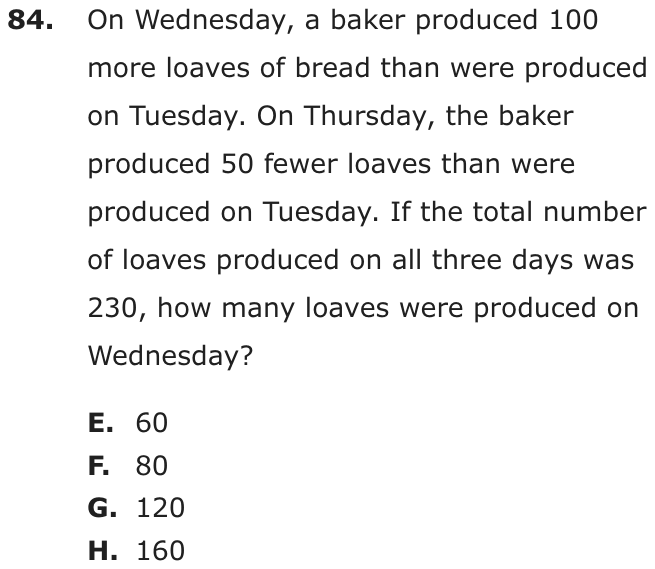
On Wednesday, a baker produced 100 more loaves of bread than were produced on Tuesday. On Thursday, the baker produced 50 fewer loaves than were produced on Tuesday. If the total number of loaves produced on all three days was 230, how many loaves were produced on Wednesday?
- A60
- B80
- C120
- D160
Show the answer
Correct answer: D
Let t represent the number of loaves of bread produced on Tuesday.
First, determine the number of loaves of bread produced on Tuesday, t, using the number of loaves produced on Wednesday, , the number produced on Thursday, , and the total number produced on these three days, 230:
Next, determine the number of loaves of bread produced on Wednesday, , when :
The number of loaves of bread produced on Wednesday is 160.
Question analysis
A word problem about a baker's bread over three days: Wednesday's output is 100 loaves more than Tuesday's, Thursday's is 50 fewer than Tuesday's, and the total is 230. Students find the number of loaves made on Wednesday. Writing every day in terms of Tuesday, and answering for the right day, are the keys.
- Grade level
- Grade 7 content, by NYS standard
- Compared with grade 7
- At grade 7 Writing and solving an equation of the form px + q = r from a word problem is a core grade 7 standard. This is a typical three-step version, with one negative adjustment and an extra step after solving.
- Estimated difficulty
- Straightforward: two steps or one careful reading.
- Thinking it demands
- Depth of knowledge 2, skills and concepts · mainly apply
- What makes it hard
- Turning words into math moderate
- Much to keep track of minor
- Solution
- 3 steps
- Reading level
- Question and choices: about grade 7, 45 words.
- Corrected from the DOE handbook
- A misplaced parenthesis in the explanation’s working was corrected.
- Students, last 30 days
- Not enough answers yet to show (it takes 10).
Why it is hard, traps and wrong answers (shows the answer)
Why it is hard
Writing all three days in terms of Tuesday turns the story into 3t + 50 = 230, a routine equation. The trap comes after it is solved: the value found is Tuesday's, and it is a listed choice. Students who label t as Tuesday from the start, and reread the question before choosing, add the 100 loaves and are done.
Turning words into math moderate Understanding the question
Both comparisons are made with Tuesday, 100 more loaves on Wednesday and 50 fewer on Thursday, so the three days become t, t + 100 and t − 50. (Hegarty, Mayer & Monk, 1995; Koedinger & Nathan, 2004)
Much to keep track of minor Working it out
The equation's unknown is Tuesday's count, while the question asks for Wednesday's, so one more step remains after the equation is solved. (Sweller, 1988; Carpenter, Just & Shell, 1990)
Strategy: Let t be Tuesday's loaves, write Wednesday and Thursday in terms of t, set the sum equal to 230, solve for t, and add 100.
Traps
- Answers a different question: A choice is right for another quantity: the other unknown, the rest instead of the part, the part instead of the whole.
- Numbers taken from the question: Combines the numbers in the question without a model of the situation, or is simply a number that appears in the question.
The wrong answers, classified
A Answers a different question (King et al., 2004; Hegarty, Mayer & Monk, 1995)
Solves 3t + 50 = 230 for Tuesday's loaves, t = 60, and gives that instead of Wednesday's t + 100.
B Numbers taken from the question (Hegarty, Mayer & Monk, 1995)
Subtracts both 100 and 50 from the total, 230 − 100 − 50 = 80, combining the numbers without writing each day in terms of Tuesday.
C Misreads the question (Hegarty, Mayer & Monk, 1995)
Finds Tuesday's 60, then gets Wednesday by subtraction, 230 − 60 − 50, taking Thursday as 50 loaves instead of 60 − 50 = 10.
What was corrected from the DOE handbook, and why
- Explanation: The handbook writes “3t + (50 − 50 = 230 − 50)”, with the closing parenthesis after the whole equation, so the line reads as an equation inside an expression (and 50 − 50 = 230 − 50 is false). The site now reads 3t + (50 − 50) = 230 − 50: subtract 50 from both sides, giving 3t = 180 as before.
Worked solution, step by step
Formulas used
- Keeping an equation balanced
- a and b are the two sides of an equation, and c is any number. An equation is like a balanced scale. If you subtract the same thing from both sides, it stays balanced. The same is true if you divide both sides by the same number that is not zero.
Sort out the question
The baker made bread on Tuesday, Wednesday and Thursday. Wednesday had 100 more loaves than Tuesday. Thursday had 50 fewer loaves than Tuesday. All three days add up to 230 loaves. You need the number of loaves made on Wednesday.
Write each day using Tuesday
Both other days are compared with Tuesday. So call Tuesday’s loaves t.
Day Loaves Tuesday Wednesday Thursday 100 more means add 100. 50 fewer means subtract 50.
Write the equation and combine
Group the t’s together and the plain numbers together. Three t’s make 3t, and .
Watch out: do not just subtract 100 and 50 from 230. That gives 80, choice B, and skips writing each day with t.
Solve for Tuesday
Subtract 50 from both sides. Then divide both sides by 3.
Tuesday had 60 loaves. Watch out: 60 is Tuesday, choice A. The question asks about Wednesday.
Find Wednesday’s loaves
Wednesday had 100 more loaves than Tuesday, so add 100 to t.
Wednesday had 160 loaves. So the answer is D, 160.
Check your answer
Find all three days. Tuesday is 60, Wednesday is 160, and Thursday is . Add them: . That is the total in the question, so 160 is right.
More questions like this
The original DOE question