Also in 2025 Practice Test B English, question 51.
Passage The End of an Era
The End of an Era
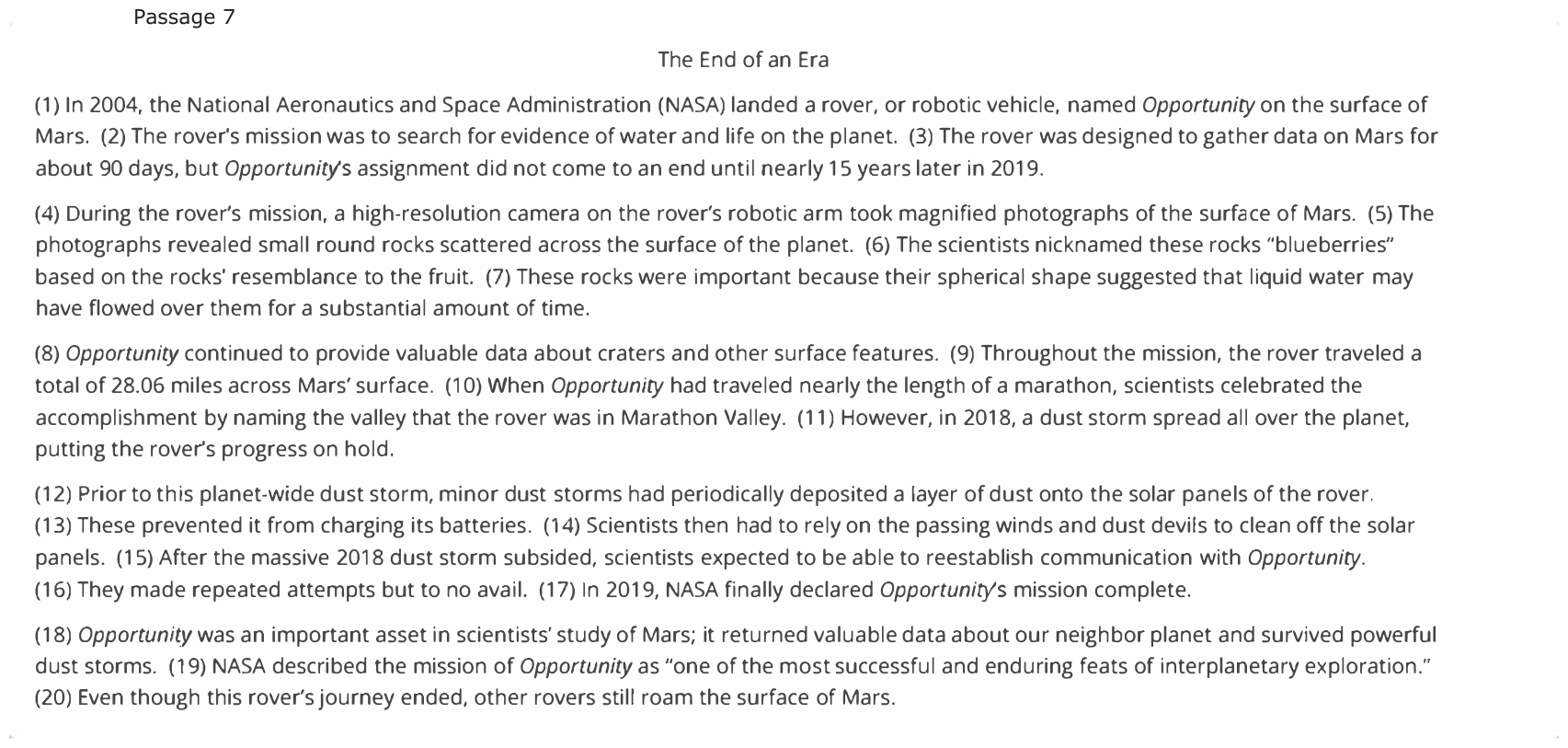
(1) In 2004, the National Aeronautics and Space Administration (NASA) landed a rover, or robotic vehicle, named Opportunity on the surface of Mars. (2) The rover’s mission was to search for evidence of water and life on the planet. (3) The rover was designed to gather data on Mars for about 90 days, but Opportunity’s assignment did not come to an end until nearly 15 years later in 2019.
(4) During the rover’s mission, a high-resolution camera on the rover’s robotic arm took magnified photographs of the surface of Mars. (5) The photographs revealed small round rocks scattered across the surface of the planet. (6) The scientists nicknamed these rocks “blueberries” based on the rocks’ resemblance to the fruit. (7) These rocks were important because their spherical shape suggested that liquid water may have flowed over them for a substantial amount of time.
(8) Opportunity continued to provide valuable data about craters and other surface features. (9) Throughout the mission, the rover traveled a total of 28.06 miles across Mars’ surface. (10) When Opportunity had traveled nearly the length of a marathon, scientists celebrated the accomplishment by naming the valley that the rover was in Marathon Valley. (11) However, in 2018, a dust storm spread all over the planet, putting the rover’s progress on hold.
(12) Prior to this planet-wide dust storm, minor dust storms had periodically deposited a layer of dust onto the solar panels of the rover. (13) These prevented it from charging its batteries. (14) Scientists then had to rely on the passing winds and dust devils to clean off the solar panels. (15) After the massive 2018 dust storm subsided, scientists expected to be able to reestablish communication with Opportunity. (16) They made repeated attempts but to no avail. (17) In 2019, NASA finally declared Opportunity’s mission complete.
(18) Opportunity was an important asset in scientists’ study of Mars; it returned valuable data about our neighbor planet and survived powerful dust storms. (19) NASA described the mission of Opportunity as “one of the most successful and enduring feats of interplanetary exploration.” (20) Even though this rover’s journey ended, other rovers still roam the surface of Mars.
Question
Which revision of sentence 11 best maintains the formal style established in the passage?
- AHowever, in 2018, a dust storm covered the planet, bringing the rover’s progress to a standstill.
- BHowever, in 2018, a dust storm shrouded the planet, impermanently halting the rover’s progress.
- CHowever, in 2018, a dust storm enveloped the whole of the planet, arresting the rover’s progress for a time.
- DHowever, in 2018, a dust storm covered up the whole planet, which quickly brought a stop to the progress of the rover.
Show the answer
Correct answer: A
The question asks for the revision of sentence 11 that best maintains the formal style established in the passage.
A. CORRECT. This sentence uses clear and formal writing throughout. The phrase “covered the planet” is accurate and formal without being overly poetic, and “standstill” is a precise word for putting something “on hold,” as expressed by the original sentence, while maintaining the formal style of the passage.
B. Incorrect. Although the sentence is formal in style, the word “shrouded” is overly poetic, and the phrase “impermanently halting” is too stilted and formal for the style and tone of the passage.
C. Incorrect. Although the sentence is formal in style, the words “enveloped” and “arresting” are overly poetic, especially when used in the same sentence, and the phrases “the whole of the planet” and “for a time” are needlessly wordy and imprecise, compared with the formal scientific language of the passage.
D. Incorrect. The phrases “covered up the whole planet” and “quickly brought a stop to the progress of the rover” are less formal and unnecessarily wordy, compared with the formal style established by the rest of the passage.
Question analysis
This style question asks which revision of sentence 11, about the 2018 dust storm that covered Mars and stopped the Opportunity rover, best maintains the formal style of the passage. All four versions say the same thing, so students must compare word choice and wordiness and decide which one reads like the rest of the passage.
- Grade level
- Grade 8 reading and task
- Compared with grade 7
- Above grade 7 Keeping a formal style is grade 7 writing work, usually tested by spotting slang or casual wording. Here all four revisions keep the meaning and differ in register by degrees, so students must judge the passage's own style closely, more than typical.
- Estimated difficulty
- Hard: combines ideas, needs a plan, and has more than one tempting wrong answer.
- Thinking it demands
- Depth of knowledge 2, skills and concepts · mainly evaluate
- What makes it hard
- Something you must already know moderate
- Every choice must be checked moderate
- Hard words minor
- Evidence
- Answered from one sentence or line
- Reading level
- Passage: about grade 11, 337 words; question and choices: about grade 9, 80 words.
- Students, last 30 days
- Not enough answers yet to show (it takes 10).
Why it is hard, traps and wrong answers (shows the answer)
Why it is hard
The question turns on what “formal” means. Many students equate it with impressive words and choose the revision with “enveloped” and “arresting,” or the one with “shrouded,” missing that both are more poetic than a passage that reports dates and distances. The casual revision is easy to reject, so the real test is preferring the plainest formal sentence to the grandest one.
Something you must already know moderate Working it out
Students must know that a formal informational style is plain and precise, so words such as “shrouded,” “enveloped” and “arresting” are too ornate for a passage that reports miles and dates. (Anderson & Krathwohl, 2001)
Every choice must be checked moderate Choosing the answer
All four revisions keep the meaning of sentence 11 and differ only in register and length, so each must be heard against the passage’s voice rather than checked for errors. (Embretson & Wetzel, 1987)
Hard words minor Understanding the question
“Impermanently,” “shrouded” and “arresting,” in its sense of stopping, are uncommon words, and students must judge how they sound in the passage, not only what they mean. (Perfetti, 2007; Freedle & Kostin, 1993)
Strategy: Reread a few sentences around sentence 11 to hear the passage's voice, then check each revision for casual phrasing, needless words and words that would sound out of place in that voice.
Traps
- Wordy, vague or informal: A revision is grammatical but wordy, imprecise or too casual for the passage.
The wrong answers, classified
B Wordy, vague or informal (Connors & Lunsford, 1988)
Equates formal with elevated, so “shrouded” and “impermanently halting” seem best, though both are stilted and poetic beside the passage’s plain reporting of facts.
C Wordy, vague or informal (Connors & Lunsford, 1988)
Avoids casual words, but “enveloped” and “arresting” are poetic, and “the whole of the planet” and “for a time” add words the plain version does without.
D Wordy, vague or informal (Connors & Lunsford, 1988)
Keeps the meaning, but the casual “covered up” and the roundabout “brought a stop to the progress of the rover” make it wordier and less formal.
Working it out, step by step
Figure out what the question asks
This question asks which version of sentence 11 keeps the passage’s formal style. Formal writing is serious and clear, like a textbook. It avoids slang and casual words. But formal doesn’t mean fancy. Formal writing about science uses plain, exact words. For example, The game got called off is casual. The contest was halted indefinitely is too fancy. The game was canceled is formal and plain.
Hear the passage’s voice
Sentence 9 says “the rover traveled a total of 28.06 miles across Mars’ surface.” Sentence 12 says minor storms “deposited a layer of dust onto the solar panels.” The words are exact and plain. The passage gives dates and numbers. It doesn’t paint poetic pictures.
Check each revision
- A is right. “Covered the planet” is plain and exact. A standstill is a complete stop, a clear way to say “on hold.”
- B is wrong. “Shrouded” is poetic. A shroud is a cloth wrapped around a body. “Impermanently halting” sounds stiff and odd.
- C is wrong. “Enveloped” and “arresting” are fancy words. Here arresting means stopping. “The whole of the planet” and “for a time” add extra words.
- D is wrong. “Covered up” is casual. “Brought a stop to the progress of the rover” is wordy, or longer than it needs to be.
Watch out: Many students think formal means big words, so they choose C. But a passage of dates and miles calls for plain words.
Choose the answer
Only A is both formal and plain, like the rest of the passage. So the answer is A: “However, in 2018, a dust storm covered the planet, bringing the rover’s progress to a standstill.”
Why this answer and not the closest wrong one
C is the closest wrong answer, because it has no slang and sounds serious. But “enveloped” and “arresting” are poetic, and “the whole of the planet” is wordy. The passage reports facts in plain words. A says the same thing in the plainest formal way.
More questions like this
The original DOE question
The passage “The End of an Era” as printed (page 60)