Question
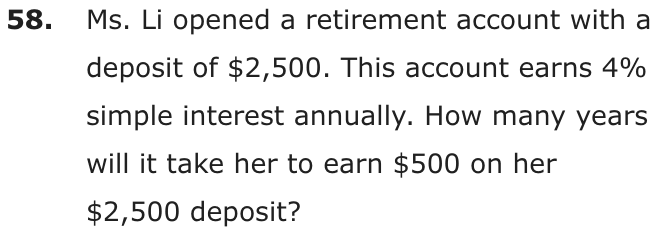
Ms. Li opened a retirement account with a deposit of $2,500. This account earns 4% simple interest annually. How many years will it take her to earn $500 on her $2,500 deposit?
Grid-in question: work out the answer and enter it as a number.
Show the answer
Correct answer: 5
Simple interest (y) is calculated by multiplying the initial deposit (p), the interest rate (r), and time (t):
Question analysis
Ms. Li deposits $2,500 in a retirement account that pays 4% simple interest each year, and this grid-in asks how many years it takes to earn $500 in interest. Students find one year's interest and work out how many years are needed. It turns the usual simple interest question around, asking for the time rather than the interest.
- Grade level
- Grade 7 content, by NYS standard
- Compared with grade 7
- At grade 7 Simple interest is a grade 7 percent application, usually asked as how much interest builds up over a given time. This one gives the interest and asks for the time, a short reverse step with friendly numbers.
- Estimated difficulty
- Straightforward: two steps or one careful reading.
- Thinking it demands
- Depth of knowledge 2, skills and concepts · mainly apply
- What makes it hard
- Solution
- 2 steps
- Reading level
- Question and choices: about grade 6, 28 words.
- Students, last 30 days
- Not enough answers yet to show (it takes 10).
Why it is hard, traps and wrong answers (shows the answer)
Why it is hard
Once one year's interest is known, $100, the rest is counting how many years make $500, so the arithmetic is light. The question turns the usual simple interest problem around, giving the interest and asking for the time, and that reversal is where students stall or grid a percent instead of a number of years. Writing 4% as 0.04, not 0.4, keeps the yearly interest from coming out ten times too big.
Something you must already know minor Working it out
The stem says 4% simple interest annually but never says that each year adds the same 4% of the $2,500 deposit, $100, so the yearly amount has to come from memory. (Anderson & Krathwohl, 2001)
Turning words into math minor Understanding the question
The question gives the interest, $500, and asks for the time, so the familiar formula runs backward: 2,500 × 0.04 × t = 500 has to be solved for t. (Hegarty, Mayer & Monk, 1995; Koedinger & Nathan, 2004)
An answer in an unexpected form minor Choosing the answer
As a grid-in it shows no choices, so 20, the interest as a percent of the deposit, can be gridded with nothing on the page to say it is not a number of years. (Enright, Morley & Sheehan, 2002)
Strategy: Work out one year's interest as 4% of $2,500, then find how many of those yearly amounts add up to the $500 of interest.
Traps
- Stops one step early: A choice is a number from partway through the solution.
- A formula you must know: Needs a formula the test does not give: area, circumference, volume, probability rules.
The wrong answers, classified
20 Stops one step early (King et al., 2004; Gierl et al., 2017)
Finds that the $500 of interest is 20% of the $2,500 deposit and grids 20, stopping before dividing by the 4% earned each year.
0.5 An arithmetic slip (Junker & Sijtsma, 2001)
Writes 4% as 0.4 instead of 0.04, so one year's interest looks like $1,000 and the $500 seems to take only half a year.
125 Numbers taken from the question (Hegarty, Mayer & Monk, 1995)
Divides the $500 of interest by the 4 in 4%, combining two numbers from the stem without first finding 4% of the deposit.
Worked solution, step by step
Formulas used
- Simple interest
- I is the interest, the extra money the account pays you. P is the deposit, the money you put in. r is the yearly rate as a decimal. t is the time in years. Simple means each year’s interest is figured on the deposit only, so every year adds the same amount.
- Percent to decimal
- p is the percent. Percent means out of 100. So divide by 100 to write it as a decimal. For example, 4% is 4 ÷ 100, which is 0.04.
Sort out the question
Ms. Li puts $2,500 into an account. This first amount is called the deposit. Each year the account pays 4% simple interest. Interest is extra money the bank pays you for keeping your money there. You need the number of years it takes to earn $500 of interest. The answer is a number of years, not dollars and not a percent.
Find one year’s interest
First write 4% as a decimal. 4% means 4 out of 100.
Now use the formula for 1 year, so t = 1.
The account earns $100 each year. Watch out: 4% is 0.04, not 0.4. Using 0.4 makes one year’s interest $1,000, and you would grid 0.5 years.
Find how many years make $500
Simple interest adds the same $100 every year. So the time t must make the interest $500.
It takes 5 years. Watch out: $500 is 20% of $2,500. But 20 is a percent, not a number of years. Don’t grid 20. So you would grid 5.
Check your answer
Count up one year at a time: $100, $200, $300, $400, $500. That is 5 years. Or put t = 5 back into the formula: . That matches the $500 in the question.
More questions like this
The original DOE question