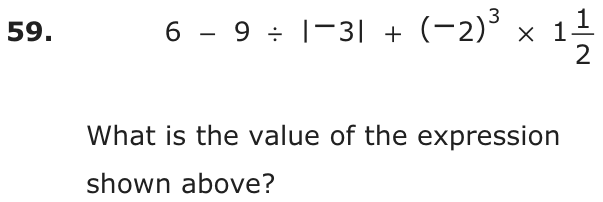
Question
What is the value of the expression shown above?
Grid-in question: work out the answer and enter it as a number.
Show the answer
Correct answer: -9
| Calculate the exponent and convert the mixed number to an improper fraction. | |
| Next, calculate the absolute value. | |
| Perform the indicated multiplication and division. | |
| Perform the addition and subtraction. | |
Question analysis
This grid-in asks for the value of an arithmetic expression that mixes an absolute value, a negative number raised to the third power, a division and a mixed number. Students apply the order of operations with signed numbers. Cubing a negative base, and doing the division and multiplication before any adding, are where most slips happen.
- NYS standards
- Grade level
- Grade 7 content, by NYS standard
- Compared with grade 7
- At grade 7 Grade 7 students routinely evaluate expressions with negative numbers in the right order. This one combines an absolute value, a cubed negative and a mixed number in a single line, so it takes more steps than usual, each with a sign to watch.
- Estimated difficulty
- Moderate: several steps, or a close reading with one strong distractor.
- Thinking it demands
- Depth of knowledge 1, recall and reproduction · mainly apply
- What makes it hard
- Error-prone arithmetic moderate
- Many steps minor
- An answer in an unexpected form minor
- Solution
- 4 steps
- Reading level
- Question and choices: about grade 5, 10 words.
- Students, last 30 days
- Not enough answers yet to show (it takes 10).
Why it is hard, traps and wrong answers (shows the answer)
Why it is hard
The expression packs four kinds of notation into one line: a subtraction, a division by an absolute value, a negative base raised to the third power and a mixed number. None of the operations is hard alone, but each has a rule that is easy to break under time pressure, and the slips lead to very different totals. Rewriting the power and the mixed number first, then dividing and multiplying before any addition, avoids them.
Error-prone arithmetic moderate Working it out
(−2)³ must stay negative, −8, and the mixed number 1½ must become 3/2 before multiplying, so the last product is −12; a sign or fraction slip here moves the total far from −9. (Brown & Burton, 1978; Junker & Sijtsma, 2001)
Many steps minor Working it out
Six numbers and six operations, including a power and an absolute value, have to be worked in a planned order, and every addition waits until the division and multiplication are done. (Daniel & Embretson, 2010; Enright, Morley & Sheehan, 2002)
An answer in an unexpected form minor Choosing the answer
The value is negative and the grid-in offers no choices, so the minus sign has to be gridded and nothing on the page confirms that the total falls below zero. (Enright, Morley & Sheehan, 2002)
Strategy: Rewrite the absolute value and the power first, change the mixed number to an improper fraction, do the division and multiplication, and only then add and subtract from left to right.
Traps
- Order of operations: Working left to right, or distributing a minus sign wrongly, gives a choice.
- Negatives and direction: Arithmetic with negative numbers, the order of a subtraction, or direction on a number line. (Moving a term across the equals sign without changing its sign is a faulty procedure.)
- A faulty procedure: A systematic but wrong procedure: adding fractions straight across, applying an exponent to each term of a sum, dropping a sign when moving a term.
The wrong answers, classified
15 Negatives and direction (Brown & Burton, 1978)
Takes (−2)³ as positive 8, as if every power of a negative were positive, so the last product is +12 and 6 − 3 + 12 = 15.
-13.5 Order of operations (Brown & Burton, 1978)
Works strictly from left to right: 6 − 9 = −3, divided by 3 is −1, plus −8 is −9, and times 1½ gives −13.5.
-6 A faulty procedure (Brown & Burton, 1978; Tatsuoka, 1983)
Multiplies the base by the exponent, taking (−2)³ as −6, so the product with 3/2 is −9 and the total is 6 − 3 − 9 = −6.
Worked solution, step by step
Formulas used
- Order of operations
- This is the order for working out an expression. First work inside grouping symbols, such as parentheses and absolute value bars. Next do powers. Then multiply and divide from left to right. Last, add and subtract from left to right. Using one order means everyone gets the same answer.
- A power
- a is the base, the number being multiplied. The small 3 is the exponent. It says how many times the base is used as a factor, a number being multiplied. It does not mean a times 3.
- Absolute value
- The bars around a number mean absolute value. It is how far the number is from 0 on a number line. A distance is never negative, so the absolute value of −3 is 3.
- Mixed number to fraction
- a is the whole number part, and b over c is the fraction part. Each whole is c pieces, so a wholes are a × c pieces. Add the b extra pieces. The bottom number stays c.
Sort out the expression
You need the value of . It has many operations, so the order matters. It has absolute value bars, a power of a negative number and a mixed number. The answer may be negative, so keep track of every sign.
Do the absolute value and the power
Grouping symbols and powers come first.
Two negatives multiply to a positive, 4. One more negative makes it negative again. Watch out: (−2)³ is −8, not +8. Using +8 leads to 15. It is also not −2 × 3. That mistake leads to a total of −6.
Change the mixed number to a fraction
A fraction is easier to multiply than a mixed number.
Now the expression looks like this:
Multiply and divide next
Multiplying and dividing come before adding and subtracting.
A negative times a positive is negative. Watch out: don’t just work from left to right. Doing 6 − 9 first, then dividing by 3, leads to −13.5.
Add and subtract last
Now only adding and subtracting are left. Work from left to right.
Adding −12 is the same as taking away 12. So you would grid −9, with the minus sign in its own column.
Check your answer
Look at the size of each part. The part 6 − 3 is a small positive number, 3. The last part, −8 times 1½, is a bigger negative number, −12. A big negative plus a small positive is negative. So an answer below zero, −9, makes sense.
More questions like this
The original DOE question