Passage Cross-Purposes
Cross-Purposes
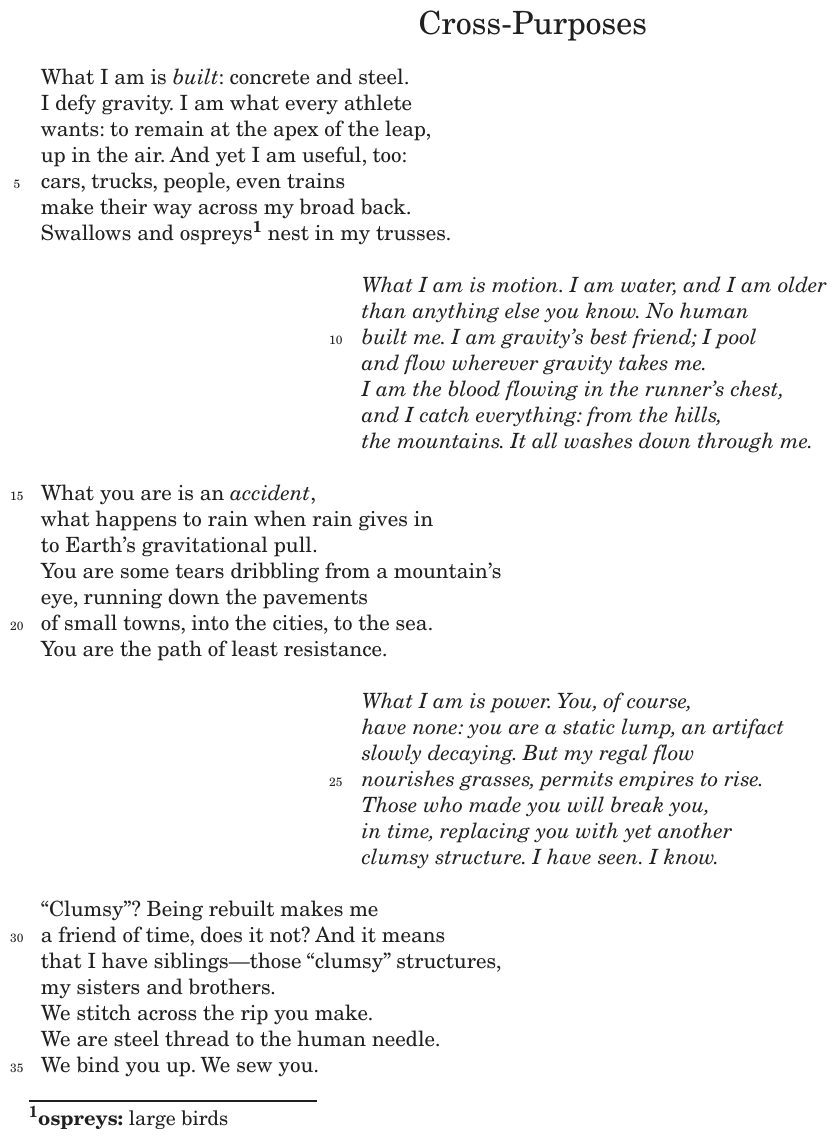
What I am is built: concrete and steel.
I defy gravity. I am what every athlete
wants: to remain at the apex of the leap,
up in the air. And yet I am useful, too:
cars, trucks, people, even trains
make their way across my broad back.
Swallows and ospreys nest in my trusses.
What I am is motion. I am water, and I am older
than anything else you know. No human
built me. I am gravity’s best friend; I pool
and flow wherever gravity takes me.
I am the blood flowing in the runner’s chest,
and I catch everything: from the hills,
the mountains. It all washes down through me.
What you are is an accident,
what happens to rain when rain gives in
to Earth’s gravitational pull.
You are some tears dribbling from a mountain’s
eye, running down the pavements
of small towns, into the cities, to the sea.
You are the path of least resistance.
What I am is power. You, of course,
have none: you are a static lump, an artifact
slowly decaying. But my regal flow
nourishes grasses, permits empires to rise.
Those who made you will break you,
in time, replacing you with yet another
clumsy structure. I have seen. I know.
“Clumsy”? Being rebuilt makes me
a friend of time, does it not? And it means
that I have siblings—those “clumsy” structures,
my sisters and brothers.
We stitch across the rip you make.
We are steel thread to the human needle.
We bind you up. We sew you.
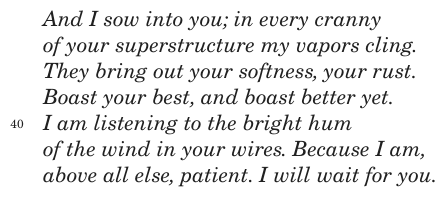
And I sow into you; in every cranny
of your superstructure my vapors cling.
They bring out your softness, your rust.
Boast your best, and boast better yet.
I am listening to the bright hum
of the wind in your wires. Because I am,
above all else, patient. I will wait for you.
ospreys: large birds
Question
How does the poet develop the points of view of the structure and the water?
- Aby giving an account of a discussion between them about the future of human civilization
- Bby narrating a debate they have over their impact on the environment
- Cby illustrating the unique power they each possess over nature
- Dby using personification to allow them to debate who is more important
Show the answer
Correct answer: D
The question asks how the poet develops the two points of view.
A. Incorrect. While the poem relates how the water views the structure as “an artifact / slowly decaying” (lines 23–24) and the structure refers to itself as “a friend of time” (line 30), the poet does not give an account of a discussion about the future of human civilization.
B. Incorrect. While the speakers do discuss their impact on the environment, there is no narrator speaking for them.
C. Incorrect. Although the structure states it is made of “concrete and steel” (line 1) and is a “steel thread to the human needle” (line 34), only the water claims to possess power over nature, stating that “all washes down through me” (line 14) and “what I am is power” (line 22).
D. CORRECT. The poet develops the speakers’ points of view by personifying (giving human characteristics to something nonhuman such as an object or animal) the structure and the water, allowing them to debate by criticizing each other and declaring their own importance.
Question analysis
This point-of-view question asks how the poet of “Cross-Purposes” develops the viewpoints of its two speakers, a human-made structure and a body of water, across six alternating stanzas. Each answer pairs a way of presenting the voices with a subject for their exchange, so students must check both halves against the poem, since a choice can be right about one and wrong about the other.
- Grade level
- Grade 7 reading and task
- Compared with grade 7
- At grade 7 This is exactly the grade 7 standard on how a writer develops and contrasts the points of view of different speakers. The choices are short, but each joins a way of presenting the voices to a subject, so two things must be checked at once.
- Estimated difficulty
- Moderate: several steps, or a close reading with one strong distractor.
- Thinking it demands
- Depth of knowledge 3, strategic thinking · mainly analyze
- What makes it hard
- How, not what moderate
- Something you must already know minor
- Every choice must be checked minor
- Evidence
- Answered from the whole text
- Reading level
- Passage: 316 words (a poem; reading level not measured); question and choices: about grade 9, 64 words.
- Students, last 30 days
- Not enough answers yet to show (it takes 10).
Why it is hard, traps and wrong answers (shows the answer)
Why it is hard
The poem is a direct exchange: stanzas alternate between two speakers who address each other as “you,” with no voice outside them. Most students sense the argument, which makes the narrated-debate choice the strongest pull, since its subject, the speakers’ effects on the land, does come up in the poem. The question is decided by the method half of each choice, and only one names a device the poet actually uses, letting the two speak for themselves about which matters more.
How, not what moderate Working it out
The stem asks how the poet develops the two viewpoints, so the right choice must name a method, speakers given voices to argue for themselves, and a choice that only reports what they say falls short. (Anderson & Krathwohl, 2001)
Something you must already know minor Working it out
The right choice relies on the term “personification,” which the poem never names, so students must recognize concrete and water that speak and boast as that device. (Anderson & Krathwohl, 2001)
Every choice must be checked minor Choosing the answer
Each choice pairs a way of presenting the voices, an account, narration, illustration or personification, with a subject, so both halves must be tested against all six stanzas. (Embretson & Wetzel, 1987)
Strategy: Go through the six stanzas noting who is speaking and what each speaker claims, then judge each choice twice: once for how it says the voices are presented, once for what it says they discuss.
Traps
- Half right: One half of a two-part choice is right and the other is not.
- Wrong purpose or structure: Names a purpose, structure or effect that the part does not serve, or describes what a part says when the question asks what it does.
The wrong answers, classified
A Too narrow (King et al., 2004)
Builds the whole exchange on passing references such as “permits empires to rise” and “the human needle,” though the speakers argue about themselves and never discuss where civilization is headed.
B Half right (King et al., 2004; Thissen, Steinberg & Fitzpatrick, 1989)
Rightly sees a debate, and the speakers do touch on their effects on the land and on each other, but “narrating” adds a narrator, while each speaker talks in its own voice.
C Wrong purpose or structure (Anderson & Krathwohl, 2001)
Lists the powers the speakers boast of, which is what the poem says rather than how the poet builds the viewpoints, and only the water claims power over nature.
Working it out, step by step
Figure out what the question asks
This asks about the poet’s method: how the poet shows what each speaker thinks. Each choice names a method and a topic. The right choice must get both parts right.
Notice who is speaking
The poem has six stanzas, or groups of lines. The structure speaks in stanzas 1, 3 and 5. The water speaks in stanzas 2, 4 and 6. Each one says “I” about itself and “you” to the other. No outside voice tells the story. A voice like that is called a narrator, and this poem has none.
Name the poet’s method
In real life, concrete and water have no voices. The poet lets them speak like people anyway. This is called personification: treating a thing as if it were a person. Then the two argue. The structure calls the water “an accident” (line 15). The water answers, “What I am is power. You, of course, / have none” (lines 22–23).
See what they argue about
Each speaker brags about itself and puts the other down. The structure says it is useful, carrying “cars, trucks, people, even trains” (line 5). The water says it is older and stronger. It ends by saying it will outlast the structure: “I will wait for you” (line 42). Their real fight is over which of them matters more.
Check each choice
- A is wrong. Empires come up only once, in line 25. The speakers argue about themselves, not the future of civilization.
- B is wrong. The speakers do mention their effects on the land. The water says it “nourishes grasses” (line 25). But “narrating” means a narrator tells the debate, and no one does. The two speak for themselves.
- C is wrong. It names what the speakers brag about, not how the poet presents them. Also, only the water claims power over nature: “It all washes down through me” (line 14).
- D is right. Personification lets the two argue about who is more important.
Choose the answer
The poet uses personification so the structure and the water can argue over who matters more. So the answer is D.
Why this answer and not the closest wrong one
B is the closest wrong answer. It is right that there is a debate, and the speakers do talk about their effects on the world around them. But B says the debate is narrated. In the poem, the structure and the water speak in their own voices. D names that method.
More questions like this
The original DOE question

The passage “Cross-Purposes” as printed (pages 72–73)