Passage Cross-Purposes
Cross-Purposes
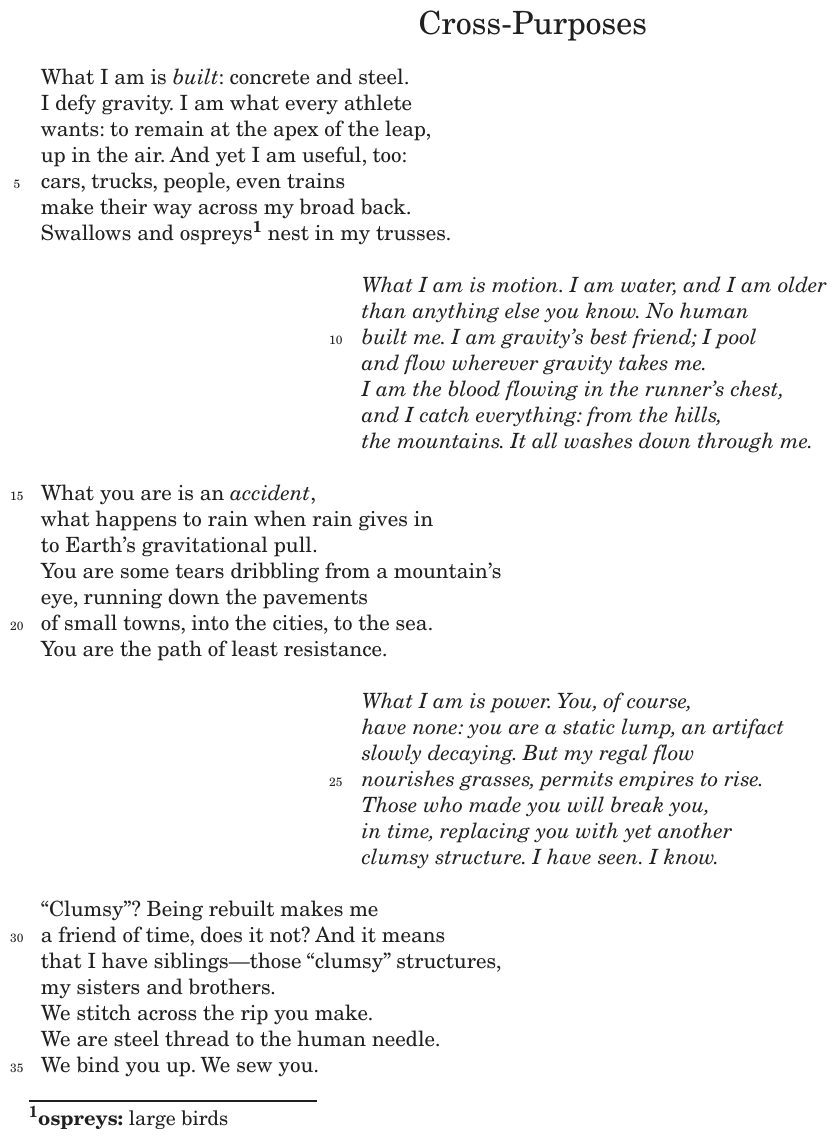
What I am is built: concrete and steel.
I defy gravity. I am what every athlete
wants: to remain at the apex of the leap,
up in the air. And yet I am useful, too:
cars, trucks, people, even trains
make their way across my broad back.
Swallows and ospreys nest in my trusses.
What I am is motion. I am water, and I am older
than anything else you know. No human
built me. I am gravity’s best friend; I pool
and flow wherever gravity takes me.
I am the blood flowing in the runner’s chest,
and I catch everything: from the hills,
the mountains. It all washes down through me.
What you are is an accident,
what happens to rain when rain gives in
to Earth’s gravitational pull.
You are some tears dribbling from a mountain’s
eye, running down the pavements
of small towns, into the cities, to the sea.
You are the path of least resistance.
What I am is power. You, of course,
have none: you are a static lump, an artifact
slowly decaying. But my regal flow
nourishes grasses, permits empires to rise.
Those who made you will break you,
in time, replacing you with yet another
clumsy structure. I have seen. I know.
“Clumsy”? Being rebuilt makes me
a friend of time, does it not? And it means
that I have siblings—those “clumsy” structures,
my sisters and brothers.
We stitch across the rip you make.
We are steel thread to the human needle.
We bind you up. We sew you.
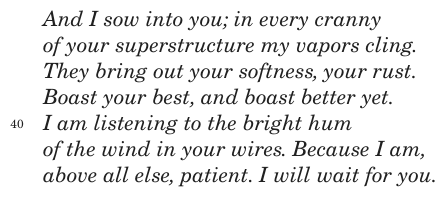
And I sow into you; in every cranny
of your superstructure my vapors cling.
They bring out your softness, your rust.
Boast your best, and boast better yet.
I am listening to the bright hum
of the wind in your wires. Because I am,
above all else, patient. I will wait for you.
ospreys: large birds
Question
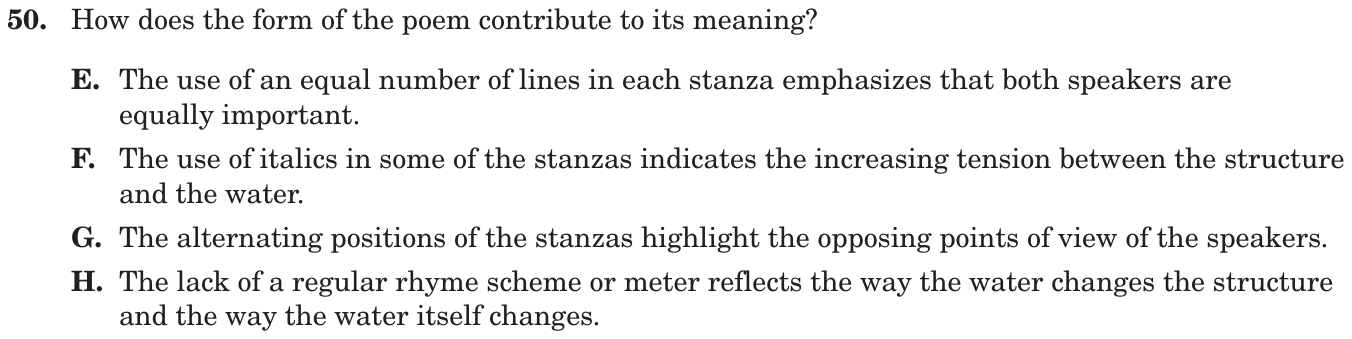
How does the form of the poem contribute to its meaning?
- AThe use of an equal number of lines in each stanza emphasizes that both speakers are equally important.
- BThe use of italics in some of the stanzas indicates the increasing tension between the structure and the water.
- CThe alternating positions of the stanzas highlight the opposing points of view of the speakers.
- DThe lack of a regular rhyme scheme or meter reflects the way the water changes the structure and the way the water itself changes.
Show the answer
Correct answer: C
The answer is (C)
The question asks how the form of the poem contributes to its meaning. The alternating positions of the stanzas create the appearance of a conversation in which the speakers share their opposing points of view, making Option C correct.
Option A is incorrect because the number of lines for each stanza does not emphasize the importance of the two speakers.
Option B is incorrect because italics are used mainly to designate the voice of the second speaker (the water).
Option D is incorrect because the lack of rhyme scheme or meter is intended to create a conversational tone, rather than reflect the changes the water causes or experiences.
Question analysis
This question about poetic form asks how the shape of “Cross-Purposes” on the page contributes to its meaning. Students must consider features such as stanza length, placement, italics and the lack of rhyme, and decide which one the poem actually uses to create meaning.
- Grade level
- Grade 8 reading and task
- Compared with grade 7
- Above grade 7 Grade 7 standards ask how genre features such as stanza form shape meaning, but most classroom questions point to one feature. Here students must weigh four features of the poem and the meaning each choice assigns, which is above typical grade 7 work.
- Estimated difficulty
- Hard: combines ideas, needs a plan, and has more than one tempting wrong answer.
- Thinking it demands
- Depth of knowledge 3, strategic thinking · mainly analyze
- What makes it hard
- How, not what major
- Every choice must be checked moderate
- Something you must already know minor
- Evidence
- Answered from the whole text
- Reading level
- Passage: 316 words (a poem; reading level not measured); question and choices: about grade 9, 87 words.
- Students, last 30 days
- Not enough answers yet to show (it takes 10).
Why it is hard, traps and wrong answers (shows the answer)
Why it is hard
All four choices point to something true about how the poem looks, so checking features against the page eliminates nothing. The real test is whether the meaning each choice assigns follows from the poem: equal stanzas do not make the rivals equal, italics mark the water's voice from its first stanza, and free verse is not a picture of erosion. Only the alternating placement maps directly onto two opposed speakers taking turns.
How, not what major Working it out
The question is about form, not content: students must ask what the page layout, indented italic stanzas against flush roman ones, does for the meaning. (Anderson & Krathwohl, 2001)
Every choice must be checked moderate Choosing the answer
Each choice names a feature that really exists, seven lines in every stanza, italics, alternating positions, no rhyme or meter, so every feature and the meaning given to it must be tested. (Embretson & Wetzel, 1987)
Something you must already know minor Working it out
Terms such as “stanza,” “rhyme scheme” and “meter” are assumed, and a student unsure what meter means cannot judge the choice about free verse. (Anderson & Krathwohl, 2001)
Strategy: For each feature named in the choices, first confirm it is really in the poem, then ask whether the meaning the choice gives it fits what happens in the poem.
Traps
- Wrong purpose or structure: Names a purpose, structure or effect that the part does not serve, or describes what a part says when the question asks what it does.
- Reads too much in: A reasonable-sounding conclusion that goes further than the text allows.
The wrong answers, classified
A Wrong purpose or structure (Anderson & Krathwohl, 2001)
Counts seven lines in every stanza, which is true, and reads that balance as equal importance, though the speakers spend the poem disputing which of them matters more.
B Wrong purpose or structure (Anderson & Krathwohl, 2001)
Notices the italics but misreads their job: they mark the water's voice from its first stanza onward, not a rising level of tension.
D Reads too much in (Graesser, Singer & Trabasso, 1994)
Applies the habit of treating free verse as a mirror of the subject, reading the missing rhyme and meter as the water's changes, which nothing in the poem supports.
Working it out, step by step
Figure out what the question asks
This asks about form: how the poem looks on the page, not just what it says. You need the feature that adds to the meaning.
Look at the page
Notice four things about the form.
- Every stanza has seven lines.
- Stanzas 2, 4 and 6 are in italics (slanted letters).
- Those italic stanzas are pushed to the right. The others sit on the left.
- The lines don’t rhyme and have no steady beat. That beat is called meter.
Work out what the layout shows
The stanzas on the left are the structure speaking. The italic stanzas on the right are the water. The two sides take turns, like two people arguing face to face. The back-and-forth placement makes it easy to see two opposite points of view.
Check each choice
- A The stanzas all have seven lines. But the speakers argue that they are not equal.
- B The italics mark the water’s voice from its first stanza to its last. They don’t show tension growing.
- C fits. The switching positions show the two opposing views.
- D Nothing suggests the missing rhyme stands for the water’s changes.
Choose the answer
The stanzas switch sides to show the speakers’ opposite views. So the answer is C.
Why this answer and not the closest wrong one
A is the closest trap, because every stanza really does have seven lines. But the speakers spend the whole poem arguing that they are not equal. Each one says it matters more. So equal stanzas can’t mean equal importance. C links the layout to what really happens: two sides taking turns.
More questions like this
The original DOE question
The passage “Cross-Purposes” as printed (pages 72–73)