Passage The Year without a Summer
The Year without a Summer
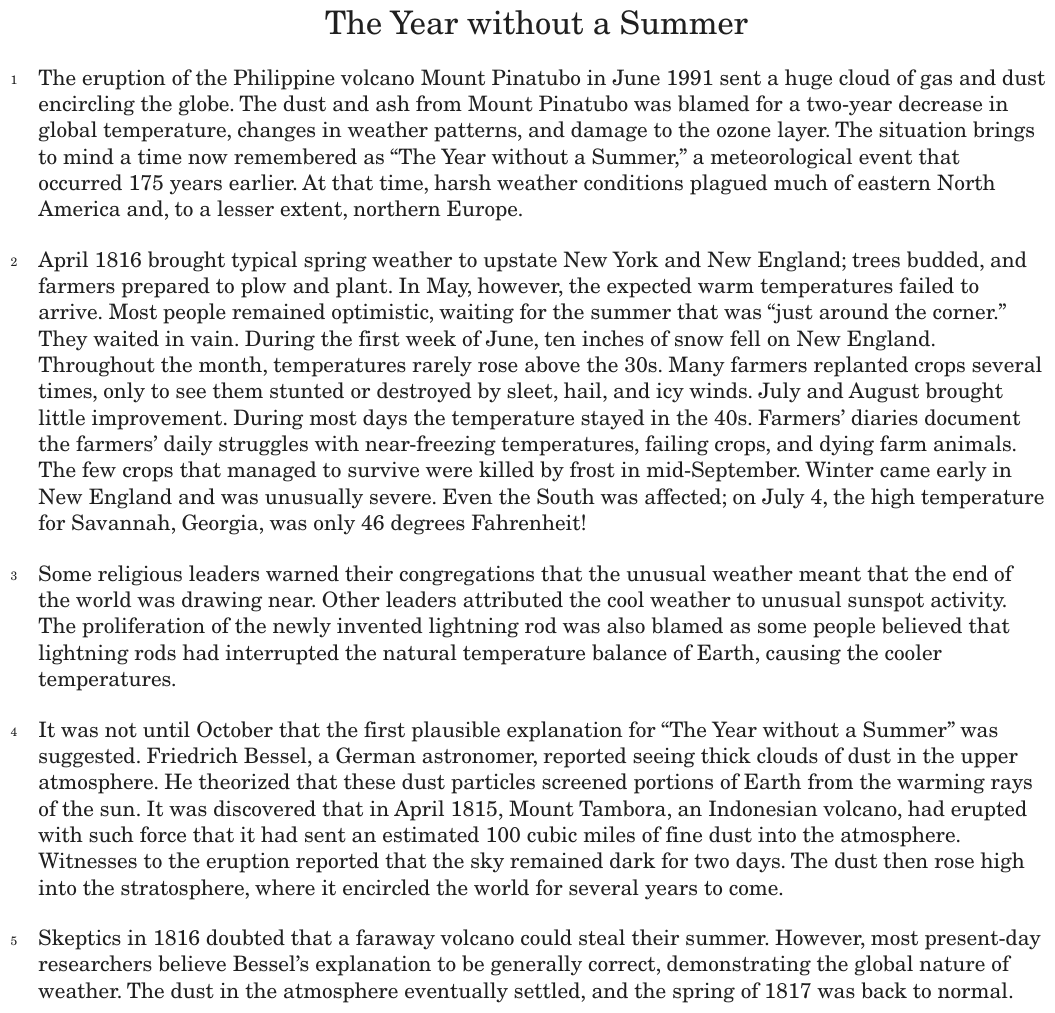
The eruption of the Philippine volcano Mount Pinatubo in June 1991 sent a huge cloud of gas and dust encircling the globe. The dust and ash from Mount Pinatubo was blamed for a two-year decrease in global temperature, changes in weather patterns, and damage to the ozone layer. The situation brings to mind a time now remembered as “The Year without a Summer,” a meteorological event that occurred 175 years earlier. At that time, harsh weather conditions plagued much of eastern North America and, to a lesser extent, northern Europe.
April 1816 brought typical spring weather to upstate New York and New England; trees budded, and farmers prepared to plow and plant. In May, however, the expected warm temperatures failed to arrive. Most people remained optimistic, waiting for the summer that was “just around the corner.” They waited in vain. During the first week of June, ten inches of snow fell on New England. Throughout the month, temperatures rarely rose above the 30s. Many farmers replanted crops several times, only to see them stunted or destroyed by sleet, hail, and icy winds. July and August brought little improvement. During most days the temperature stayed in the 40s. Farmers’ diaries document the farmers’ daily struggles with near-freezing temperatures, failing crops, and dying farm animals. The few crops that managed to survive were killed by frost in mid-September. Winter came early in New England and was unusually severe. Even the South was affected; on July 4, the high temperature for Savannah, Georgia, was only 46 degrees Fahrenheit!
Some religious leaders warned their congregations that the unusual weather meant that the end of the world was drawing near. Other leaders attributed the cool weather to unusual sunspot activity. The proliferation of the newly invented lightning rod was also blamed as some people believed that lightning rods had interrupted the natural temperature balance of Earth, causing the cooler temperatures.
It was not until October that the first plausible explanation for “The Year without a Summer” was suggested. Friedrich Bessel, a German astronomer, reported seeing thick clouds of dust in the upper atmosphere. He theorized that these dust particles screened portions of Earth from the warming rays of the sun. It was discovered that in April 1815, Mount Tambora, an Indonesian volcano, had erupted with such force that it had sent an estimated 100 cubic miles of fine dust into the atmosphere. Witnesses to the eruption reported that the sky remained dark for two days. The dust then rose high into the stratosphere, where it encircled the world for several years to come.
Skeptics in 1816 doubted that a faraway volcano could steal their summer. However, most present-day researchers believe Bessel’s explanation to be generally correct, demonstrating the global nature of weather. The dust in the atmosphere eventually settled, and the spring of 1817 was back to normal.
Question
Which of the following best tells what this passage is about?
- Athe belief of some religious leaders that the end of the world was coming in 1816
- Ba summer of strange weather and its probable cause
- Cthe importance of summer weather to agriculture in New England
- Da comparison of the weather of 1816 and 1991
Show the answer
Correct answer: B
The answer is (B)
The question asks for the best summary sentence for the passage. The passage is mostly about the strange, cold summer of 1816 and speculation around its cause, which is best stated in Option B.
Option A is incorrect because it is a detail in paragraph 3 about one theory regarding the cause of the weather.
Option C is incorrect because the passage is about more than agriculture in New England (paragraphs 1 and 2).
Option D is incorrect because it is a detail in the passage mentioned only in paragraph 1.
Question analysis
This central idea question asks students to choose the best summary of “The Year without a Summer,” a short informational passage about weather history. The passage brings in several groups of people and more than one time period, and the right summary has to cover all of it.
- NYS standards
- 7R2 theme or central idea
- Grade level
- Grade 6 reading and task
- Compared with grade 7
- Below grade 7 Summarizing a short, clearly organized informational passage is a grade 6 skill. The text is plain and the choices are short, so the demand is lower than most grade 7 central idea work.
- Estimated difficulty
- Routine: one familiar step, little to misread.
- Thinking it demands
- Depth of knowledge 2, skills and concepts · mainly understand
- What makes it hard
- Evidence
- Answered from the whole text
- Reading level
- Passage: about grade 9, 469 words; question and choices: about grade 6, 52 words.
- Students, last 30 days
- Not enough answers yet to show (it takes 10).
Why it is hard, traps and wrong answers (shows the answer)
Why it is hard
The passage is short and plainly organized, and the key names its two halves, the cold summer and its cause. The wrong choices each enlarge one detail into the whole: the 1991 eruption that opens the passage, the farmers' struggles, the religious warnings. Students most likely to slip are those who let the first paragraph's Mount Pinatubo set the topic.
Evidence in several places minor Working it out
The strange weather fills paragraph 2, but its probable cause arrives only in paragraphs 4 and 5, so a summary must reach the end to cover both halves. (Kirsch & Mosenthal, 1990; Gorin & Embretson, 2006)
Strategy: Before reading the choices, sum up the passage in a sentence of your own, then pick the choice closest to it in scope and meaning.
Traps
- Too narrow: A single detail offered as the central idea or a summary, or a summary that keeps minor details and leaves out an essential part.
The wrong answers, classified
A Too narrow (King et al., 2004)
Fixes on the religious leaders' end-of-the-world warnings, one of three 1816 guesses in paragraph 3, and treats it as the topic.
C Too narrow (King et al., 2004)
Expands the farmers' failing crops in paragraph 2 into a theme about agriculture, though the passage is about the weather and what caused it.
D Too narrow (King et al., 2004)
Takes the opening mention of Mount Pinatubo as the subject, though 1991 only introduces the 1816 story and the two years' weather is never compared.
Working it out, step by step
Figure out what the question asks
This asks what the whole passage is about. The right answer must cover the full passage, not just one detail.
Note what each paragraph does
- Paragraph 1: A volcano in 1991 brings to mind “The Year without a Summer.”
- Paragraph 2: In 1816, snow and frost hit New England all summer.
- Paragraph 3: People at the time guessed at the cause.
- Paragraph 4: Bessel blamed dust from a volcano.
- Paragraph 5: Scientists today agree with him.
See the two halves
The passage has two halves. First it describes the strange, cold summer of 1816. Then it explains the likely cause: dust from Mount Tambora. A good summary needs both parts. “Probable” means likely.
Check each choice
- A The end-of-the-world warning is one guess in paragraph 3.
- B fits. It covers the strange summer and its likely cause.
- C Farming comes up in paragraph 2, but the passage is about the weather and its cause.
- D 1991 is mentioned only to start the passage. The two years’ weather is never compared.
Choose the answer
The passage tells about a summer of strange weather and what probably caused it. So the answer is B.
Why this answer and not the closest wrong one
D is a trap if you let the first paragraph decide the topic. Mount Pinatubo in 1991 only leads into the 1816 story. Paragraphs 2 to 5 are all about 1816. B covers all of that, so it fits best.
More questions like this
The original DOE question
The passage “The Year without a Summer” as printed (page 76)