Passage Cross-Purposes
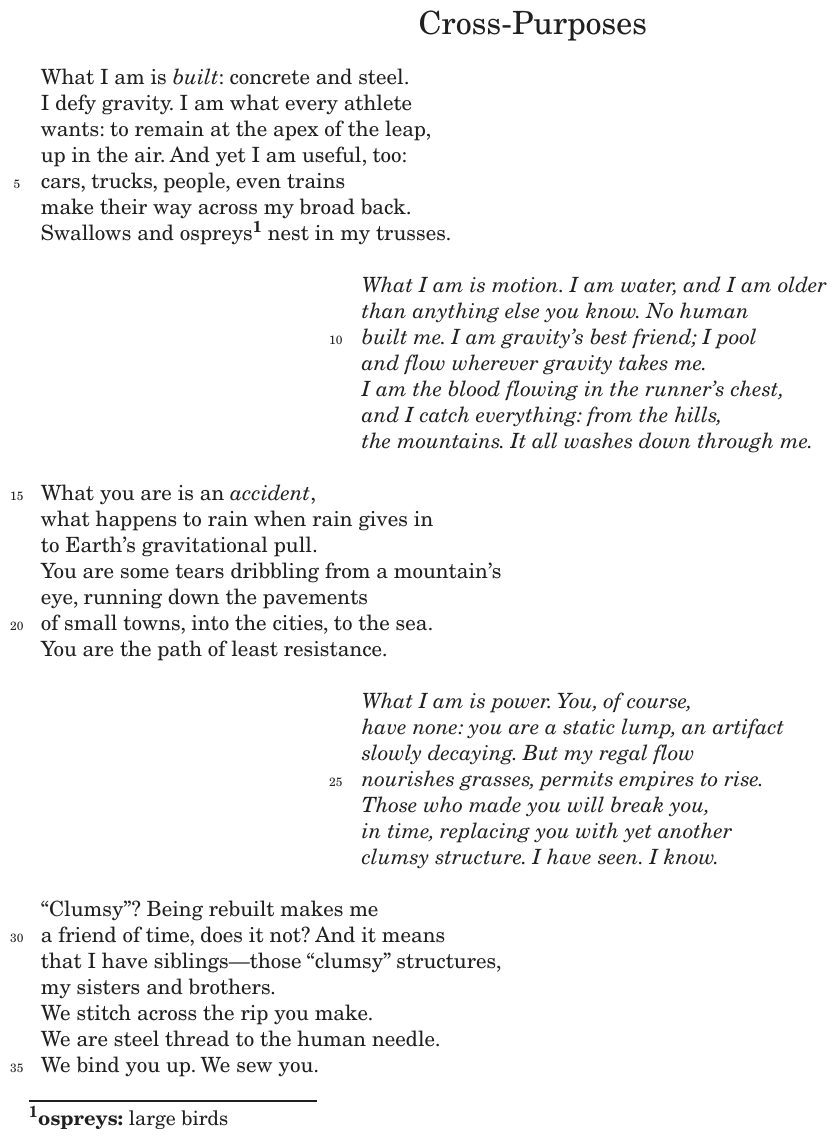
Cross-Purposes
What I am is built: concrete and steel.
I defy gravity. I am what every athlete
wants: to remain at the apex of the leap,
up in the air. And yet I am useful, too:
cars, trucks, people, even trains
make their way across my broad back.
Swallows and ospreys nest in my trusses.
What I am is motion. I am water, and I am older
than anything else you know. No human
built me. I am gravity’s best friend; I pool
and flow wherever gravity takes me.
I am the blood flowing in the runner’s chest,
and I catch everything: from the hills,
the mountains. It all washes down through me.
What you are is an accident,
what happens to rain when rain gives in
to Earth’s gravitational pull.
You are some tears dribbling from a mountain’s
eye, running down the pavements
of small towns, into the cities, to the sea.
You are the path of least resistance.
What I am is power. You, of course,
have none: you are a static lump, an artifact
slowly decaying. But my regal flow
nourishes grasses, permits empires to rise.
Those who made you will break you,
in time, replacing you with yet another
clumsy structure. I have seen. I know.
“Clumsy”? Being rebuilt makes me
a friend of time, does it not? And it means
that I have siblings—those “clumsy” structures,
my sisters and brothers.
We stitch across the rip you make.
We are steel thread to the human needle.
We bind you up. We sew you.
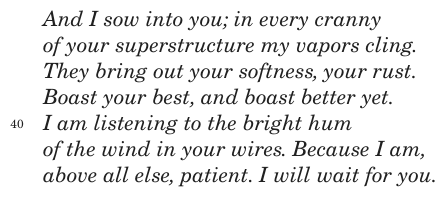
And I sow into you; in every cranny
of your superstructure my vapors cling.
They bring out your softness, your rust.
Boast your best, and boast better yet.
I am listening to the bright hum
of the wind in your wires. Because I am,
above all else, patient. I will wait for you.
ospreys: large birds
Question
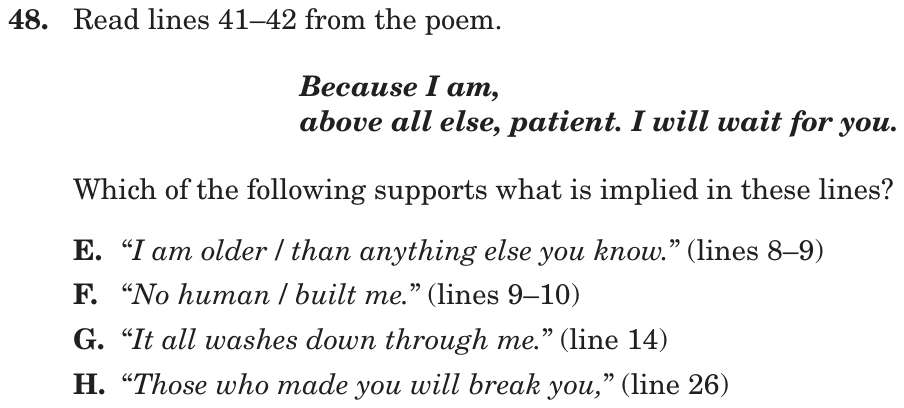
Read lines 41–42 from the poem.
Because I am,
above all else, patient. I will wait for you.
Which of the following supports what is implied in these lines?
- A“I am older / than anything else you know.” (lines 8–9)
- B“No human / built me.” (lines 9–10)
- C“It all washes down through me.” (line 14)
- D“Those who made you will break you,” (line 26)
Show the answer
Correct answer: A
The answer is (A)
The question asks how the implication in lines 41–42 is supported by other lines in the poem. The words “patient” and “wait” in line 42 suggest that the speaker (the water) has the ability to outlast the other speaker because the water doesn’t weaken as it ages, making Option A (lines 8–9) the correct response.
Option B is incorrect because the promise made in line 42 is not affected by whether the water was built by humans (lines 9–10).
Option C is incorrect because, in line 14, the water’s ability to wait longer than the structure is not enhanced by what flows through the water.
Option D is incorrect because, in line 26, the water’s knowledge does not make its ability to wait any stronger—rather, its seemingly unending lifespan does.
Question analysis
This textual evidence question gives the water's closing words in “Cross-Purposes,” that it is patient and will wait, and asks which earlier line supports what they imply. Students must first state the implication in their own words, then choose among four lines spoken by the water that each say something true about it.
- NYS standards
- 7R1 textual evidence and inferences
- Grade level
- Grade 8 reading and task
- Compared with grade 7
- Above grade 7 Most grade 7 evidence items back up a claim the text states outright. Here the claim is only implied, and all four lines come from the same speaker, so students must reason about what patience would achieve, which goes beyond typical grade 7 work.
- Estimated difficulty
- Hard: combines ideas, needs a plan, and has more than one tempting wrong answer.
- Thinking it demands
- Depth of knowledge 3, strategic thinking · mainly evaluate
- What makes it hard
- Reading between the lines major
- Every choice must be checked moderate
- Evidence
- Answered from several paragraphs or stanzas
- Reading level
- Passage: 316 words (a poem; reading level not measured); question and choices: about grade 1, 57 words.
- Students, last 30 days
- Not enough answers yet to show (it takes 10).
Why it is hard, traps and wrong answers (shows the answer)
Why it is hard
The difficulty is in the first step: putting “I will wait for you” into words as a claim about time, that the water will still be there after the structure is gone. Students who read it as a prediction about the structure's end pick the line about humans breaking it, and those who read it as a contrast with built things pick the line about no human building the water. Only age directly supports a promise to outwait.
Reading between the lines major Working it out
Lines 41–42 never say the water will outlast the structure; students must state that implication of “patient” and “wait for you” before they can judge which earlier line supports it. (Graesser, Singer & Trabasso, 1994; Kintsch, 1998)
Every choice must be checked moderate Choosing the answer
All four lines are the water's own boasts from different stanzas, each true of it, so every one must be tested against the specific claim of lasting longer. (Embretson & Wetzel, 1987)
Strategy: Put the implied claim of the final two lines into your own words, then ask which earlier line gives a reason to believe that claim rather than just describing the water.
Traps
- Supports only part of the claim: In a question about evidence: a line that backs one half of the claim but not the other, or a related point rather than the claim itself.
- Reads too much in: A reasonable-sounding conclusion that goes further than the text allows.
The wrong answers, classified
B Supports only part of the claim (King et al., 2004; Thissen, Steinberg & Fitzpatrick, 1989)
Sees that being unbuilt sets the water apart from the structure, but having no human maker says nothing about its capacity to wait.
C Reads too much in (Graesser, Singer & Trabasso, 1994)
Reads “washes down through me” as slow erosion that will wear the structure away, though the line describes what the water carries, not how long it lasts.
D Supports only part of the claim (King et al., 2004; Thissen, Steinberg & Fitzpatrick, 1989)
Supports the structure's eventual end, but the implied claim is about the water outlasting it, which needs evidence of the water's long life.
Working it out, step by step
Figure out what the question asks
This is an evidence question. First, figure out what lines 41–42 hint at. Then find the earlier line that best supports that hint.
Work out the hint
The water says: “Because I am, / above all else, patient. I will wait for you.” Patient means able to wait calmly for a long time.
The water is telling the structure that it will still be here after the structure is gone. So the hidden claim is that the water will outlast the structure.
Find a line that supports it
To outlast something, you need a very long life. So look for a line about the water’s age. In lines 8–9 the water says: “I am older / than anything else you know.” It has already lasted longer than anything else. So it makes sense that it can outlast a bridge too.
Check each choice
- A fits. Great age backs up the claim that the water can wait the structure out.
- B “No human / built me” tells who made the water, not how long it lasts.
- C “It all washes down through me” tells what the water carries, not how long it lasts.
- D shows the structure will end, but not that the water will still be here.
Choose the answer
The water’s great age supports its promise to outwait the structure. So the answer is A.
Why this answer and not the closest wrong one
D is the closest trap, because “Those who made you will break you” also points to the structure’s end. But the hint in lines 41–42 is about the water lasting. D says nothing about the water. Only A gives proof of the water’s long life.
More questions like this
The original DOE question
The passage “Cross-Purposes” as printed (pages 72–73)