Passage Cross-Purposes
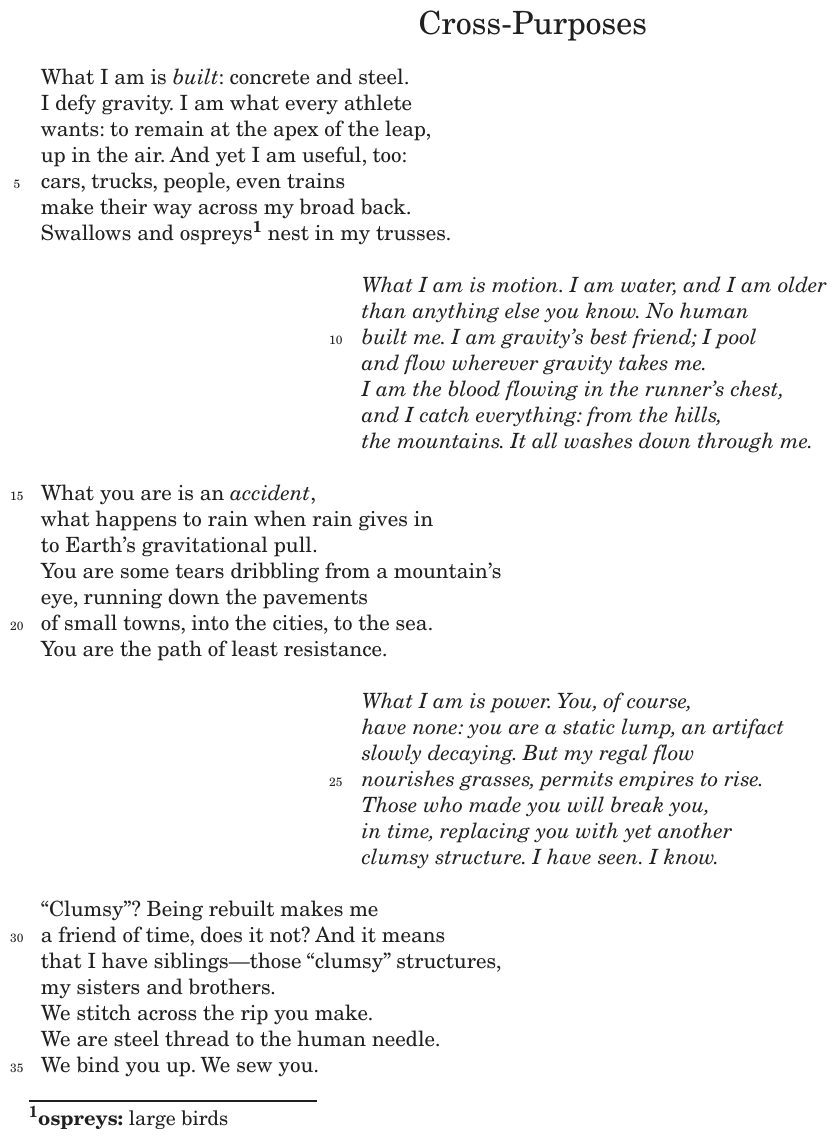
Cross-Purposes
What I am is built: concrete and steel.
I defy gravity. I am what every athlete
wants: to remain at the apex of the leap,
up in the air. And yet I am useful, too:
cars, trucks, people, even trains
make their way across my broad back.
Swallows and ospreys nest in my trusses.
What I am is motion. I am water, and I am older
than anything else you know. No human
built me. I am gravity’s best friend; I pool
and flow wherever gravity takes me.
I am the blood flowing in the runner’s chest,
and I catch everything: from the hills,
the mountains. It all washes down through me.
What you are is an accident,
what happens to rain when rain gives in
to Earth’s gravitational pull.
You are some tears dribbling from a mountain’s
eye, running down the pavements
of small towns, into the cities, to the sea.
You are the path of least resistance.
What I am is power. You, of course,
have none: you are a static lump, an artifact
slowly decaying. But my regal flow
nourishes grasses, permits empires to rise.
Those who made you will break you,
in time, replacing you with yet another
clumsy structure. I have seen. I know.
“Clumsy”? Being rebuilt makes me
a friend of time, does it not? And it means
that I have siblings—those “clumsy” structures,
my sisters and brothers.
We stitch across the rip you make.
We are steel thread to the human needle.
We bind you up. We sew you.
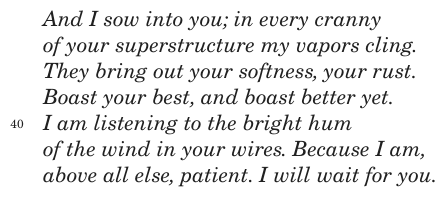
And I sow into you; in every cranny
of your superstructure my vapors cling.
They bring out your softness, your rust.
Boast your best, and boast better yet.
I am listening to the bright hum
of the wind in your wires. Because I am,
above all else, patient. I will wait for you.
ospreys: large birds
Question
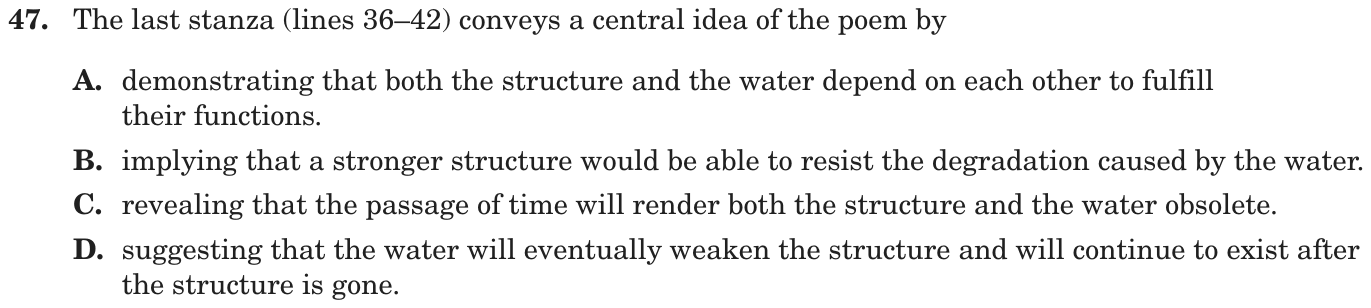
The last stanza (lines 36–42) conveys a central idea of the poem by
- Ademonstrating that both the structure and the water depend on each other to fulfill their functions.
- Bimplying that a stronger structure would be able to resist the degradation caused by the water.
- Crevealing that the passage of time will render both the structure and the water obsolete.
- Dsuggesting that the water will eventually weaken the structure and will continue to exist after the structure is gone.
Show the answer
Correct answer: D
The answer is (D)
The question asks how the last stanza conveys a central idea of the poem. In lines 36–38, the speaker (the water) describes how its “vapors cling” to the structure, bringing out the structure’s “softness” and “rust,” thus destroying the structure over time. Also, in line 42, the speaker says it is “patient” and “will wait for you,” suggesting that the speaker will be around after the structure is gone. These phrases in the last stanza indicate that Option D is correct.
Option A is incorrect because the last stanza includes no indication that the structure and the water depend on each other.
Option B is incorrect because the last stanza refers to the opposing speaker (the structure) and not to any other structure.
Option C is incorrect because the last stanza addresses only the idea that the structure will grow weak and obsolete over time.
Question analysis
Students must explain how the final stanza of “Cross-Purposes,” spoken by the water, conveys a central idea of the poem. The stanza mixes a pun on sewing and sowing, images of vapor and rust, and a taunt about boasting, so students must read past the wordplay to the stanza's main claim.
- Grade level
- Grade 7 reading and task
- Compared with grade 7
- At grade 7 Linking a stanza to a poem's central idea is standard grade 7 work. The stanza's wordplay takes some decoding, but each choice can be checked against the stanza itself, so the overall demand is typical.
- Estimated difficulty
- Moderate: several steps, or a close reading with one strong distractor.
- Thinking it demands
- Depth of knowledge 2, skills and concepts · mainly analyze
- What makes it hard
- Figurative or literary language major
- A very close wrong answer moderate
- Hard words minor
- Evidence
- Answered from one paragraph or stanza
- Reading level
- Passage: 316 words (a poem; reading level not measured); question and choices: about grade 9, 78 words.
- Students, last 30 days
- Not enough answers yet to show (it takes 10).
Why it is hard, traps and wrong answers (shows the answer)
Why it is hard
The stanza's meaning is a quiet threat: moisture works into the structure, rusts it, and the water simply waits. Students who decode the rust and the waiting usually reach the key, but one wrong choice gets the decay right and then sweeps the water into it too. The taunt to “boast better yet” is the other snare, since read straight it sounds like an invitation to build a stronger structure.
Figurative or literary language major Understanding the question
The stanza works through wordplay and images: “I sow into you” puns on the structure's “We sew you,” vapors cling to bring out “your rust,” and “I will wait for you” is a threat. (Graesser, Singer & Trabasso, 1994; Kintsch, 1998)
A very close wrong answer moderate Choosing the answer
C and D agree that time will wear the structure down; they differ only in the water's fate, which D says outlasts the structure and C says becomes obsolete too, against “above all else, patient.” (Embretson & Wetzel, 1987; Gorin & Embretson, 2006; Ascalon et al., 2007)
Hard words minor Understanding the question
“Cranny” and “superstructure” in the stanza, and “degradation” and “obsolete” in the choices, are words a seventh grader may not know. (Perfetti, 2007; Freedle & Kostin, 1993)
Strategy: Paraphrase each sentence of the last stanza in plain words, then check both halves of every choice, since a choice can fit one speaker and not the other.
Traps
- Half right: One half of a two-part choice is right and the other is not.
- Taking figurative language literally: A choice reads a figure of speech or image at face value.
The wrong answers, classified
A Reads too much in (Graesser, Singer & Trabasso, 1994)
Reads the sew-and-sow echo as mutual need, but the last stanza shows the water acting on the structure, with no dependence either way.
B Taking figurative language literally (Graesser, Singer & Trabasso, 1994)
Takes the taunt “boast better yet” at face value, as if a stronger structure could resist, though the water's answer to any boast is that it will wait.
C Half right (King et al., 2004; Thissen, Steinberg & Fitzpatrick, 1989)
Gets the structure's decline right but makes the water obsolete as well, though it is “patient” and plans to outlast the structure.
Working it out, step by step
Figure out what the question asks
This asks how the last stanza shows a central idea. The water is speaking. You need to work out what it is really saying to the structure.
Read the last stanza
Lines 36–38 say: “And I sow into you; in every cranny / of your superstructure my vapors cling. / They bring out your softness, your rust.”
Lines 41–42 end the poem: “Because I am, / above all else, patient. I will wait for you.”
Work out the hidden threat
A cranny is a small crack. Vapors are tiny drops of water in the air, like mist. The superstructure is the main body of the structure. So the water’s mist creeps into every crack and makes the steel rust and weaken.
“Sow” sounds like “sew,” but it means to plant seeds. The water plants rust. Then it says it will wait. It expects to still be here after the structure is gone.
Check each choice
- A The stanza shows the water harming the structure, not needing it.
- B No stronger structure is mentioned. “Boast better yet” is a dare, not advice.
- C The structure will wear down, but the water won’t. It is patient and waiting.
- D fits. The water will rust the structure and outlast it.
Choose the answer
The water will slowly weaken the structure and still be around after it is gone. So the answer is D.
Why this answer and not the closest wrong one
C is the closest trap. C and D agree that time will wear down the structure. But C says the water will become obsolete, or useless, too. The water says the opposite: “I will wait for you.” Only D gets both speakers right.
More questions like this
The original DOE question
The passage “Cross-Purposes” as printed (pages 72–73)