Passage Cross-Purposes
Cross-Purposes
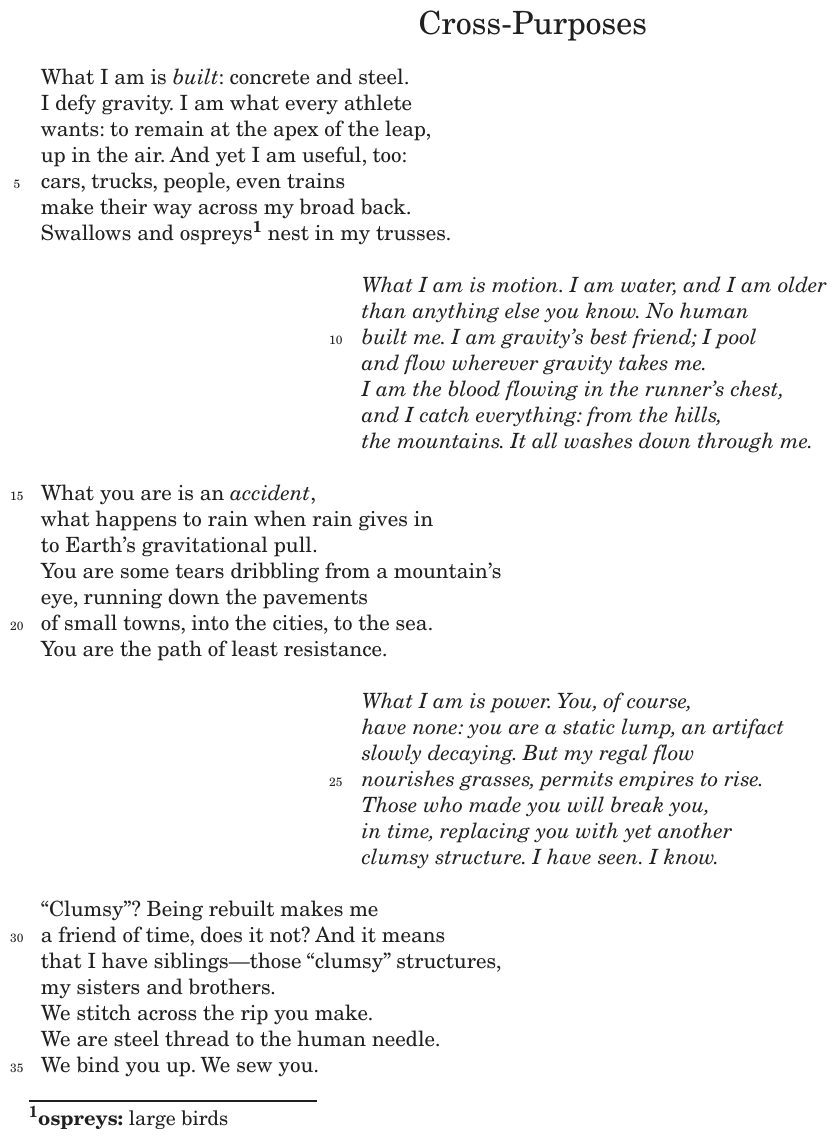
What I am is built: concrete and steel.
I defy gravity. I am what every athlete
wants: to remain at the apex of the leap,
up in the air. And yet I am useful, too:
cars, trucks, people, even trains
make their way across my broad back.
Swallows and ospreys nest in my trusses.
What I am is motion. I am water, and I am older
than anything else you know. No human
built me. I am gravity’s best friend; I pool
and flow wherever gravity takes me.
I am the blood flowing in the runner’s chest,
and I catch everything: from the hills,
the mountains. It all washes down through me.
What you are is an accident,
what happens to rain when rain gives in
to Earth’s gravitational pull.
You are some tears dribbling from a mountain’s
eye, running down the pavements
of small towns, into the cities, to the sea.
You are the path of least resistance.
What I am is power. You, of course,
have none: you are a static lump, an artifact
slowly decaying. But my regal flow
nourishes grasses, permits empires to rise.
Those who made you will break you,
in time, replacing you with yet another
clumsy structure. I have seen. I know.
“Clumsy”? Being rebuilt makes me
a friend of time, does it not? And it means
that I have siblings—those “clumsy” structures,
my sisters and brothers.
We stitch across the rip you make.
We are steel thread to the human needle.
We bind you up. We sew you.
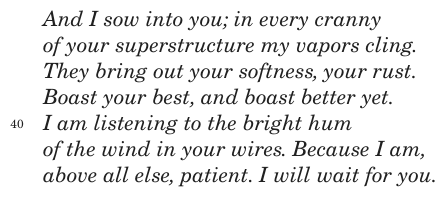
And I sow into you; in every cranny
of your superstructure my vapors cling.
They bring out your softness, your rust.
Boast your best, and boast better yet.
I am listening to the bright hum
of the wind in your wires. Because I am,
above all else, patient. I will wait for you.
ospreys: large birds
Question
The comparison to sewing in lines 33–35 helps show that the structure
- Aenhances the beauty of the natural landscape.
- Bbrings people together more effectively than nature does.
- Cprovides clear boundaries for natural environments.
- Dserves as a means for people to overcome an obstacle created by nature.
Show the answer
Correct answer: D
The answer is (D)
The question asks what the comparison in lines 33–35 shows about the structure. The speaker states, “We are steel thread to the human needle” (line 34), which illustrates that the structure (and others like it) is a tool used by humans to “bind . . . up” (line 35) or overcome “the rip” (line 33) that the water creates in the earth, making Option D correct.
Option A is incorrect because the language in the lines is used only to imply the flaw that the water creates—“the rip you make” (line 33).
Option B is incorrect because, while the water states that it enables “empires to rise” (line 25), implying that it is needed for society to thrive, it never shares a purpose of bringing people together through its existence.
Option C is incorrect because the language used for sewing (“We stitch across the rip you make” [line 33]) indicates the repair of a flaw and not the establishment of boundaries.
Question analysis
This figurative language question asks what the comparison to sewing, “We stitch across the rip you make,” shows about the structure in the poem “Cross-Purposes.” Students must work out what the speaker and the rip stand for, since the poem never names either, before the thread-and-needle metaphor makes sense.
- Grade level
- Grade 7 reading and task
- Compared with grade 7
- At grade 7 Interpreting an extended metaphor is standard grade 7 work, and the sewing words are concrete and familiar. One inference about what the speaker really is comes first, which keeps the task typical rather than hard.
- Estimated difficulty
- Moderate: several steps, or a close reading with one strong distractor.
- Thinking it demands
- Depth of knowledge 2, skills and concepts · mainly understand
- What makes it hard
- Figurative or literary language major
- Reading between the lines moderate
- Evidence
- Answered from one paragraph or stanza
- Reading level
- Passage: 316 words (a poem; reading level not measured); question and choices: about grade 8, 45 words.
- Corrected from the DOE handbook
- A misstatement of the question in the explanation was corrected.
- Two small typos in the explanation were corrected.
- Students, last 30 days
- Not enough answers yet to show (it takes 10).
Why it is hard, traps and wrong answers (shows the answer)
Why it is hard
Students who see that the structure is a bridge usually find the metaphor's sense: a river tears the land, and bridges stitch it closed for people to cross. The danger is the choice that also talks about connecting people, which matches the general idea of bridges but slips in a comparison with nature. The other choices treat stitching as decoration or as drawing lines, which a reader who pictures a needle closing a tear will not accept.
Figurative or literary language major Understanding the question
The sewing image runs over three lines: the river is a “rip,” bridges are “steel thread,” builders are “the human needle,” so each part must be mapped before the meaning appears. (Graesser, Singer & Trabasso, 1994; Kintsch, 1998)
Reading between the lines moderate Working it out
The poem never says the structure is a bridge or the rip a river gorge; students must infer both from earlier clues such as trains crossing its “broad back.” (Graesser, Singer & Trabasso, 1994; Kintsch, 1998)
Strategy: Use the earlier stanzas to work out what kind of structure is speaking and what the rip is, then translate the thread-and-needle comparison into plain terms.
Traps
- Reads too much in: A reasonable-sounding conclusion that goes further than the text allows.
- Twists what the text says: Uses the text's topic and ideas but changes what it says: who did it, how much, when, or why.
The wrong answers, classified
A Outside knowledge (King et al., 2004; Recht & Leslie, 1988)
Assumes bridges beautify a landscape, a common real-world view, but the lines describe repairing a tear, not adding beauty.
B Reads too much in (Graesser, Singer & Trabasso, 1994)
Rightly sees bridges joining people across water, but adds that they do it better than nature does, a comparison these lines never draw.
C Twists what the text says (King et al., 2004)
Treats stitches as lines that divide, while stitching across a rip pulls its two sides together rather than marking a boundary.
What was corrected from the DOE handbook, and why
- Explanation: The handbook says the question asks what the comparison “shows about the structure of the poem.” The question asks what it shows about the structure that speaks in the poem, not about the poem’s form, so “of the poem” was removed.
- Explanation: “(lines 25)” now reads “(line 25)”, and a stray closing parenthesis after “establishment of boundaries.” was removed.
Working it out, step by step
Figure out what the question asks
This asks what a comparison means. In lines 33–35 the structure compares itself to sewing. You need to turn that picture into plain words.
Read the sewing lines
The lines say: “We stitch across the rip you make. / We are steel thread to the human needle. / We bind you up. We sew you.”
“We” means the structure and its “siblings,” other structures like it. “You” is the water.
Match each part to the real thing
- The “rip” stands for the gap a river cuts through the land.
- The “steel thread” stands for the bridges.
- The “human needle” stands for the people who build them.
When you sew a rip, you pull the two sides back together. Bridges do the same. They join the land on both sides of a river, so people can cross.
Check each choice
- A The lines are about fixing a tear, not about adding beauty.
- B Bridges do bring people together, but the lines never say they do it better than nature.
- C Stitching across a rip pulls the sides together. It does not mark boundaries (lines that divide).
- D fits. The structure helps people get past the gap the water made.
Choose the answer
The sewing picture shows the structure helps people get past an obstacle the water created. So the answer is D.
Why this answer and not the closest wrong one
B is the closest trap, because bridges really do connect people. But B says they do it “more effectively than nature does.” The lines never compare the two that way. D sticks to what the picture shows: a tear made by water, closed by the structure so people can cross.
More questions like this
The original DOE question
The passage “Cross-Purposes” as printed (pages 72–73)