Passage Cross-Purposes
Cross-Purposes
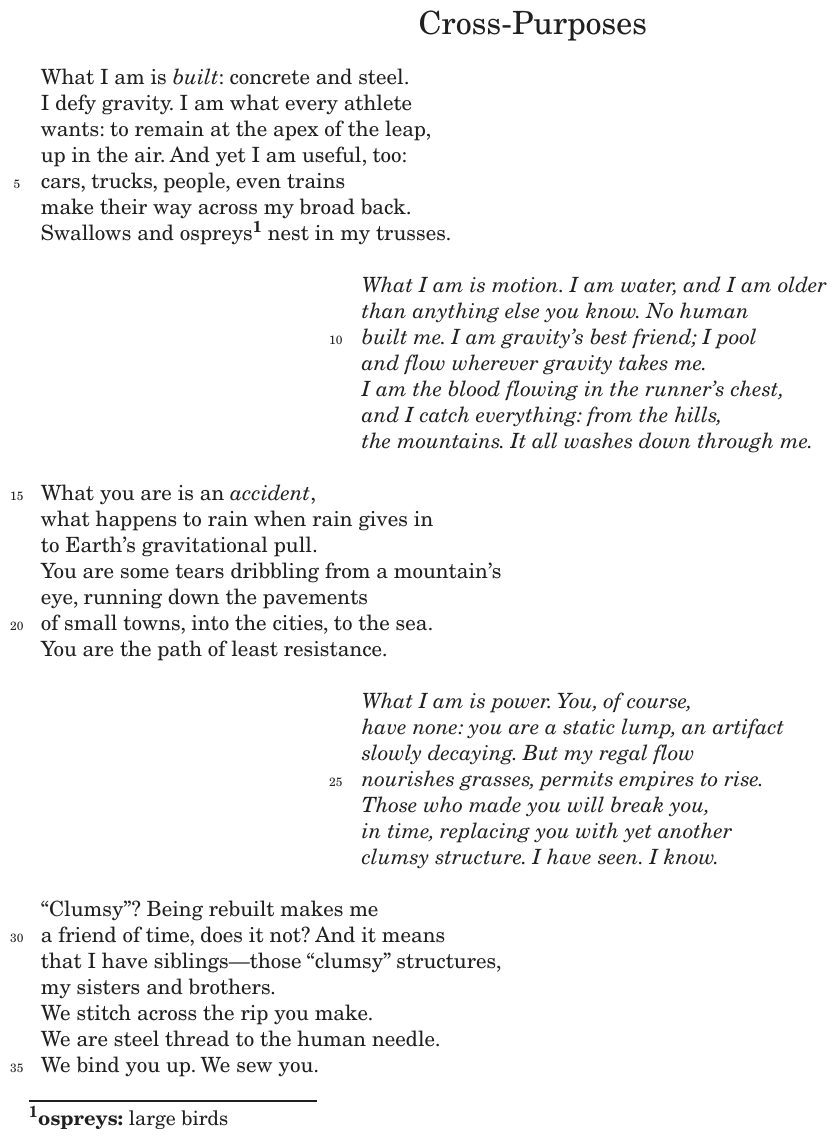
What I am is built: concrete and steel.
I defy gravity. I am what every athlete
wants: to remain at the apex of the leap,
up in the air. And yet I am useful, too:
cars, trucks, people, even trains
make their way across my broad back.
Swallows and ospreys nest in my trusses.
What I am is motion. I am water, and I am older
than anything else you know. No human
built me. I am gravity’s best friend; I pool
and flow wherever gravity takes me.
I am the blood flowing in the runner’s chest,
and I catch everything: from the hills,
the mountains. It all washes down through me.
What you are is an accident,
what happens to rain when rain gives in
to Earth’s gravitational pull.
You are some tears dribbling from a mountain’s
eye, running down the pavements
of small towns, into the cities, to the sea.
You are the path of least resistance.
What I am is power. You, of course,
have none: you are a static lump, an artifact
slowly decaying. But my regal flow
nourishes grasses, permits empires to rise.
Those who made you will break you,
in time, replacing you with yet another
clumsy structure. I have seen. I know.
“Clumsy”? Being rebuilt makes me
a friend of time, does it not? And it means
that I have siblings—those “clumsy” structures,
my sisters and brothers.
We stitch across the rip you make.
We are steel thread to the human needle.
We bind you up. We sew you.
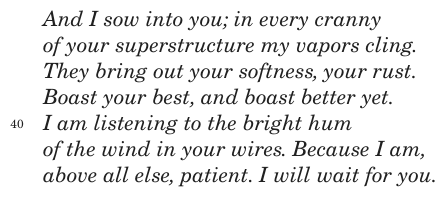
And I sow into you; in every cranny
of your superstructure my vapors cling.
They bring out your softness, your rust.
Boast your best, and boast better yet.
I am listening to the bright hum
of the wind in your wires. Because I am,
above all else, patient. I will wait for you.
ospreys: large birds
Question
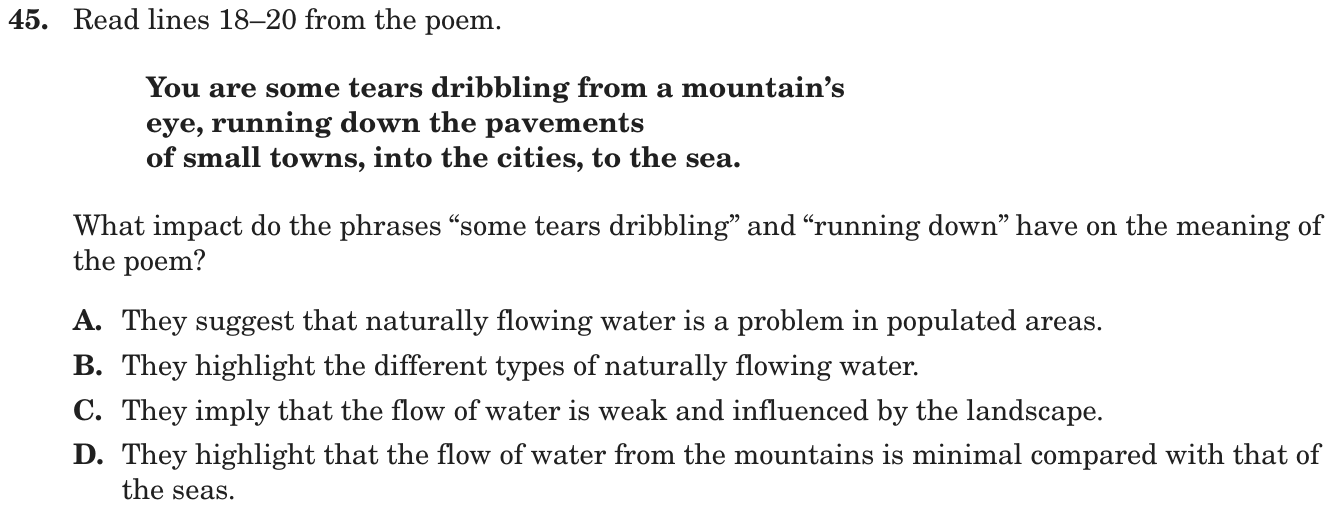
Read lines 18–20 from the poem.
You are some tears dribbling from a mountain’s
eye, running down the pavements
of small towns, into the cities, to the sea.
What impact do the phrases “some tears dribbling” and “running down” have on the meaning of the poem?
- AThey suggest that naturally flowing water is a problem in populated areas.
- BThey highlight the different types of naturally flowing water.
- CThey imply that the flow of water is weak and influenced by the landscape.
- DThey highlight that the flow of water from the mountains is minimal compared with that of the seas.
Show the answer
Correct answer: C
The answer is (C)
The question asks for the impact that the phrases have on the meaning of the poem. The phrases “some tears dribbling” and “running down” (lines 18–19) imply weakness in form and being influenced by the landscape, making Option C correct.
Option A is incorrect because, while the lines do describe the water in populated areas, they do not describe the water as a problem for the people living there.
Option B is incorrect because the lines do more than bring attention to different types of water; the lines make a judgment about the strength and importance of the water.
Option D is incorrect because a comparison is not made based on the volume of water streaming from the mountains and the volume of water in the seas.
Question analysis
In this question about figurative language in “Cross-Purposes,” students explain the impact of the phrases “some tears dribbling” and “running down,” used to describe the water. They must first work out which of the poem's two speakers is talking, then judge the connotations of the words rather than only the picture they paint.
- Grade level
- Grade 7 reading and task
- Compared with grade 7
- At grade 7 Judging the connotation of a few words is standard grade 7 work. The two-voice format adds one step, since the speakers are never named, but the lines are quoted and short, so the demand stays typical.
- Estimated difficulty
- Moderate: several steps, or a close reading with one strong distractor.
- Thinking it demands
- Depth of knowledge 2, skills and concepts · mainly analyze
- What makes it hard
- Figurative or literary language moderate
- A very close wrong answer moderate
- Reading between the lines minor
- Evidence
- Answered from one paragraph or stanza
- Reading level
- Passage: 316 words (a poem; reading level not measured); question and choices: about grade 6, 98 words.
- Students, last 30 days
- Not enough answers yet to show (it takes 10).
Why it is hard, traps and wrong answers (shows the answer)
Why it is hard
The lines can be read as a simple picture of water running from mountains to the sea, and that reading leads to choices about kinds of water, flooding or volume. The phrases matter for what they say about the water's strength: it dribbles, it runs downhill, it goes where the land sends it. Students who ask how the speaker feels about the water, and remember the stanza's “path of least resistance,” arrive at the key.
Figurative or literary language moderate Understanding the question
“Some tears dribbling from a mountain's eye” turns a river into a weak trickle of tears, so the judgment lies in the connotation of “some” and “dribbling,” not in the picture. (Graesser, Singer & Trabasso, 1994; Kintsch, 1998)
A very close wrong answer moderate Choosing the answer
C and D both say the water's flow is weak, D's “minimal” matching “dribbling”; they differ in the second part, where D adds a comparison with the seas that the lines never make. (Embretson & Wetzel, 1987; Gorin & Embretson, 2006; Ascalon et al., 2007)
Reading between the lines minor Working it out
The stanza is unlabeled, so students must work out from its roman type and its “you” that the structure is speaking and belittling the water. (Graesser, Singer & Trabasso, 1994; Kintsch, 1998)
Strategy: Compare “dribbling” with a neutral word such as “flowing,” and ask what the difference suggests about how this stanza's speaker regards the water.
Traps
- Reads too much in: A reasonable-sounding conclusion that goes further than the text allows.
- Taking figurative language literally: A choice reads a figure of speech or image at face value.
The wrong answers, classified
A Taking figurative language literally (Graesser, Singer & Trabasso, 1994)
Reads water “running down the pavements” of towns and cities as literal flooding, a problem for people, though the speaker is belittling the water, not warning of harm.
B Wrong purpose or structure (Anderson & Krathwohl, 2001)
Lists what the lines show, tears, streets and sea, as kinds of water, describing the content instead of the judgment the phrases make.
D Reads too much in (Graesser, Singer & Trabasso, 1994)
Catches the weakness in “dribbling,” but the lines never set the mountain trickle against the sea's volume; the sea is simply where the water ends up.
Working it out, step by step
Figure out what the question asks
This is a word-choice question. It asks what two phrases suggest about the water. Notice how the words make the water seem.
Work out who is speaking
Lines 15–21 are spoken by the structure. It talks to the water as “you.” It starts: “What you are is an accident.” It ends: “You are the path of least resistance.” The path of least resistance is the easiest way, the one that takes no effort.
Look closely at the phrases
Lines 18–19 say the water is “some tears dribbling from a mountain’s eye, running down the pavements.”
To dribble is to drip a little at a time. “Some tears” sounds small and weak. “Running down” means the water just goes downhill, wherever the land sends it. So the structure is putting the water down. It calls the water weak and pushed around by the land.
Check each choice
- A The lines mention towns, but they never call the water a problem for people.
- B The lines do more than list kinds of water. They judge the water.
- C fits. The water is weak and goes where the landscape sends it.
- D The lines never compare how much water is in mountains and in seas.
Choose the answer
The phrases make the water seem weak and controlled by the land. So the answer is C.
Why this answer and not the closest wrong one
D is the closest trap, since “dribbling” does sound small, like “minimal.” But D adds a comparison with the seas. The sea is just where the water ends up. C keeps the weakness and adds the land, which matches “running down” and “the path of least resistance.”
More questions like this
The original DOE question
The passage “Cross-Purposes” as printed (pages 72–73)