Also in 2025 Practice Test B English, question 40.
Passage Letter from Brooklyn
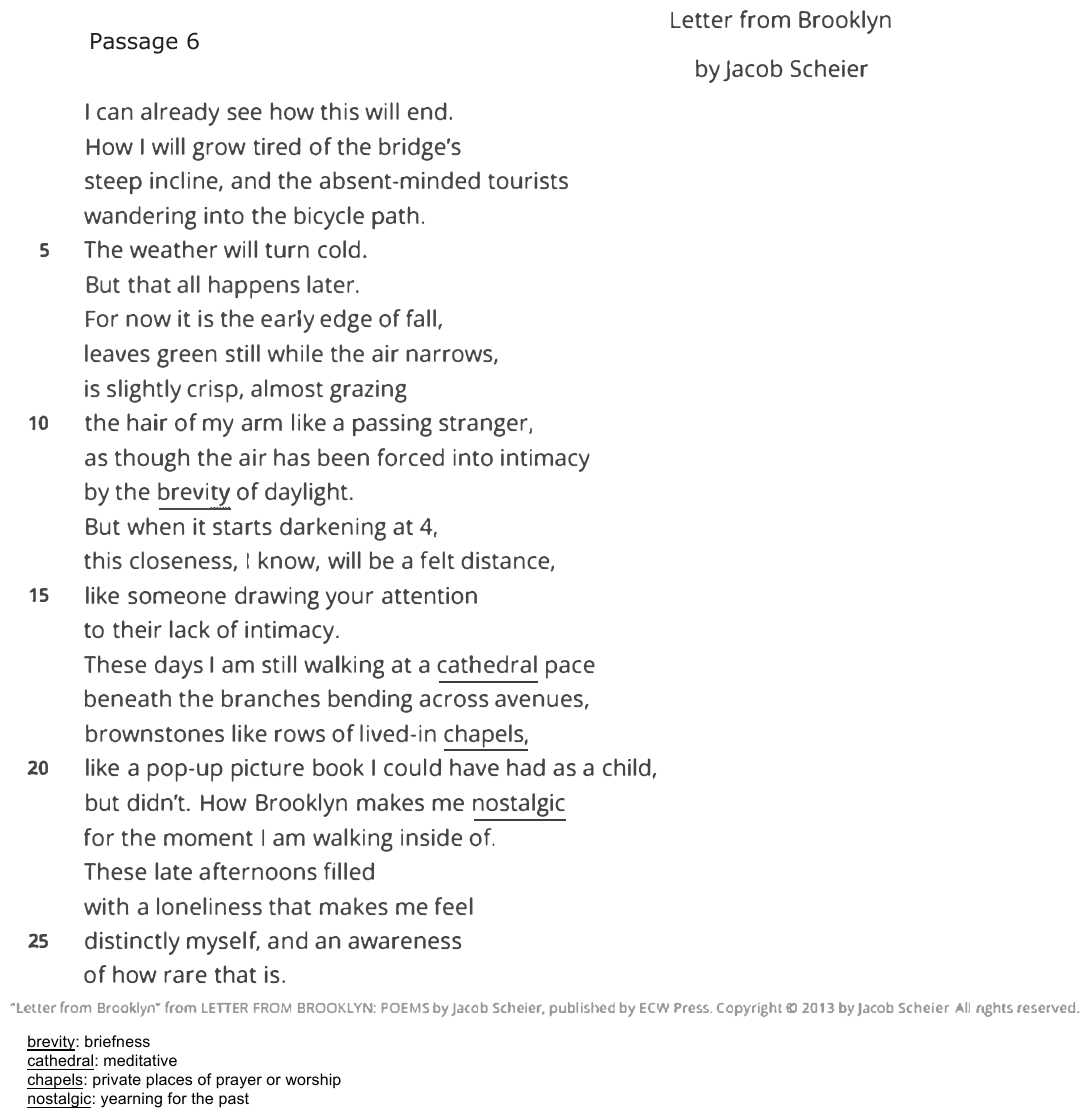
Letter from Brooklyn
by Jacob Scheier
I can already see how this will end.
How I will grow tired of the bridge’s
steep incline, and the absent-minded tourists
wandering into the bicycle path.
The weather will turn cold.
But that all happens later.
For now it is the early edge of fall,
leaves green still while the air narrows,
is slightly crisp, almost grazing
the hair of my arm like a passing stranger,
as though the air has been forced into intimacy
by the brevity of daylight.
But when it starts darkening at 4,
this closeness, I know, will be a felt distance,
like someone drawing your attention
to their lack of intimacy.
These days I am still walking at a cathedral pace
beneath the branches bending across avenues,
brownstones like rows of lived-in chapels,
like a pop-up picture book I could have had as a child,
but didn’t. How Brooklyn makes me nostalgic
for the moment I am walking inside of.
These late afternoons filled
with a loneliness that makes me feel
distinctly myself, and an awareness
of how rare that is.
“Letter from Brooklyn” from LETTER FROM BROOKLYN: POEMS by Jacob Scheier, published by ECW Press. Copyright © 2013 by Jacob Scheier All rights reserved.
brevity: briefness
cathedral: meditative
chapels: private places of prayer or worship
nostalgic: yearning for the past
Question
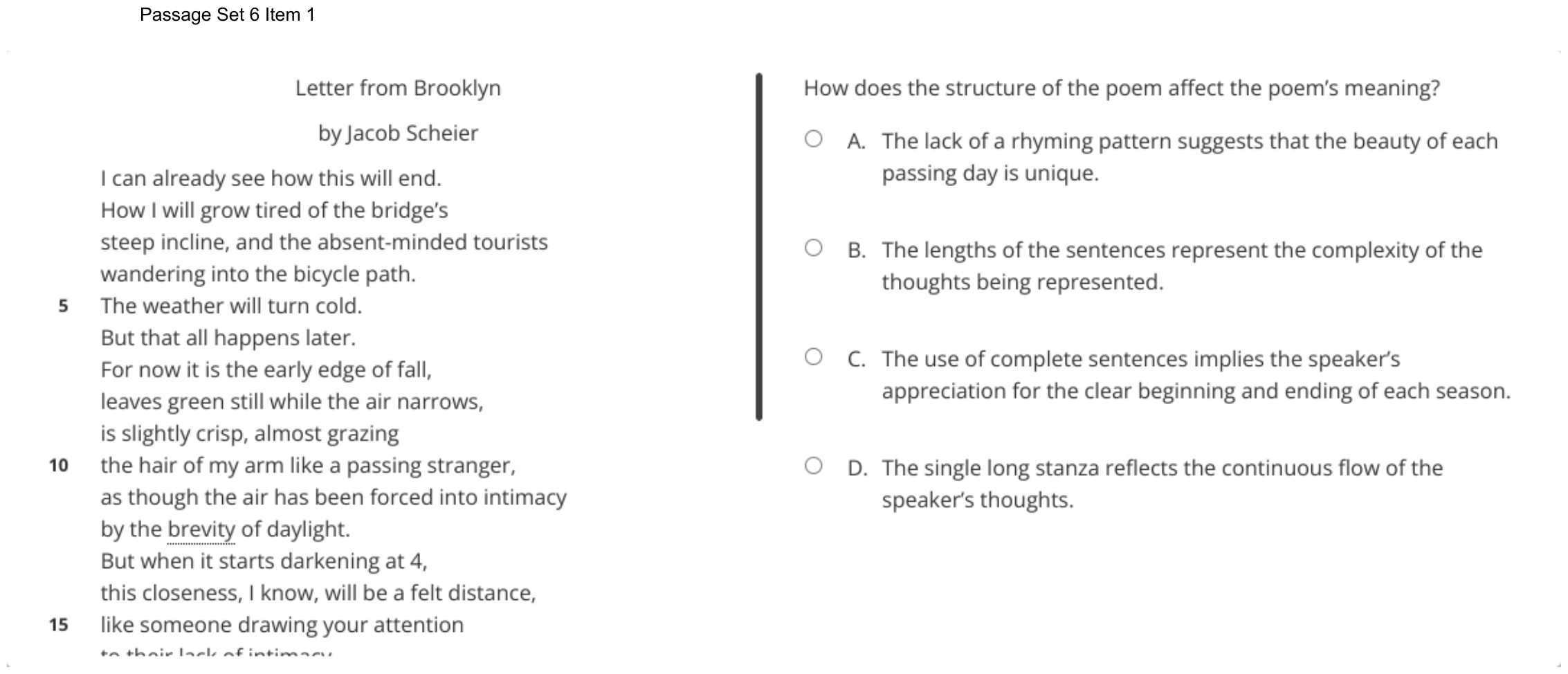
How does the structure of the poem affect the poem’s meaning?
- AThe lack of a rhyming pattern suggests that the beauty of each passing day is unique.
- BThe lengths of the sentences represent the complexity of the thoughts being represented.
- CThe use of complete sentences implies the speaker’s appreciation for the clear beginning and ending of each season.
- DThe single long stanza reflects the continuous flow of the speaker’s thoughts.
Show the answer
Correct answer: D
The question asks how the structure of the poem affects its meaning.
A. Incorrect. Though the poem lacks a rhyming pattern, such a structure is not related to the uniqueness of the passing days. The speaker is savoring “the early edge of fall” (line 7) and describes walks taken on “these days” (line 17), but the beauty the speaker appreciates is attributed to the fall season rather than to a unique day. Further, the poem is primarily concerned with broad seasonal shifts, not the passing of each day, and the absence of rhyme does not suggest that each day is unique in its beauty.
B. Incorrect. The poem includes both long sentences (such as the one in lines 7–12) and short sentences (such as those in lines 5 and 6). However, the sentence lengths are not connected with the complexity of the ideas expressed.
C. Incorrect. A complete sentence serves to present the beginning and the end of a single thought, but the poem is not primarily concerned with the speaker’s thoughts on the “clear beginning and ending of each season.” Though it contrasts the speaker’s feelings and experiences during different seasons, the poem does not present descriptions focused specifically on the beginnings or ends of these seasons.
D. CORRECT. Unlike poems that are broken into stanzas reflecting unified groups of thoughts, this poem is one long stanza. This structure serves to emphasize the uninterrupted flow of the speaker’s thoughts from time to time and experience to experience without a clear break between any specific thoughts.
Question analysis
This poetry question asks how the structure of Jacob Scheier's “Letter from Brooklyn,” a poem about walking through the city in early fall, affects its meaning. Students must look at how the poem is built, its sentences, line breaks, stanzas and lack of rhyme, and decide which feature really shapes what the poem says.
- NYS standards
- 7R5 structure and genre features
- Grade level
- Grade 7 reading and task
- Compared with grade 7
- At grade 7 Grade 7 standards ask how a poem's form shapes its meaning. Here each choice names a feature of form that students must first confirm in the poem and then link to its meaning, a typical grade 7 poetry task on a short poem.
- Estimated difficulty
- Moderate: several steps, or a close reading with one strong distractor.
- Thinking it demands
- Depth of knowledge 2, skills and concepts · mainly analyze
- What makes it hard
- How, not what moderate
- Every choice must be checked moderate
- Something you must already know minor
- Evidence
- Answered from the whole text
- Reading level
- Passage: 217 words (a poem; reading level not measured); question and choices: about grade 8, 70 words.
- Students, last 30 days
- Not enough answers yet to show (it takes 10).
Why it is hard, traps and wrong answers (shows the answer)
Why it is hard
Checking whether a feature exists rules out little here, since the poem is unrhymed, its sentences vary widely and it has one stanza. The decision rests on which feature matches what the speaker does: thoughts move from future to present to memory without a break. The strongest pull ties the lack of rhyme to the uniqueness of each day, which sounds like the poem’s theme of rare moments but is not something rhyme or its absence can show.
How, not what moderate Working it out
The question is about form, so students must ask what the single unbroken stanza does: it carries the speaker from the coming cold back to the present walk without a pause. (Anderson & Krathwohl, 2001)
Every choice must be checked moderate Choosing the answer
Three choices name features the poem really has, no rhyme, sentences from five words to six lines, and one stanza, so the meaning each feature is given is what separates them. (Embretson & Wetzel, 1987)
Something you must already know minor Working it out
Students must know what a stanza and a rhyming pattern are, and that a poem without stanza breaks has no white space marking separate groups of thought. (Anderson & Krathwohl, 2001)
Strategy: For each choice, first check that the poem really has the feature named, then ask whether that feature fits what the speaker is doing throughout the poem, not just in one line.
Traps
- Wrong purpose or structure: Names a purpose, structure or effect that the part does not serve, or describes what a part says when the question asks what it does.
- Reads too much in: A reasonable-sounding conclusion that goes further than the text allows.
The wrong answers, classified
A Reads too much in (Graesser, Singer & Trabasso, 1994)
Applies the habit of finding meaning in free verse, linking the missing rhyme to each day’s unique beauty, which echoes “how rare that is” but follows from nothing in the form.
B Wrong purpose or structure (Anderson & Krathwohl, 2001)
Rightly sees sentences ranging from five words to six lines, but gives their length a job, matching complex thoughts, that the poem never connects to it.
C Wrong purpose or structure (Anderson & Krathwohl, 2001)
Assumes complete sentences marking each season’s clear start and end, though the last four lines are a fragment and the poem follows fall’s gradual early turn.
Working it out, step by step
Figure out what the question asks
This question asks how the poem’s structure shapes its meaning. Structure means how the poem is built: its stanzas, its sentences and its rhyme. A stanza is a group of lines set apart by a blank line. It is like a paragraph in a poem.
Look at how the poem is built
The poem has 26 lines and no blank lines, so it is one long stanza. The lines don’t rhyme. The sentences have many lengths. Line 5, “The weather will turn cold,” is short. The sentence in lines 7–12 runs six lines.
Follow the speaker’s thoughts
The speaker is the voice talking in the poem. Line 1 jumps ahead: “I can already see how this will end.” Line 6 comes back: “But that all happens later.” Then the speaker describes the fall air, then the walk, then a lonely feeling. One thought slides into the next with no stop. One unbroken stanza matches that steady flow.
Check each choice
- A is wrong. The poem has no rhyme. But missing rhyme can’t show that each day’s beauty is unique, or one of a kind.
- B is wrong. The sentences do vary in length. But the poem doesn’t link long sentences to hard thoughts.
- C is wrong. The poem isn’t about each season’s clear start and end. It describes fall just starting to turn.
- D is right. The single stanza matches thoughts that flow on with no breaks.
Watch out: Three choices name real features of the poem. So don’t stop at Is this true? Ask whether that feature really creates the meaning the choice gives it.
Choose the answer
Continuous means going on without stopping. So the answer is D: “The single long stanza reflects the continuous flow of the speaker’s thoughts.”
Why this answer and not the closest wrong one
A is the closest wrong answer, because the poem does praise a rare moment. But rhyme, or no rhyme, can’t show that each day is unique. One long stanza can show thoughts flowing without a stop. That is how the speaker thinks, from line 1 to line 26.
More questions like this
The original DOE question
The passage “Letter from Brooklyn” as printed (page 50)