Question
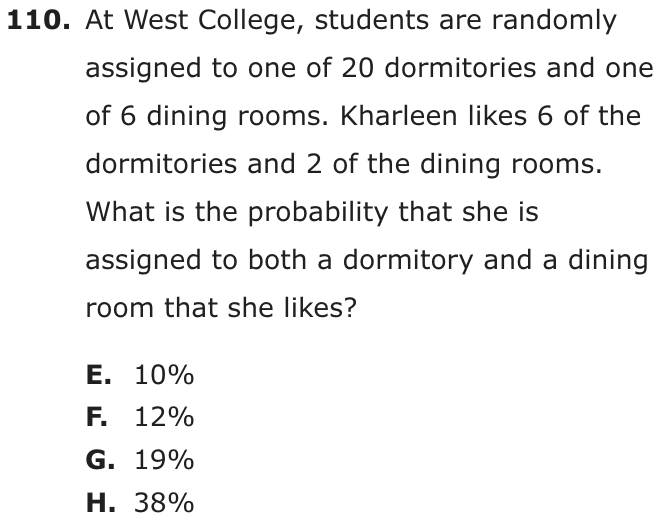
At West College, students are randomly assigned to one of 20 dormitories and one of 6 dining rooms. Kharleen likes 6 of the dormitories and 2 of the dining rooms. What is the probability that she is assigned to both a dormitory and a dining room that she likes?
- A10%
- B12%
- C19%
- D38%
Show the answer
Correct answer: A
Kharleen likes of the dormitories. She likes of the dining rooms. Multiply those fractions together to calculate the probability of Kharleen being assigned to both a dormitory and a dining room that she likes: .
Question analysis
This probability word problem says students at West College are randomly assigned one of 20 dormitories and one of 6 dining rooms, and Kharleen likes 6 dormitories and 2 dining rooms. It asks for the chance that she gets both a dormitory and a dining room she likes. Students combine two independent events and write the result as a percent.
- Grade level
- Grade 7 content, by NYS standard
- Compared with grade 7
- At grade 7 Finding the chance that two independent events both happen is grade 7 compound probability. Each event's chance comes straight from the counts given, and joining them and writing the result as a percent is a typical grade 7 task.
- Estimated difficulty
- Moderate: several steps, or a close reading with one strong distractor.
- Thinking it demands
- Depth of knowledge 2, skills and concepts · mainly apply
- What makes it hard
- Something you must already know moderate
- Turning words into math minor
- A very close wrong answer minor
- Solution
- 3 steps
- Reading level
- Question and choices: about grade 8, 45 words.
- Students, last 30 days
- Not enough answers yet to show (it takes 10).
Why it is hard, traps and wrong answers (shows the answer)
Why it is hard
The question turns on one rule, multiplying the chances of two independent events. Students who know it reduce the fractions first and finish in seconds; students who don't tend to combine the counts, and 6 × 2 = 12 reads naturally as 12%. The other two choices match no common working, so the real contest is between the product of the counts and the product of the chances.
Something you must already know moderate Working it out
The rule that the chance of two independent events both happening is the product of their chances, 3/10 × 1/3, is assumed; nothing in the stem says to multiply. (Anderson & Krathwohl, 2001)
Turning words into math minor Understanding the question
The phrase “both a dormitory and a dining room that she likes” describes two separate random assignments that must both go her way, so the two chances are combined, not compared. (Hegarty, Mayer & Monk, 1995; Koedinger & Nathan, 2004)
A very close wrong answer minor Choosing the answer
The choice 12% sits only 2 points above 10%, so a rough sense that the answer is small cannot separate them; only computing 3/10 × 1/3 does. (Embretson & Wetzel, 1987; Gorin & Embretson, 2006; Ascalon et al., 2007)
Strategy: Write the chance of a liked dormitory and the chance of a liked dining room as fractions, multiply them because both must happen, and convert the product to a percent.
Traps
- Numbers taken from the question: Combines the numbers in the question without a model of the situation, or is simply a number that appears in the question.
- A formula you must know: Needs a formula the test does not give: area, circumference, volume, probability rules.
The wrong answers, classified
B Numbers taken from the question (Hegarty, Mayer & Monk, 1995)
Multiplies the numbers of liked options, 6 × 2 = 12, and reads that product as 12%, without dividing by the 20 × 6 possible assignments.
C Little reason to choose it (Haladyna & Downing, 1993; Rodriguez, 2005)
No combination of 6/20 and 2/6 gives 19%, a value between the right answer and either single chance, so it mostly draws estimates and guesses.
D Little reason to choose it (Haladyna & Downing, 1993; Rodriguez, 2005)
No common working gives 38%, which is larger than either single chance, 30% or about 33%, so it mostly catches guesses.
Worked solution, step by step
Formulas used
- Probability
- P is the probability, the chance that something happens. The top counts the outcomes you want. The bottom counts every outcome that could happen. Each outcome must be equally likely.
- Probability of two separate events
- A and B are two events that don’t affect each other, like two separate random picks. P(A) is the chance of A, and P(B) is the chance of B. The chance that both happen is the two chances multiplied.
Sort out the question
Kharleen gets one of 20 dorms, or dormitories, where students live. She also gets one of 6 dining rooms. Each is picked at random. She likes 6 dorms and 2 dining rooms. You need the chance that she gets a dorm she likes and a dining room she likes.
Find the chance of a liked dorm
She likes 6 of the 20 dorms. Divide the top and bottom by 2 to simplify.
Find the chance of a liked dining room
Use the same formula for the dining rooms.
She likes 2 of the 6 dining rooms. Divide the top and bottom by 2.
Multiply the two chances
The two picks are separate. One doesn’t change the other.
Both must happen, so the chance is smaller than either one alone.
Change to a percent
Watch out: multiplying 6 × 2 = 12 and calling it 12% skips dividing by all the possible assignments. That is choice B. So the answer is A, 10%.
Check your answer
Count every possible assignment. There are dorm and dining room pairs, all equally likely. She likes of them. Then , which is 10%, the same answer.
More questions like this
The original DOE question