Question
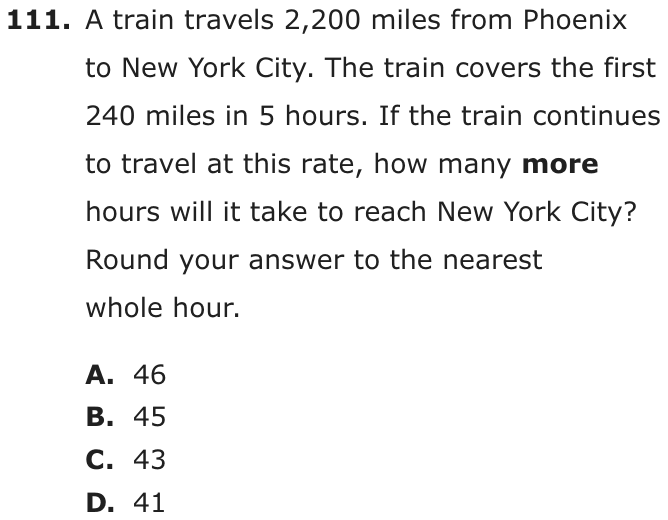
A train travels 2,200 miles from Phoenix to New York City. The train covers the first 240 miles in 5 hours. If the train continues to travel at this rate, how many more hours will it take to reach New York City? Round your answer to the nearest whole hour.
- A46
- B45
- C43
- D41
Show the answer
Correct answer: D
First, find the speed of the train in miles per hour: .
The number of miles left to travel is .
To find the number of hours left, use the equation :
| Apply the multiplicative inverse property; divide both sides of the equation by 48. | |
That number rounded to the nearest whole hour is 41 hours.
Question analysis
This rate word problem describes a 2,200-mile train trip from Phoenix to New York City in which the first 240 miles take 5 hours, and asks how many more hours the rest will take, rounded to the nearest hour. Students find a unit rate and the remaining distance. The choices are close together, so the time for the whole trip is a tempting trap.
- Grade level
- Grade 6 content, by NYS standard
- Compared with grade 7
- At grade 7 Unit rates are grade 6 content, but this chains four steps: a speed, the distance left, a long division that does not come out even, and rounding. The word more must be read closely, which puts it at typical grade 7 demand.
- Estimated difficulty
- Moderate: several steps, or a close reading with one strong distractor.
- Thinking it demands
- Depth of knowledge 2, skills and concepts · mainly apply
- What makes it hard
- Many steps moderate
- Turning words into math minor
- Error-prone arithmetic minor
- Solution
- 4 steps
- Reading level
- Question and choices: about grade 4, 47 words.
- Students, last 30 days
- Not enough answers yet to show (it takes 10).
Why it is hard, traps and wrong answers (shows the answer)
Why it is hard
Each step is routine, but the question has a long chain and asks for only part of the trip. Dividing the whole 2,200 miles by the speed is the natural shortcut and gives a listed choice, and the rounding instruction adds a second place to go wrong. Checking that 41 hours at 48 miles per hour covers about 1,970 miles, close to the 1,960 left, confirms the answer.
Many steps moderate Working it out
Four steps follow in order, the speed 240 ÷ 5 = 48, the miles left 2,200 − 240 = 1,960, the time 1,960 ÷ 48, and the rounding, and an early slip carries through. (Daniel & Embretson, 2010; Enright, Morley & Sheehan, 2002)
Turning words into math minor Understanding the question
The bold more in “how many more hours” limits the question to the 1,960 miles still ahead, though 2,200, the whole trip, is the distance the stem names first. (Hegarty, Mayer & Monk, 1995; Koedinger & Nathan, 2004)
Error-prone arithmetic minor Working it out
Dividing 1,960 by 48 leaves 40 with a remainder of 40, so the time, 40 5/6 hours, must be rounded up to the nearest hour rather than cut short. (Brown & Burton, 1978; Junker & Sijtsma, 2001)
Strategy: Find the train's speed from the first 240 miles, subtract those miles from the total to get the distance left, divide by the speed, and round only at the end.
Traps
- Answers a different question: A choice is right for another quantity: the other unknown, the rest instead of the part, the part instead of the whole.
- An arithmetic slip: The right method with a plausible arithmetic error: a digit, a place value or a times-table fact.
- Rounds too early: Rounds a value partway through, or rounds the wrong way, so the final answer drifts from the exact one.
The wrong answers, classified
A Answers a different question (King et al., 2004; Hegarty, Mayer & Monk, 1995)
Divides the whole 2,200 miles by 48 miles per hour, about 45.8, or 46 hours, the time for the entire trip rather than the hours still to go.
B Rounds too early (King et al., 2004)
Divides the whole 2,200 miles by 48 and then cuts 45.8 down to 45 instead of rounding to the nearest hour, two errors at once.
C An arithmetic slip (Junker & Sijtsma, 2001)
Subtracts 240 from 2,200 without reducing the hundreds after borrowing, getting 2,060 instead of 1,960, and 2,060 ÷ 48 ≈ 42.9 rounds to 43.
Worked solution, step by step
Formulas used
- Distance, rate and time
- d is the distance, r is the rate or speed, and t is the time. If you know two of them, you can find the third. To find the speed, divide the distance by the time. To find the time, divide the distance by the speed.
Sort out the question
The whole trip is 2,200 miles. The train goes the first 240 miles in 5 hours, and it keeps that speed. You need how many more hours it takes, rounded to the nearest whole hour. “More” means the time after the first 240 miles.
Find the train’s speed
Divide the 240 miles by the 5 hours. The train goes 48 miles per hour.
Find the miles still to go
There are 1,960 miles left. Watch out: use the miles left, not the whole trip. Dividing 2,200 by 48 gives about 45.8 hours, which leads to 46 or 45, choices A and B.
Find the hours still to go
Here 48 × 40 = 1,920, and 40 miles are left over. That leftover is of an hour.
Round to the nearest hour
of an hour is more than half an hour, so round up to 41. Watch out: don’t just drop the fraction.
So the answer is D, 41 hours.
Check your answer
At 48 miles per hour, 41 hours covers miles. That is just a bit more than 1,960, as it should be after rounding up. In 40 hours, the train would cover only 1,920 miles, which is not enough.
More questions like this
The original DOE question