Question
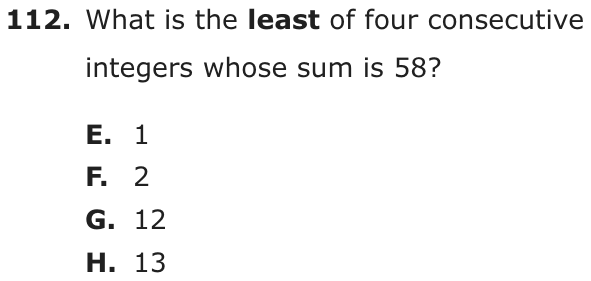
What is the least of four consecutive integers whose sum is 58?
- A1
- B2
- C12
- D13
Show the answer
Correct answer: D
Let n represent the least of the four integers. The other three integers are , , and . Write an equation to solve for n:
Question analysis
This number properties question asks for the least of four consecutive integers that add up to 58. Students write the integers in terms of one unknown and solve a two-step equation, or reason from the average of the four. Starting the list at n + 1 instead of n, which shifts every integer by one, is the main trap.
- Grade level
- Grade 7 content, by NYS standard
- Compared with grade 7
- At grade 7 Writing and solving an equation of the form px + q = r is core grade 7 work. Expressing four consecutive integers in terms of the least one is a familiar setup, so this is a routine three-step grade 7 problem.
- Estimated difficulty
- Straightforward: two steps or one careful reading.
- Thinking it demands
- Depth of knowledge 2, skills and concepts · mainly apply
- What makes it hard
- Turning words into math minor
- A very close wrong answer minor
- Solution
- 3 steps
- Reading level
- Question and choices: about grade 6, 11 words.
- Students, last 30 days
- Not enough answers yet to show (it takes 10).
Why it is hard, traps and wrong answers (shows the answer)
Why it is hard
One equation, 4n + 6 = 58, solves the question, and dividing 58 by 4 to find the middle of the four, 14.5, is quicker still. The only real risk is the count: writing the integers as n + 1 through n + 4 and reporting n gives a least integer one too small. The two smallest choices match no reasonable working, so they draw only guesses. Adding the four integers back up to 58 is a ten-second check.
Turning words into math minor Understanding the question
The phrase “four consecutive integers” has to become n, n + 1, n + 2 and n + 3, with n the least, so the sum is 4n + 6, not 4n + 10. (Hegarty, Mayer & Monk, 1995; Koedinger & Nathan, 2004)
A very close wrong answer minor Choosing the answer
The choices 12 and 13 differ by one, the size of a fence-post error, so only checking that 13 + 14 + 15 + 16 = 58 separates them. (Embretson & Wetzel, 1987; Gorin & Embretson, 2006; Ascalon et al., 2007)
Strategy: Call the least integer n, write the next three as n + 1, n + 2 and n + 3, add them and solve; or divide 58 by 4 to find the middle of the four.
Traps
- Counting the ends: Inclusive or exclusive ends, fence posts, consecutive numbers: an answer that is one too many or too few, or an endpoint drawn open where it belongs closed (or the reverse).
The wrong answers, classified
A Little reason to choose it (Haladyna & Downing, 1993; Rodriguez, 2005)
No equation for four consecutive integers gives 1; it may echo the step of 1 between them, but it mostly catches guesses.
B Little reason to choose it (Haladyna & Downing, 1993; Rodriguez, 2005)
No working with a sum of 58 leads to 2, which may echo the + 2 in n + 2, so it mostly draws guesses.
C Counting the ends (Brown & Burton, 1978)
Writes the four integers as n + 1 through n + 4, solves 4n + 10 = 58 to get n = 12, and reports n instead of the least integer, n + 1.
Worked solution, step by step
Formulas used
- Consecutive integers
- Integers are whole numbers and their negatives, like −2, 0 and 7. Consecutive integers come one right after another, like 4, 5, 6, 7. If n is the least one, each next one is 1 more than the one before.
Sort out the question
You need four consecutive integers, numbers in a row like 7, 8, 9, 10. Together they add up to 58. You need the least, or smallest, of the four.
Name the four numbers
Let n be the least number. Then the other three are 1, 2 and 3 more than n.
Write and simplify the equation
Add the four numbers and set the sum equal to 58.
To combine, count the n’s: there are four of them. The plain numbers make 1 + 2 + 3 = 6.
Solve for n
Subtract 6 from both sides. Then divide both sides by 4.
Watch out: if you call the numbers n + 1 to n + 4, you get n = 12. Then 12 is not one of the four numbers; the least one is 13. Answering 12 is choice C.
So the answer is D, 13.
Check your answer
Add them up: . It works. Another way: is their average. It falls halfway between the two middle numbers, 14 and 15. So the four numbers are 13, 14, 15 and 16.
More questions like this
The original DOE question