Question
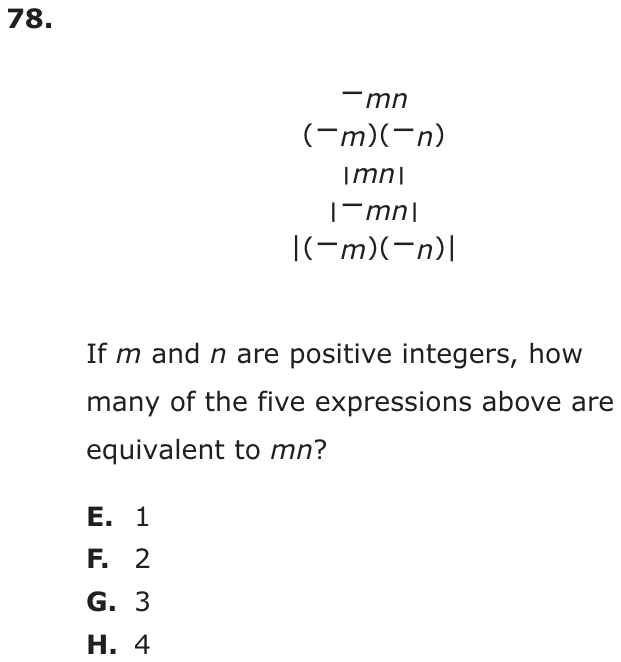
If m and n are positive integers, how many of the five expressions above are equivalent to ?
- A1
- B2
- C3
- D4
Show the answer
Correct answer: D
Since m and n are positive, the value of is also positive. Of the five options given:
is negative.
is positive.
is positive.
is positive.
is positive.
There are 4 expressions that are positive, and each one is equal to .
Question analysis
Five expressions are listed: −mn, (−m)(−n), |mn|, |−mn| and |(−m)(−n)|. If m and n are positive integers, students count how many are equivalent to mn. It tests the sign rules for multiplying negatives together with what absolute value does, and each expression has to be judged on its own.
- Grade level
- Grade 7 content, by NYS standard
- Compared with grade 7
- At grade 7 Multiplying signed numbers and absolute value are grade 6 and 7 content. Checking five expressions one by one takes longer than a typical single computation, but each check uses a familiar rule.
- Estimated difficulty
- Moderate: several steps, or a close reading with one strong distractor.
- Thinking it demands
- Depth of knowledge 2, skills and concepts · mainly analyze
- What makes it hard
- Variables instead of numbers moderate
- Much to keep track of minor
- Something you must already know minor
- Solution
- 5 steps
- Reading level
- Question and choices: about grade 10, 23 words.
- Students, last 30 days
- Not enough answers yet to show (it takes 10).
Why it is hard, traps and wrong answers (shows the answer)
Why it is hard
Each expression takes only a moment, but the answer is a count, so one misjudged expression changes it. The minus signs are designed to unsettle: four of the five expressions show at least one, and only one of those actually stays negative. Substituting small positive numbers and comparing each value with mn turns the question into arithmetic.
Variables instead of numbers moderate Understanding the question
The five expressions use only m and n, so each sign rule has to be applied in general unless the student substitutes values such as m = 2 and n = 3. (Koedinger & Nathan, 2004; Enright, Morley & Sheehan, 2002)
Much to keep track of minor Working it out
Five expressions are judged one at a time and a count kept, and two of them combine the product rule for negatives with absolute value bars. (Sweller, 1988; Carpenter, Just & Shell, 1990)
Something you must already know minor Working it out
The rules that two negative factors give a positive product and that absolute value removes a minus sign are assumed, not stated. (Anderson & Krathwohl, 2001)
Strategy: Pick small values such as m = 2 and n = 3, evaluate each of the five expressions, and count the ones equal to 6.
Traps
- Negatives and direction: Arithmetic with negative numbers, the order of a subtraction, or direction on a number line. (Moving a term across the equals sign without changing its sign is a faulty procedure.)
- Misunderstands the concept: A wrong belief about a concept: that percents can be added, that area grows like length, that averages can be averaged, that a bigger denominator means a bigger fraction.
The wrong answers, classified
A Negatives and direction (Brown & Burton, 1978)
Treats any minus sign as making the value negative, even inside bars or in a product of two negatives, so counts only |mn|.
B Misunderstands the concept (Smith, diSessa & Roschelle, 1993; De Bock et al., 1998; Ni & Zhou, 2005)
Accepts |mn| and (−m)(−n) but believes bars cannot cancel a minus sign written inside them, rejecting |−mn| and |(−m)(−n)|.
C Negatives and direction (Brown & Burton, 1978)
Thinks a negative times a negative stays negative, so rejects (−m)(−n) along with −mn and counts only the three absolute values.
Worked solution, step by step
Formulas used
- Multiplying two negatives
- a and b are positive numbers. A negative number times a negative number gives a positive number. The two minus signs cancel out. One negative and one positive give a negative.
- Absolute value
- The bars around a number mean absolute value. It is how far the number is from 0 on a number line. A distance is never negative, so |−6| = 6 and |6| = 6. The bars remove any minus sign.
Sort out the question
m and n are positive integers. That means whole numbers greater than 0. Writing mn means m times n, so mn is positive. You need to count how many of the five expressions always equal mn.
Pick numbers to test
Pick easy values: and . Then . Any expression that equals mn must come out to 6.
Test the first two expressions
This is negative, so it does not equal 6.
A negative times a negative is positive, so this one equals 6. Watch out: if you think a negative times a negative stays negative, you reject this one and get 3, choice C.
Test the three absolute values
All three equal 6, because absolute value bars remove a minus sign. Watch out: the bars work even when the minus sign is inside them. Rejecting the last two gives 2, choice B.
Count the matches
Four expressions equal mn: , , and . Only does not. The sign rules work the same for any positive m and n, not just 2 and 3. So the answer is D, 4.
Check your answer
Try other numbers, such as and . Then . The five expressions give −5, 5, 5, 5 and 5. Again, four of them match mn.
More questions like this
The original DOE question