Question
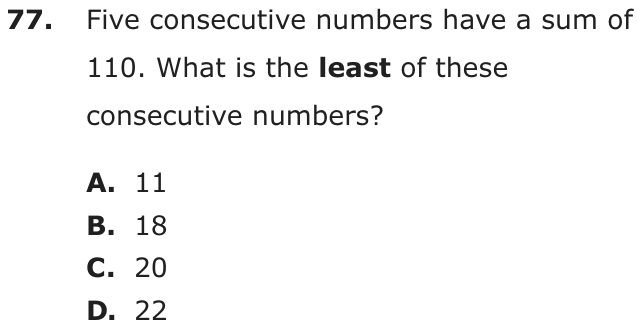
Five consecutive numbers have a sum of 110. What is the least of these consecutive numbers?
- A11
- B18
- C20
- D22
Show the answer
Correct answer: C
Let n represent the least of the five numbers. Then the next four consecutive numbers are , , , . Write an equation to solve for n:
Question analysis
Five consecutive numbers add up to 110, and students find the least of them. This number-properties question can be solved with an equation in one unknown, or by noting that the middle of an odd number of consecutive numbers equals their average. The bold word least matters, because the middle number is easier to find.
- Grade level
- Grade 7 content, by NYS standard
- Compared with grade 7
- At grade 7 A sum of consecutive numbers leads to a two-step equation, standard grade 7 work. The average shortcut makes it quicker, and the only extra demand is answering for the least number rather than the middle one.
- Estimated difficulty
- Straightforward: two steps or one careful reading.
- Thinking it demands
- Depth of knowledge 2, skills and concepts · mainly apply
- What makes it hard
- Solution
- 3 steps
- Reading level
- Question and choices: about grade 5, 15 words.
- Students, last 30 days
- Not enough answers yet to show (it takes 10).
Why it is hard, traps and wrong answers (shows the answer)
Why it is hard
Dividing 110 by 5 is the natural first move, and it gives the middle number, which is a listed choice. The bold word least signals that one more step is needed, counting down two from the middle. The equation route, 5n + 10 = 110, goes straight to the least number but takes longer to set up.
Turning words into math minor Understanding the question
“Consecutive numbers” means each is 1 more than the last, and the bold “least” asks for the first of the five, not the middle one that dividing by 5 gives. (Hegarty, Mayer & Monk, 1995; Koedinger & Nathan, 2004)
Variables instead of numbers minor Understanding the question
None of the five numbers is given, so they must be written as n through n + 4, or pictured as two on each side of a middle value. (Koedinger & Nathan, 2004; Enright, Morley & Sheehan, 2002)
Strategy: Divide 110 by 5 to find the middle of the five numbers, then count down to the least of them.
Traps
- Answers a different question: A choice is right for another quantity: the other unknown, the rest instead of the part, the part instead of the whole.
- Misunderstands the concept: A wrong belief about a concept: that percents can be added, that area grows like length, that averages can be averaged, that a bigger denominator means a bigger fraction.
The wrong answers, classified
A Little reason to choose it (Haladyna & Downing, 1993; Rodriguez, 2005)
No common working gives 11, which is 110 ÷ 10; five consecutive numbers starting at 11 add to only 65, so it mostly draws guesses.
B Misunderstands the concept (Smith, diSessa & Roschelle, 1993; De Bock et al., 1998; Ni & Zhou, 2005)
Steps by 2 as if the numbers were consecutive even numbers, n through n + 8, so 5n + 20 = 110 gives 18.
D Answers a different question (King et al., 2004; Hegarty, Mayer & Monk, 1995)
Divides 110 by 5 to get 22, the middle number, and gives it without counting down to the least number.
Worked solution, step by step
Formulas used
- Consecutive numbers
- Consecutive numbers come one right after another when you count, like 7, 8, 9. Each is 1 more than the one before. If n is the least number, the next ones are n + 1, n + 2, and so on.
Sort out the question
Five consecutive numbers add up to 110. Consecutive means each number is 1 more than the one before. You need the least, or smallest, of the five.
Name the five numbers
Let n be the least number. Then the five numbers are:
Each one is 1 more than the one before it.
Write the sum as an equation
Add all five and set the sum equal to 110.
There are five n’s, which make 5n. The extra numbers add up to 1 + 2 + 3 + 4 = 10.
Solve for n
Subtract 10 from both sides. Then divide both sides by 5.
So the least number is 20.
Give the answer
Watch out: is the middle number, not the least. Picking 22 is choice D. The question asks for the least of the five. So the answer is C, 20.
Check your answer
Write out the five numbers and add them: . The sum matches. Also, the middle number, 22, is 110 ÷ 5, and the least is 2 less than the middle.
More questions like this
The original DOE question