Also in 2025 Practice Test A English, question 54.
Question
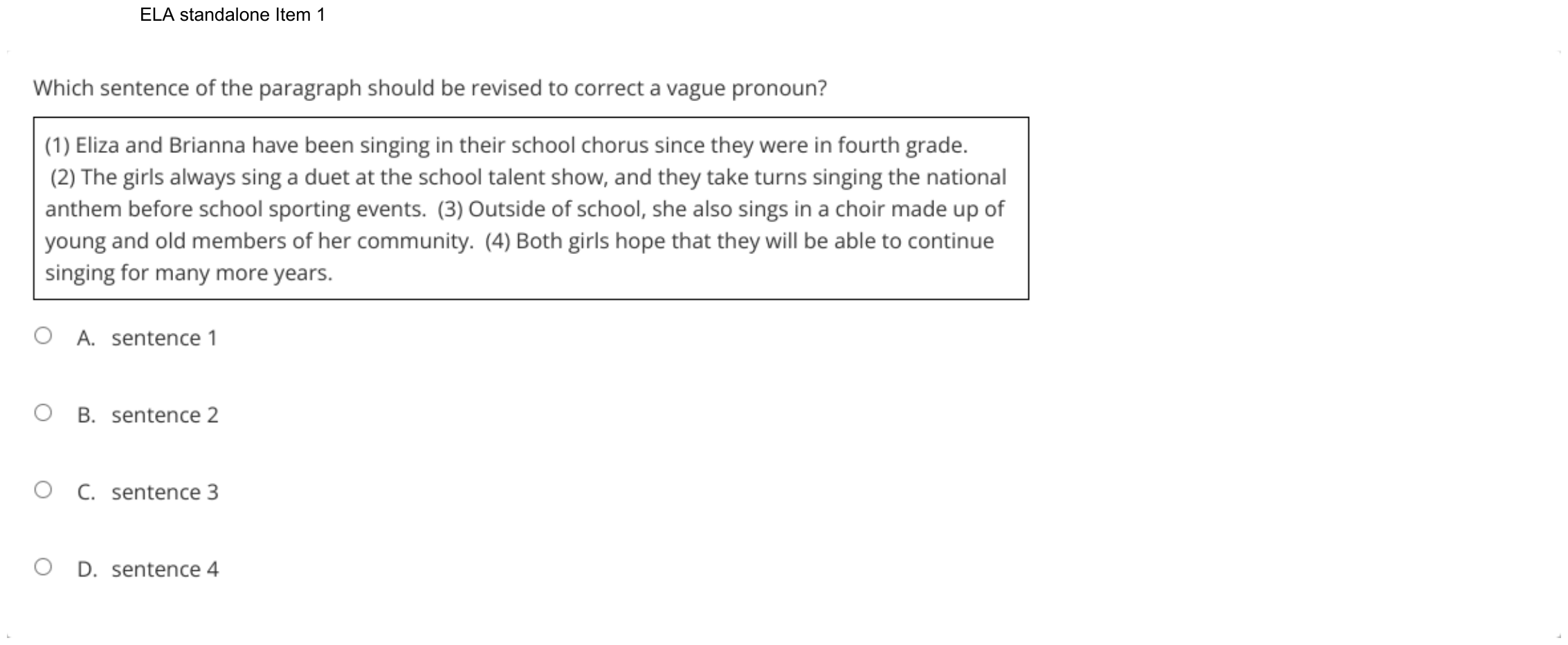
Which sentence of the paragraph should be revised to correct a vague pronoun?
(1) Eliza and Brianna have been singing in their school chorus since they were in fourth grade. (2) The girls always sing a duet at the school talent show, and they take turns singing the national anthem before school sporting events. (3) Outside of school, she also sings in a choir made up of young and old members of her community. (4) Both girls hope that they will be able to continue singing for many more years.
- Asentence 1
- Bsentence 2
- Csentence 3
- Dsentence 4
Show the answer
Correct answer: C
The question asks for identification of the sentence with a vague pronoun.
A. Incorrect. There is no vague pronoun in sentence 1, which correctly uses the plural pronouns “their”/“they” to refer to both Eliza and Brianna.
B. Incorrect. There is no vague pronoun in sentence 2, which uses the pronoun “they” to correctly refer to both girls again.
C. CORRECT. Sentence 3 is the only sentence where the pronoun is vague. The sentence uses the pronoun “she” near the beginning, but whether “she” refers to Eliza or Brianna is unclear.
D. Incorrect. There is no vague pronoun in sentence 4, which uses the pronoun “they” to correctly refer to “both girls.”
Question analysis
This editing question gives a short paragraph about Eliza and Brianna, two girls who have sung in their school chorus since fourth grade, and asks which sentence should be revised to fix a vague pronoun. Students must trace each pronoun back to the person or people it stands for and ask whether a reader could tell who is meant.
- NYS standards
- 7L1 grammar and usage conventions
- Grade level
- Grade 6 reading and task
- Compared with grade 7
- Below grade 7 Recognizing and fixing vague pronouns is taught in grade 6. This paragraph is four short sentences in everyday language with one rule to apply, lighter than the multi-error paragraphs typical of grade 7 editing.
- Estimated difficulty
- Routine: one familiar step, little to misread.
- Thinking it demands
- Depth of knowledge 1, recall and reproduction · mainly apply
- What makes it hard
- Evidence
- Answered from one paragraph or stanza
- Reading level
- Question and choices: about grade 5, 90 words.
- Students, last 30 days
- Not enough answers yet to show (it takes 10).
Why it is hard, traps and wrong answers (shows the answer)
Why it is hard
The paragraph is short, plainly worded and about two named girls, so the one singular pronoun stands out once students look for the person each pronoun stands for. Points are lost mainly by students unsure what “vague” means, who suspect a sentence with several pronouns or a plural “they” instead. Tracing each pronoun back to its noun settles the question in seconds.
Something you must already know minor Working it out
Students must know what makes a pronoun vague: “she” in sentence 3 could mean either Eliza or Brianna, while each plural “they” clearly means both girls. (Anderson & Krathwohl, 2001)
Strategy: Circle every pronoun, draw a line from each to the noun it replaces, and look for one where the line could go to more than one person.
Traps
- Fixes what isn't broken: Changes a part of the sentence that was already correct, while the real error stays; or, where the question asks which sentence has an error or should go, picks one that is correct and belongs.
The wrong answers, classified
A Fixes what isn't broken (Connors & Lunsford, 1988)
Sees two pronouns, “their” and “they,” in the first sentence and suspects confusion, though both are plural and plainly refer to Eliza and Brianna together.
B Fixes what isn't broken (Connors & Lunsford, 1988)
Thinks “The girls” and “they” are too general and wants the names repeated, though both point clearly back to the two girls just named.
D Fixes what isn't broken (Connors & Lunsford, 1988)
Wonders whether “they” could include the choir members of the sentence before, though “Both girls” at the start of sentence 4 fixes who “they” are.
Working it out, step by step
Learn the rule for pronouns
A pronoun is a short word that stands in for a noun, like she, he, they or it. A pronoun is vague when the reader can’t tell who it means. For example: Ana and Lily went to the park, and she fell. Who fell, Ana or Lily? You can’t tell.
Trace each pronoun to its noun
- Sentence 1: “their” and “they” mean both girls, Eliza and Brianna.
- Sentence 2: “they” means “The girls,” both of them.
- Sentence 3: “she” and “her” mean one girl. But which one?
- Sentence 4: “they” means “Both girls.”
Find the vague one
Sentence 3 says, “Outside of school, she also sings in a choir made up of young and old members of her community.” Two girls were just named. “She” could be Eliza or Brianna. The reader can’t tell who sings in the choir.
Show the fix
Replace the pronoun with a name: Outside of school, Brianna also sings in a choir made up of young and old members of her community. It could just as well be Eliza. The point is to name one girl. Now the reader knows who sings in the choir.
Check each choice
- A is wrong. “Their” and “they” are plural, meaning more than one. Both clearly mean the two girls.
- B is wrong. “They” points back to “The girls,” just named.
- C is right. “She” could mean either girl.
- D is wrong. “Both girls” at the start makes “they” clear.
Watch out: Having many pronouns doesn’t make a sentence vague. Sentence 1 has two, but each one is clear.
Choose the answer
Only sentence 3 has a pronoun that could point to two different people. So the answer is C, sentence 3.
Why this answer and not the closest wrong one
Sentence 1 is the closest wrong answer, because it has two pronouns, “their” and “they.” But both are plural, and both mean Eliza and Brianna together. In sentence 3, the singular “she” could mean either girl. So only sentence 3 needs a fix.
More questions like this
The original DOE question