Also in 2025 Practice Test A English, question 56.
Question
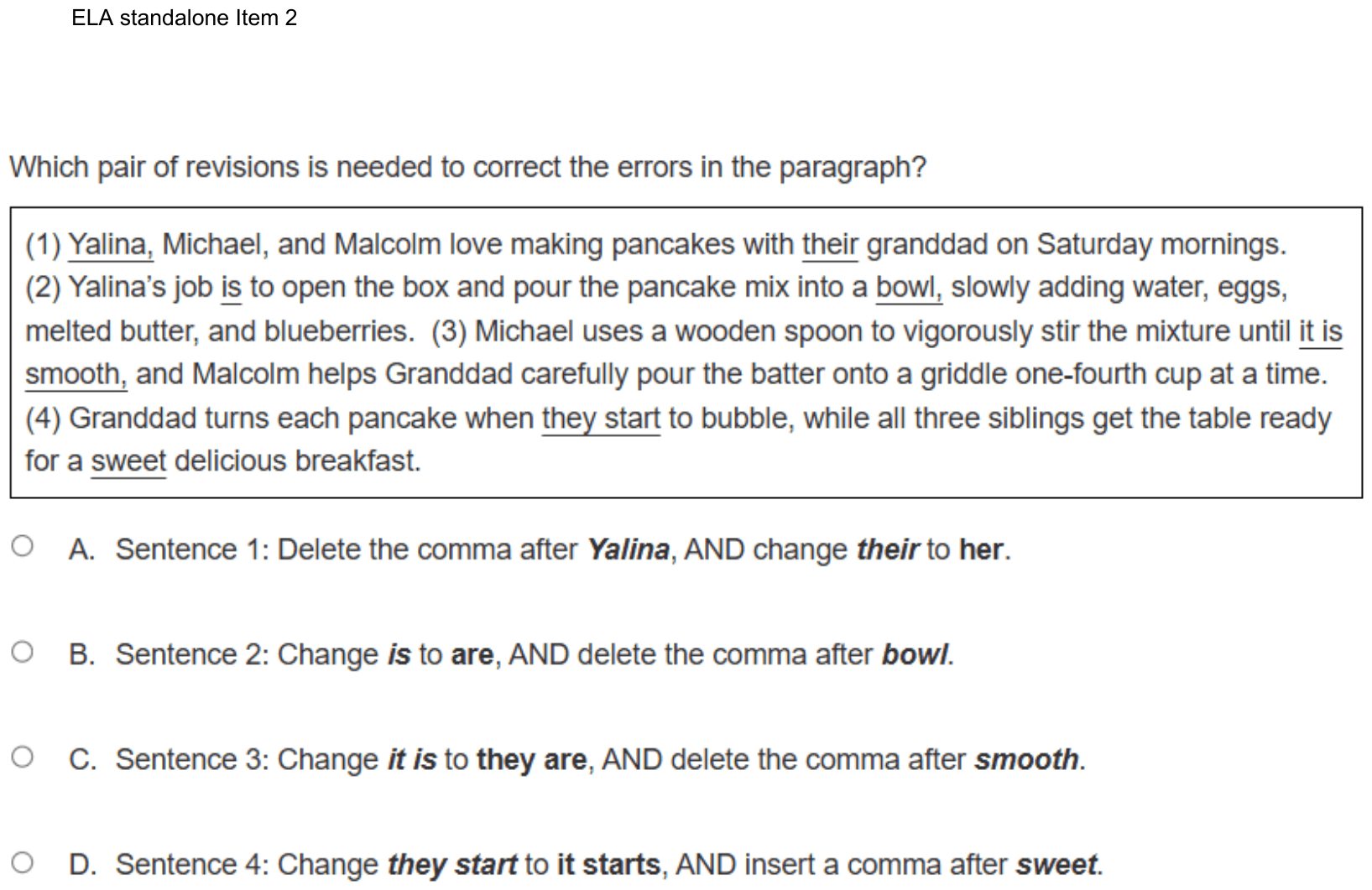
Which pair of revisions is needed to correct the errors in the paragraph?
(1) Yalina, Michael, and Malcolm love making pancakes with their granddad on Saturday mornings. (2) Yalina’s job is to open the box and pour the pancake mix into a bowl, slowly adding water, eggs, melted butter, and blueberries. (3) Michael uses a wooden spoon to vigorously stir the mixture until it is smooth, and Malcolm helps Granddad carefully pour the batter onto a griddle one-fourth cup at a time. (4) Granddad turns each pancake when they start to bubble, while all three siblings get the table ready for a sweet delicious breakfast.
- ASentence 1: Delete the comma after Yalina, AND change their to her.
- BSentence 2: Change is to are, AND delete the comma after bowl.
- CSentence 3: Change it is to they are, AND delete the comma after smooth.
- DSentence 4: Change they start to it starts, AND insert a comma after sweet.
Show the answer
Correct answer: D
The question asks which two revisions are needed to correct the paragraph.
A. Incorrect. The comma is needed after “Yalina” to separate the first and second names in the series of three names (Yalina, Michael, and Malcolm). The possessive determiner “their” is also correct as written because it refers back to “Yalina, Michael, and Malcolm,” a plural group of people.
B. Incorrect. Changing “is” to “are” would introduce an error in subject-verb agreement into the sentence; the singular subject “Yalina’s job” requires the singular verb “is.” The comma after “bowl” is required because it separates the phrase “slowly adding water, eggs, melted butter, and blueberries,” which modifies how Yalina prepares the batter, from the remainder of the sentence.
C. Incorrect. “It is” refers to the singular noun “mixture,” so this singular pronoun and verb form is correct. The comma after “smooth” is necessary because this is a compound sentence where two independent clauses (“Michael uses a wooden spoon to vigorously stir the mixture until it is smooth” and “Malcolm helps Granddad carefully pour the batter onto a griddle one-fourth cup at a time”) are joined using a coordinating conjunction, which requires a comma.
D. CORRECT. The plural pronoun “they” refers incorrectly to a singular antecedent, “each pancake.” The pronoun should be changed to a singular one to match its antecedent. A comma is needed between two adjectives of equal importance that modify the noun “breakfast.” Because “sweet” and “delicious” could be written as “sweet and delicious,” they are of equal importance, and a comma is needed.
Question analysis
This editing question gives a four-sentence paragraph about three siblings making blueberry pancakes with their granddad and asks which pair of revisions corrects its errors. Eight words or commas are underlined, and each choice bundles a pronoun or verb change with a comma change in one sentence, so a choice is right only if both of its edits are needed.
- Grade level
- Grade 7 reading and task
- Compared with grade 7
- At grade 7 Pronoun and verb agreement and comma use are grade 6 and 7 conventions. Checking eight underlined spots across four long sentences, and accepting a pair only when both edits are needed, matches typical grade 7 editing.
- Estimated difficulty
- Moderate: several steps, or a close reading with one strong distractor.
- Thinking it demands
- Depth of knowledge 2, skills and concepts · mainly apply
- What makes it hard
- A rule that doesn't sound wrong moderate
- Every choice must be checked moderate
- Evidence
- Answered from one paragraph or stanza
- Reading level
- Question and choices: about grade 8, 149 words.
- Students, last 30 days
- Not enough answers yet to show (it takes 10).
Why it is hard, traps and wrong answers (shows the answer)
Why it is hard
The errors sit together in the paragraph's last sentence, and neither is heard easily, so students who judge by ear look for problems elsewhere. The strongest pull applies two familiar but wrong rules, no comma before “and” and a plural pronoun for a mixture of several ingredients, to a sentence that is already correct. The question rewards testing each pronoun against its noun and each comma against a rule before reading the pairs.
A rule that doesn't sound wrong moderate Working it out
Both real errors sound natural: “each pancake … when they start to bubble” passes because several pancakes are cooking, and “sweet delicious breakfast” seldom sounds as if it needs a comma between its adjectives. (Connors & Lunsford, 1988)
Every choice must be checked moderate Choosing the answer
Eight underlined spots are paired into four proposed revisions, one pair per sentence, and a pair is right only if both of its edits fix real errors, so every edit has to be tried in place. (Embretson & Wetzel, 1987)
Strategy: Before reading the choices, test each underlined spot yourself: find what each pronoun and verb refers to, and decide whether each comma is needed. Then look for the pair whose two edits both fix real errors.
Traps
- Fixes what isn't broken: Changes a part of the sentence that was already correct, while the real error stays; or, where the question asks which sentence has an error or should go, picks one that is correct and belongs.
- Agreement: A verb that does not agree with its subject, or a pronoun that does not agree with the word it stands for.
- Punctuation: A comma, semicolon, colon, dash or apostrophe used where it does not belong, or missing where it does.
The wrong answers, classified
A Fixes what isn't broken (Connors & Lunsford, 1988)
Deletes the comma after the first of three names in a series and changes “their” to “her,” though the pronoun refers to all three siblings.
B Agreement (Connors & Lunsford, 1988)
Counts two tasks, opening the box and pouring, and wants the plural “are,” though the subject is the singular “job,” and drops the comma before “slowly adding.”
C Punctuation (Connors & Lunsford, 1988)
Applies the rule that a comma never comes before “and,” though this one joins two complete clauses, and makes “it” plural for the ingredients, though it means the mixture.
Working it out, step by step
Figure out what the question asks
Eight spots are underlined. Each choice offers two changes in one sentence. A choice is right only if both of its changes fix real errors. So test each underlined spot yourself first.
Test sentence 1
Commas go between the items in a list of three or more: ham, eggs, and toast. So the comma after “Yalina” is needed. “Their” is plural, and it means all three kids, so it is correct too. Nothing needs fixing here, so A is out.
Test sentence 2
A verb must match its subject, the word the sentence is about. Here the subject is “Yalina’s job,” one job, so “is” is right. Example: My chore is easy, not My chore are easy. The comma after “bowl” is needed too. It shows that “slowly adding water” tells what Yalina does. Without it, the bowl seems to be adding the water. So B is out.
Test sentence 3
“It” means “the mixture,” one thing, so “it is” is correct. The comma after “smooth” comes before “and.” When and joins two complete sentences, put a comma before it. Example: I made the salad, and Dad grilled the fish. Here both halves are complete: Michael stirs, and Malcolm pours. So C is out.
Watch out: Some students learn that a comma never goes before and. That is not true when and joins two complete sentences. Believing it leads to C.
Fix the pronoun in sentence 4
A pronoun must match its noun in number. One thing takes it, and more than one takes they. Here the noun is “each pancake,” one at a time. So “they start” should be “it starts.” Example: Each cookie is done when it turns brown.
Watch out: Many pancakes are on the griddle, so they sounds fine. But each means you are talking about one pancake at a time.
Fix the comma in sentence 4
Two describing words of equal weight need a comma between them. Test: can you put and between them, or swap them? Sweet and delicious breakfast and delicious, sweet breakfast both work. So write sweet, delicious breakfast. Compare three small dogs. You can’t say three and small dogs, so no comma there.
Choose the answer
Both changes in sentence 4 fix real errors. Fixed, it reads: Granddad turns each pancake when it starts to bubble, while all three siblings get the table ready for a sweet, delicious breakfast. So the answer is D.
Why this answer and not the closest wrong one
C is the closest wrong answer. It relies on two wrong ideas: that a comma never comes before and, and that a mix of many ingredients needs they. But the comma joins two complete sentences, and “it” means the one mixture. Only D’s two changes both fix real errors.
More questions like this
The original DOE question