Question
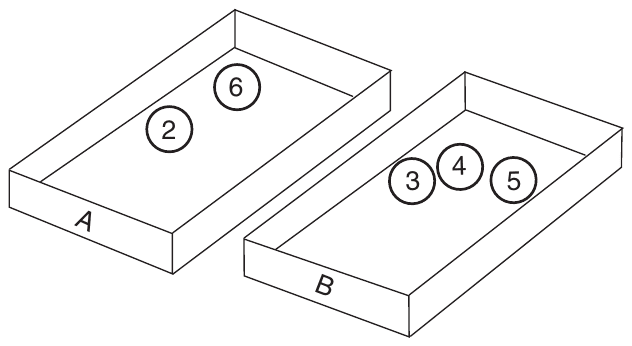
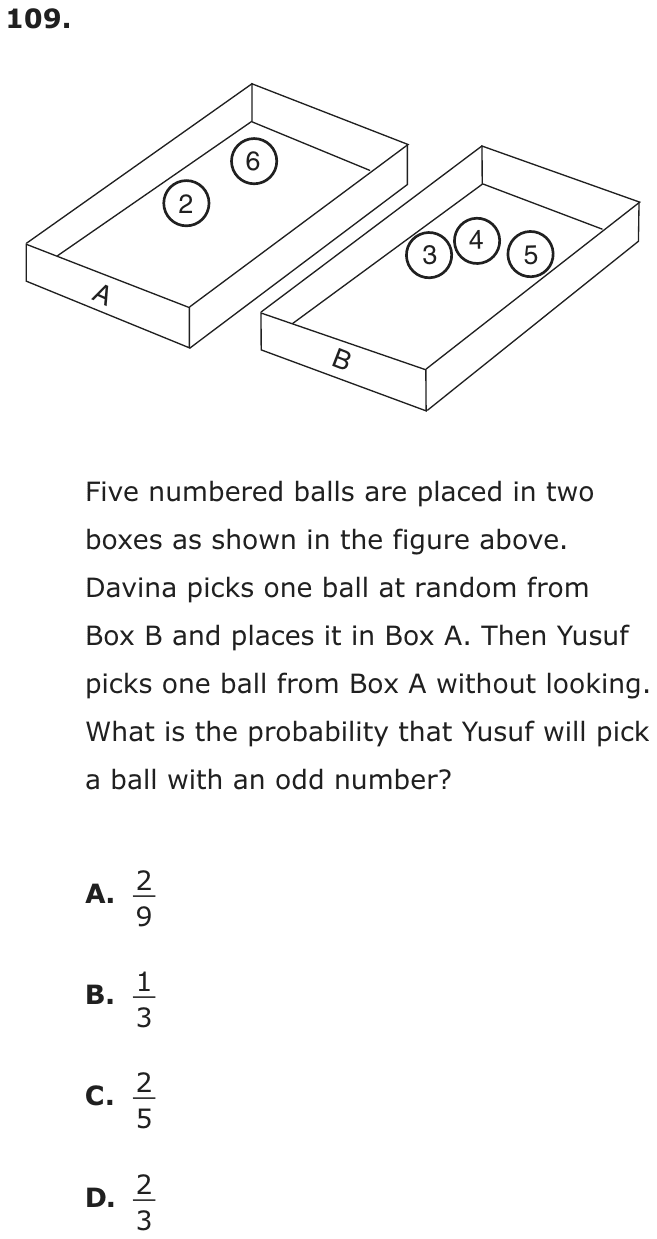
Five numbered balls are placed in two boxes as shown in the figure above. Davina picks one ball at random from Box B and places it in Box A. Then Yusuf picks one ball from Box A without looking. What is the probability that Yusuf will pick a ball with an odd number?
- A
- B
- C
- D
Show the answer
Correct answer: A
The probability of Davina picking an odd-numbered ball from Box B is . If Davina places an odd-numbered ball in Box A, then the probability of Yusuf picking an odd-numbered ball from Box A is . The probability of both of these events happening is the product of the two probabilities.
Question analysis
Two boxes hold five numbered balls, and Davina moves one ball at random from Box B into Box A before Yusuf draws one from Box A. Students find the probability that Yusuf's ball shows an odd number. It tests two-stage probability, and the tricky part is that the second draw depends on which ball was moved.
- NYS standards
- Grade level
- Grade 7 content, by NYS standard
- Compared with grade 7
- Above grade 7 Grade 7 compound probability lists outcomes for independent stages such as coins or spinners. Here the first random move changes what is in the second box, so students must follow two linked stages, a dependence typical grade 7 work does not include.
- Estimated difficulty
- Among the hardest on the SHSAT: a non-obvious approach, heavy reading, or a well-hidden trap.
- Thinking it demands
- Depth of knowledge 3, strategic thinking · mainly analyze
- What makes it hard
- Solution
- 3 steps
- Reading level
- Question and choices: about grade 4, 57 words.
- Students, last 30 days
- Not enough answers yet to show (it takes 10).
Why it is hard, traps and wrong answers (shows the answer)
Why it is hard
Two chance events are hidden in what reads like a question about a single draw. Every listed wrong answer is a reasonable single-stage answer, either one of the two factors on its own or a count of odd balls across both boxes. Listing the nine equally likely pairs, Davina's ball and then Yusuf's, shows that only two of them end with an odd ball and makes the structure visible without any formula.
No obvious method major Working it out
The stem asks one question about Yusuf's draw, but the answer depends on Davina's earlier random pick; the key is that Box A starts with only even balls, so Yusuf can draw odd only by drawing the ball she moved. (Schoenfeld, 1985)
Something you must already know minor Working it out
Multiplying the chances of the two stages, 2/3 for an odd ball moving and 1/3 for Yusuf then drawing it, is a rule students must bring themselves. (Anderson & Krathwohl, 2001)
Reading a figure, table or graph minor Understanding the question
The numbers appear only in the figure, Box A holding 2 and 6 and Box B holding 3, 4 and 5, so the odd balls have to be spotted there. (Lesh, Post & Behr, 1987; Kirsch & Mosenthal, 1990)
Strategy: List every equally likely pair of a ball moved by Davina and a ball picked by Yusuf, and count the pairs that end with an odd ball.
Traps
- Stops one step early: A choice is a number from partway through the solution.
- Numbers taken from the question: Combines the numbers in the question without a model of the situation, or is simply a number that appears in the question.
The wrong answers, classified
B Stops one step early (King et al., 2004; Gierl et al., 2017)
Finds Yusuf's chance of drawing the odd ball once one is in Box A, 1 out of 3, leaving out the chance that Davina moves an odd ball at all.
C Numbers taken from the question (Hegarty, Mayer & Monk, 1995)
Counts the odd balls in the figure, 3 and 5, over all five balls, 2/5, ignoring that Yusuf draws only from Box A.
D Stops one step early (King et al., 2004; Gierl et al., 2017)
Gives the chance that Davina moves an odd ball, 2 out of 3, the first stage only, without multiplying by Yusuf's 1/3 chance of drawing it.
Worked solution, step by step
Formulas used
- Probability
- P is the probability, the chance that something happens. It is a number from 0 to 1. The top counts the results you want. The bottom counts all the results that can happen. It works when every result is equally likely.
- Chance of events in a row
- A and B are two events that happen one after the other. P(A) is the chance of the first. P(B after A) is the chance of the second, counting only what is left after the first. You multiply because the second must also happen inside the share of times the first did.
Read the figure
Box A holds balls numbered 2 and 6. Box B holds balls numbered 3, 4 and 5.
An odd number does not divide evenly by 2. So the only odd balls are 3 and 5, and both start in Box B. Box A starts with no odd balls at all.
Spot the two chance events
Two things happen by chance, one after the other:
- Davina picks one of the 3 balls in Box B and moves it to Box A.
- Then Yusuf picks one of the 3 balls now in Box A.
Yusuf gets an odd ball only if both go right. Davina must move an odd ball. Then Yusuf must pick that very ball.
The question asks only about Yusuf. But his chance depends on Davina’s pick, which comes first.
Find the chance for Davina’s pick
Box B has 3 balls, and 2 of them, the 3 and the 5, are odd.
If she moves the 4 instead, Box A holds only even balls. Then Yusuf can’t get an odd ball at all.
Find the chance for Yusuf’s pick
Say Davina moved an odd ball. Box A now holds 3 balls: the 2, the 6 and that one odd ball.
Watch out: alone is choice B. It forgets that Davina might move the 4.
Multiply the two chances
Both events must happen, so use the rule for events in a row.
Watch out: alone, choice D, stops after Davina’s pick. , choice C, counts 2 odd balls out of all 5. But Yusuf picks only from Box A.
So the answer is A, .
Check your answer
List all 9 equally likely outcomes. Davina can move 3, 4 or 5. Then Yusuf picks one of 3 balls.
| Ball moved | Box A then | Odd picks |
|---|---|---|
| 3 | 2, 6, 3 | 1 |
| 4 | 2, 6, 4 | 0 |
| 5 | 2, 6, 5 | 1 |
That is 2 odd picks out of 9, or .
More questions like this
The original DOE question