Also in 2025 Practice Test B Math, question 18.
Question
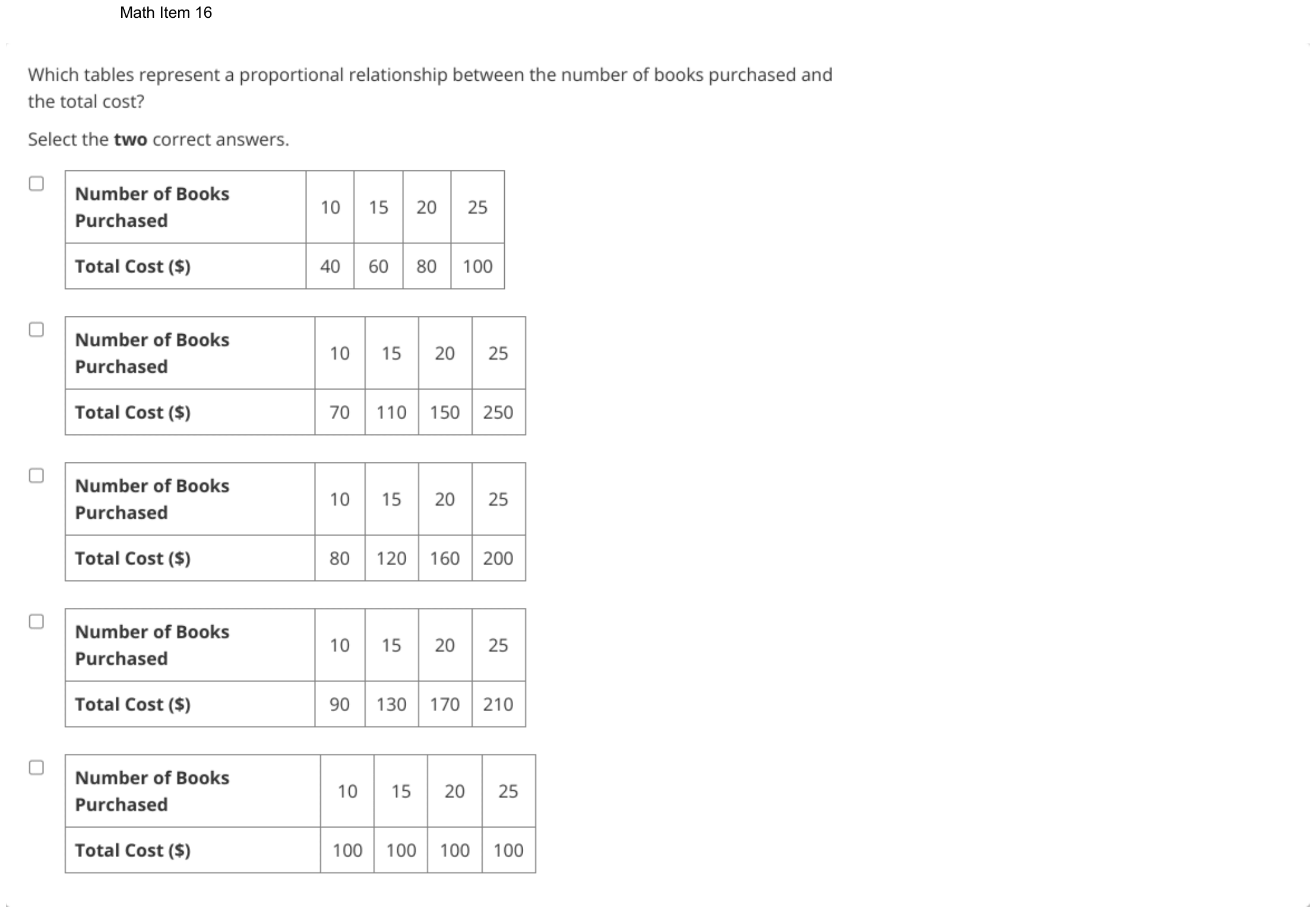
Which tables represent a proportional relationship between the number of books purchased and the total cost?
Select the two correct answers.
Choose every answer that is correct, then check. The DOE has not published how answers with several parts are scored; this site counts one right only when every part is right.
- A
Number of Books Purchased 10 15 20 25 Total Cost ($) 40 60 80 100 - B
Number of Books Purchased 10 15 20 25 Total Cost ($) 70 110 150 250 - C
Number of Books Purchased 10 15 20 25 Total Cost ($) 80 120 160 200 - D
Number of Books Purchased 10 15 20 25 Total Cost ($) 90 130 170 210 - E
Number of Books Purchased 10 15 20 25 Total Cost ($) 100 100 100 100
Show the answer
Correct answer: A and C
The two tables that represent a proportional relationship are tables A and C.
In table A, the total costs divided by the numbers of books for each set of quantities are:
These ratios are equivalent; therefore, these quantities are in a proportional relationship.
In table C, the total costs divided by the numbers of books for each set of quantities are:
These ratios are equivalent; therefore, these quantities are in a proportional relationship.
Question analysis
Five tables list the total cost of buying 10, 15, 20 and 25 books, and students select the two tables that show a proportional relationship between books and cost. It tests recognizing proportional relationships from a constant unit rate. A steady rise in cost is not enough on its own, so each pair of values has to be checked.
- Grade level
- Grade 7 content, by NYS standard
- Compared with grade 7
- At grade 7 Deciding from a table whether two quantities are proportional is a core grade 7 skill, and the divisions here are easy. The demand lies in checking every column of five tables rather than judging by how the costs change.
- Estimated difficulty
- Straightforward: two steps or one careful reading.
- Thinking it demands
- Depth of knowledge 2, skills and concepts · mainly apply
- What makes it hard
- A very close wrong answer moderate
- Every choice must be checked minor
- Something you must already know minor
- Solution
- 2 steps
- Reading level
- Question and choices: about grade 5, 51 words.
- Students, last 30 days
- Not enough answers yet to show (it takes 10).
Why it is hard, traps and wrong answers (shows the answer)
Why it is hard
The divisions are easy, so the question tests what proportional means. Three tables grow by the same amount for every 5 books, and the one with a $10 head start looks just as regular as the right one it copies; only its cost per book, drifting from $9 down to $8.40, gives it away. The flat $100 table and the one that jumps to $250 catch fewer students, and dividing the first and last column of each table is a quick, reliable check.
A very close wrong answer moderate Choosing the answer
The table running $90, $130, $170, $210 is the $80-to-$200 table with $10 added to every cost; both climb $40 for each 5 books, and only the cost per book separates them. (Embretson & Wetzel, 1987; Gorin & Embretson, 2006; Ascalon et al., 2007)
Every choice must be checked minor Choosing the answer
Five tables of four columns each have to be tested by dividing cost by books, and both right tables must be picked to score, so no table can be judged from one column. (Embretson & Wetzel, 1987)
Something you must already know minor Working it out
Students must know that proportional means the same cost per book in every column, a line through zero, not merely a cost that grows by the same amount each time. (Anderson & Krathwohl, 2001)
Strategy: Divide the total cost by the number of books in every column of each table; a table is proportional only when that cost per book stays the same all the way across.
Traps
- Misunderstands the concept: A wrong belief about a concept: that percents can be added, that area grows like length, that averages can be averaged, that a bigger denominator means a bigger fraction.
The wrong answers, classified
B Misunderstands the concept (Smith, diSessa & Roschelle, 1993; De Bock et al., 1998; Ni & Zhou, 2005)
Sees the cost climb $40 for each 5 books across the first three columns and stops checking, though the cost per book goes $7, about $7.33, $7.50, then $10.
D Misunderstands the concept (Smith, diSessa & Roschelle, 1993; De Bock et al., 1998; Ni & Zhou, 2005)
Takes the steady rise of $40 for every 5 books as proportional, but 90 ÷ 10 = 9 while 210 ÷ 25 = 8.4, so the cost per book is not constant.
E Misunderstands the concept (Smith, diSessa & Roschelle, 1993; De Bock et al., 1998; Ni & Zhou, 2005)
Mistakes a cost that never changes for a constant ratio, though $100 for 10 books is $10 a book and $100 for 25 books is $4 a book.
Worked solution, step by step
Formulas used
- Cost per book
- This is the unit rate, the price of one book. Divide the total cost in dollars by the number of books bought. If every book has the same price, this number comes out the same in every column.
- A proportional relationship
- x is the number of books, and y is the total cost in dollars. k is the cost per book, a number that never changes. In a proportional relationship, y is always k times x. So 0 books cost $0, and twice as many books cost twice as much.
Sort out the question
Each table shows the total cost of 10, 15, 20 and 25 books. Proportional means the cost per book is the same in every column. In other words, each book has one fixed price. You must pick the two tables where that is true.
Test the first table
Divide each total cost by its number of books. For table A:
Every column gives $4 per book. So table A is proportional.
Test the other four tables
Do the same division for every table. The numbers are dollars per book:
Table 10 books 15 books 20 books 25 books Same? A 4 4 4 4 Yes B 7 about 7.33 7.50 10 No C 8 8 8 8 Yes D 9 about 8.67 8.50 8.40 No E 10 about 6.67 5 4 No Only tables A and C keep the same price all the way across.
Watch for steady growth
Watch out: table D climbs $40 for every 5 more books, just like table C. That steady climb looks proportional, but it is not enough. D starts $10 higher than C, so its price per book slides from $9 down to $8.40.
Watch out: table E never changes. But $100 for 10 books is $10 each, and $100 for 25 books is $4 each. A total that stays the same is not a price that stays the same.
Name the two answers
Table A charges $4 per book and table C charges $8 per book, in every column. On the test, you check the box next to each of those tables. So the answers are A and C.
Check your answer
In a proportional table, twice the books cost twice as much. In table A, 10 books cost $40 and 20 books cost $80, which is double. In table C, $80 doubles to $160. In table D, $90 would have to double to $180, but the table shows $170. So D fails.
More questions like this
The original DOE question