Also in 2026 Practice Test B Math, question 15; 2025 Practice Test B Math, question 17.
Question
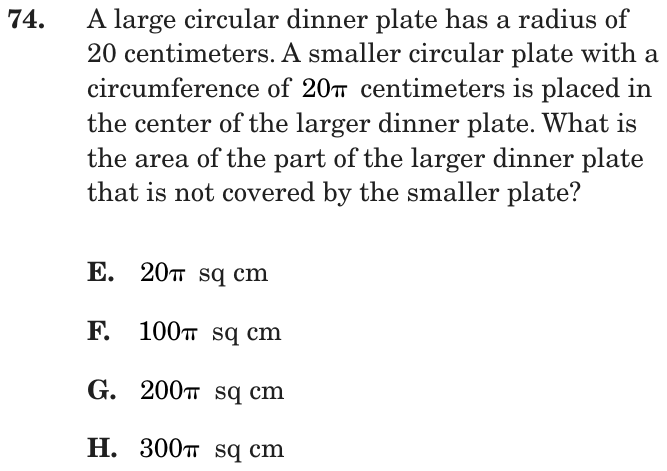
A large circular dinner plate has a radius of 20 centimeters. A smaller circular plate with a circumference of centimeters is placed in the center of the larger dinner plate. What is the area of the part of the larger dinner plate that is not covered by the smaller plate?
- A sq cm
- B sq cm
- C sq cm
- D sq cm
Show the answer
Correct answer: D
The radius of the large plate is 20 cm. Use that to find the area of the large plate:
The circumference of the smaller plate is 20π cm. Use that to find the radius, and then the area, of the smaller plate:
Subtract the area of the small plate from the area of the large plate:
400π − 100π = 300π sq cm
Question analysis
This circle question places a smaller plate, described by its circumference, on a larger dinner plate described by its radius, and asks for the area of the large plate left uncovered. Students recall the circumference and area formulas, find the small radius and subtract areas. Because the two plates are described in different ways, circumference and area have to be kept apart.
- NYS standards
- 7.G.4 circle area and circumference
- Grade level
- Grade 7 content, by NYS standard
- Compared with grade 7
- At grade 7 Applying circle area and circumference formulas is the grade 7 standard, and subtracting one area from another is a common grade 7 exercise. Working backward from a circumference adds one step but no new content.
- Estimated difficulty
- Moderate: several steps, or a close reading with one strong distractor.
- Thinking it demands
- Depth of knowledge 2, skills and concepts · mainly apply
- What makes it hard
- Many steps moderate
- Something you must already know moderate
- Solution
- 4 steps
- Reading level
- Question and choices: about grade 6, 62 words.
- Students, last 30 days
- Not enough answers yet to show (it takes 10).
Why it is hard, traps and wrong answers (shows the answer)
Why it is hard
The question describes the two plates in different measures, one by radius and one by circumference, so students must convert before they can compare. The trap is a halving argument: the small circumference is half the large one, but the area it covers is only a quarter. Students who keep both areas in terms of π and subtract finish quickly; those who reason from the circumferences alone go wrong.
Many steps moderate Working it out
The chain runs through four stages: the large area 400π, the small radius 10 from the circumference 20π, the small area 100π, then the uncovered difference. (Daniel & Embretson, 2010; Enright, Morley & Sheehan, 2002)
Something you must already know moderate Working it out
Neither formula is given: students need C = 2πr to recover the small plate's radius and A = πr² for both areas. (Anderson & Krathwohl, 2001)
Strategy: Use C = 2πr to get the small plate's radius, find both areas with A = πr², keep everything in terms of π, and subtract.
Traps
- Answers a different question: A choice is right for another quantity: the other unknown, the rest instead of the part, the part instead of the whole.
- A formula you must know: Needs a formula the test does not give: area, circumference, volume, probability rules.
The wrong answers, classified
A Wrong formula (King et al., 2004)
Works with circumferences instead of areas, subtracting the small plate's 20π from the large plate's 40π.
B Answers a different question (King et al., 2004; Hegarty, Mayer & Monk, 1995)
Finds the area of the smaller plate, the part that is covered, instead of the part of the large plate left uncovered.
C Misunderstands the concept (Smith, diSessa & Roschelle, 1993; De Bock et al., 1998; Ni & Zhou, 2005)
Reasons that a circumference half as long covers half the area, so takes half of 400π, not seeing that area scales with the square.
Worked solution, step by step
Formulas used
- Circumference of a circle
- C is the circumference, the distance around the circle. r is the radius, the distance from the center to the edge. π, said “pie,” is a number a little more than 3. The distance around is always about 6.28 times the radius.
- Area of a circle
- A is the area, the space inside the circle. r is the radius. r² means r times r. π is about 3.14. The radius is squared because area spreads out in two directions.
Write down what you know
The big plate has a radius of 20 cm. The radius is the distance from the center to the edge.
The small plate has a circumference of 20π cm. Circumference is the distance around a circle.
You need the area of the big plate that the small plate does not cover. Area is the space inside a shape.
Find the big plate's area
The big plate is 400π sq cm. Keep π as a symbol, because the choices use it.
Find the small plate's radius
You know the small plate’s circumference, not its radius. Use the circumference formula to work back.
Divide both sides by 2π. That leaves . The small radius is 10 cm.
Find the small plate's area
Use the area formula again, with the small radius.
The small plate covers 100π sq cm.
Watch out: 100π is the covered part. The question asks for the part not covered, so do not stop at choice B.
Subtract to find the uncovered part
The uncovered area is 300π sq cm.
Watch out: Do not subtract the distances around the plates. That gives 40π − 20π = 20π, choice A.
So the answer is D, 300π sq cm.
Check your answer
The small radius is half the big radius. So the small area is of the big area. That leaves three quarters uncovered: . It matches.
More questions like this
The original DOE question