Question
PRICES FOR NEWSPAPER ADVERTISING
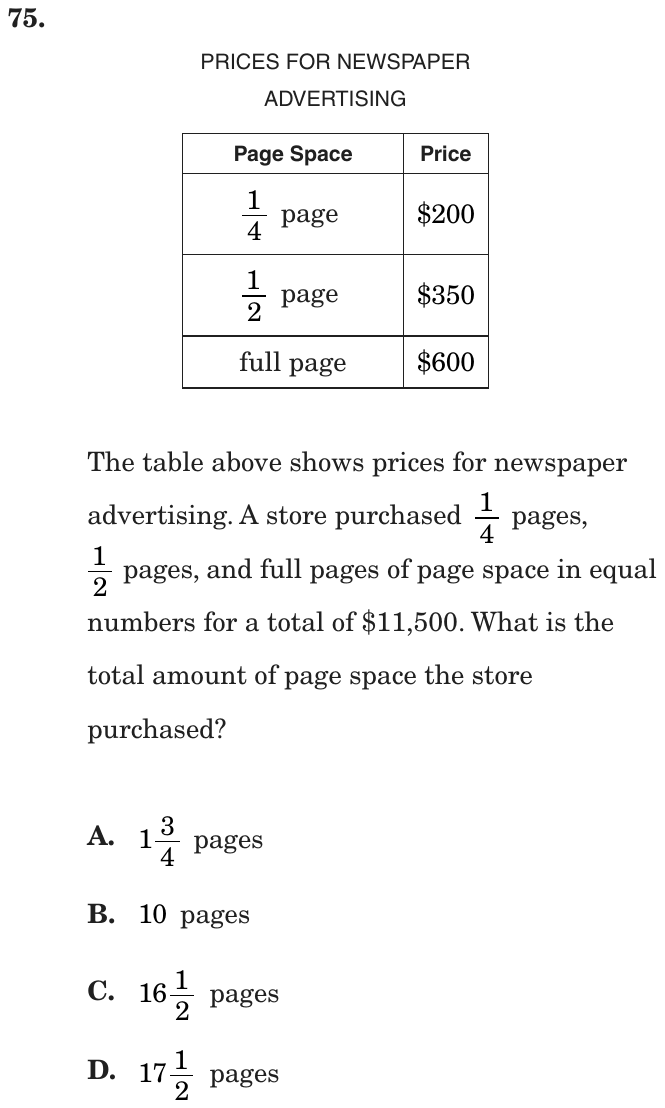
| Page Space | Price |
| page | $200 |
| page | $350 |
| full page | $600 |
The table above shows prices for newspaper advertising. A store purchased pages, pages, and full pages of page space in equal numbers for a total of $11,500. What is the total amount of page space the store purchased?
- A pages
- B10 pages
- C pages
- D pages
Show the answer
Correct answer: D
The question says that an equal number () of each type of page space was purchased. To find the number of each type of page space that was purchased, multiply the price per type by and set it equal to the total amount spent, then solve for :
Thus, the store purchased 10 units of each type of page space. To find the total amount of page space purchased, multiply each type of page space by 10, and add:
Question analysis
This word problem gives a table of newspaper advertising prices for quarter-page, half-page and full-page ads, and says a store bought equal numbers of each for a set total. Students write and solve an equation for how many ads of each size were bought. The question wants total page space, which takes a second calculation with fractions.
- Grade level
- Grade 7 content, by NYS standard
- Compared with grade 7
- Above grade 7 Grade 7 students write and solve equations like px = r from word problems. This adds a table, combines three prices into one coefficient and needs a second step with fractions after solving, a longer chain than typical grade 7 work.
- Estimated difficulty
- Hard: combines ideas, needs a plan, and has more than one tempting wrong answer.
- Thinking it demands
- Depth of knowledge 2, skills and concepts · mainly apply
- What makes it hard
- Many steps major
- Turning words into math moderate
- Reading a figure, table or graph minor
- Solution
- 4 steps
- Reading level
- Question and choices: about grade 5, 59 words.
- Corrected from the DOE handbook
- An arithmetic slip in the explanation was corrected.
- Students, last 30 days
- Not enough answers yet to show (it takes 10).
Why it is hard, traps and wrong answers (shows the answer)
Why it is hard
Solving for the number of ads is the obvious goal, and finding it feels like the finish, but the question asks for page space, which needs one more pass through the table. The awkward wording about buying pages in equal numbers slows students before any arithmetic starts. The wrong choices mark each place to stop: one set of ads, the number of each ad, or a slip in adding the fractional pages.
Many steps major Working it out
The work has two phases: turn the money into a count, 1,150x = 11,500 so x = 10, then turn the count into space by multiplying 10 by 1/4, 1/2 and 1 and adding. (Daniel & Embretson, 2010; Enright, Morley & Sheehan, 2002)
Turning words into math moderate Understanding the question
The phrase “purchased 1/4 pages, 1/2 pages, and full pages of page space in equal numbers” has to be read as the same number of ads of each size, so the three prices add to one coefficient. (Hegarty, Mayer & Monk, 1995; Koedinger & Nathan, 2004)
Reading a figure, table or graph minor Understanding the question
Both columns of the table are needed: the price column builds the equation, and the page-space column turns the count of ads into the final total. (Lesh, Post & Behr, 1987; Kirsch & Mosenthal, 1990)
Strategy: Let x be the number of each ad size, add the three prices to write one equation for the total, solve it, then multiply x by the page space in one set of ads.
Traps
- Stops one step early: A choice is a number from partway through the solution.
- Answers a different question: A choice is right for another quantity: the other unknown, the rest instead of the part, the part instead of the whole.
The wrong answers, classified
A Answers a different question (King et al., 2004; Hegarty, Mayer & Monk, 1995)
Adds 1/4 + 1/2 + 1, the page space in one set of the three ads, without using the $11,500 to find how many sets were bought.
B Stops one step early (King et al., 2004; Gierl et al., 2017)
Solves 1,150x = 11,500 for the number of ads of each size and stops there instead of converting the count to page space.
C An arithmetic slip (Junker & Sijtsma, 2001)
Takes ten quarter pages as 1 1/2 pages instead of 2 1/2, so adds 1 1/2 + 5 + 10.
What was corrected from the DOE handbook, and why
- Explanation: The handbook adds 200x + 350x + 600x and writes 1,500x = 11,500. The sum is 1,150x, and the handbook’s next line, x = 10, only follows from 1,150x = 11,500. The site shows 1,150x = 11,500.
Worked solution, step by step
Formulas used
- Number of equal sets
- A set here means one ad of each size. The cost of one set is what one of each costs together. Dividing the total money by it tells how many sets were bought, because every set costs the same.
Sort out the question
The store bought the same number of each ad size: quarter page, half page and full page. It spent $11,500 in all.
You need the total page space. That is not the number of ads, and not the money.
Find the cost of one set
Think of one quarter page, one half page and one full page as a set. The store bought equal numbers of each, so it bought whole sets.
One set costs $1,150.
Find how many sets
The store bought 10 sets. That means 10 ads of each size.
Watch out: 10 is the number of each ad, not the page space. Stopping here gives choice B.
Find the page space in one set
Add the sizes in one set. Write them in quarters so they have the same bottom number.
One set is , or , pages.
Watch out: pages is only one set. That is choice A.
Multiply by the number of sets
There are 10 sets, so multiply the space in one set by 10.
So the answer is D, pages.
Check your answer
Add the sizes another way. 10 quarter pages make 2.5 pages, not 1.5. 10 half pages make 5 pages. 10 full pages make 10 pages. Then , the same answer.
More questions like this
The original DOE question