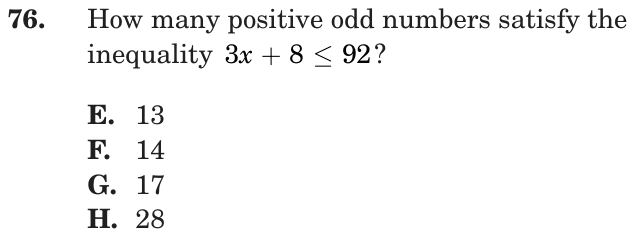
Question
How many positive odd numbers satisfy the inequality ?
- A13
- B14
- C17
- D28
Show the answer
Correct answer: B
Solve the inequality for x.
3x + 8 ≤ 92
3x ≤ 84
x ≤ 28
The positive odd numbers less than or equal to 28 are 1, 3, 5, …, 25, and 27. There are 14 of them.
Question analysis
This question asks how many positive odd numbers satisfy the two-step inequality 3x + 8 ≤ 92. Students solve the inequality and then count the odd whole numbers in the solution. The counting after the algebra is where errors creep in, especially at the end of the list.
- Grade level
- Grade 7 content, by NYS standard
- Compared with grade 7
- At grade 7 Solving a two-step inequality is grade 7 work. Asking for a count of the odd solutions adds a number-property step and an endpoint check, but the total demand stays close to a typical grade 7 problem.
- Estimated difficulty
- Moderate: several steps, or a close reading with one strong distractor.
- Thinking it demands
- Depth of knowledge 2, skills and concepts · mainly apply
- What makes it hard
- A very close wrong answer moderate
- Combines ideas minor
- Solution
- 3 steps
- Reading level
- Question and choices: about grade 16, 9 words.
- Corrected from the DOE handbook
- The explanation’s description of the solutions was corrected.
- Students, last 30 days
- Not enough answers yet to show (it takes 10).
Why it is hard, traps and wrong answers (shows the answer)
Why it is hard
Solving the inequality is routine, and that is the trap: x ≤ 28 looks like an answer and 28 is among the choices. The real task is counting odd numbers from 1 to 27, where the usual shortcut, (27 − 1) ÷ 2, misses the first term. Pairing each odd number with the even number after it, up to 28, gives the count directly and avoids the fencepost slip.
A very close wrong answer moderate Choosing the answer
13 and 14 differ by one, and a rough count of the odd numbers up to 27 cannot separate them; only counting both ends, 1 and 27, gives the exact 14. (Embretson & Wetzel, 1987; Gorin & Embretson, 2006; Ascalon et al., 2007)
Combines ideas minor Working it out
Solving 3x + 8 ≤ 92 is only half the work; counting the positive odd whole numbers up to 28 is a separate number-sense task. (Embretson, 1998; Daniel & Embretson, 2010)
Strategy: Solve the inequality as you would an equation, keeping the direction of the sign, then count odd numbers from 1 up to the boundary by pairing or halving.
Traps
- Counting the ends: Inclusive or exclusive ends, fence posts, consecutive numbers: an answer that is one too many or too few, or an endpoint drawn open where it belongs closed (or the reverse).
- Stops one step early: A choice is a number from partway through the solution.
The wrong answers, classified
A Counting the ends (Brown & Burton, 1978)
Counts the odd numbers from 1 to 27 as (27 − 1) ÷ 2 = 13, forgetting to add one for the first term.
C A faulty procedure (Brown & Burton, 1978; Tatsuoka, 1983)
Moves the 8 across without changing its sign, solving 3x ≤ 100, and counts the odd numbers up to 33.
D Stops one step early (King et al., 2004; Gierl et al., 2017)
Solves the inequality to x ≤ 28 and gives the boundary 28 instead of counting the positive odd numbers up to it.
What was corrected from the DOE handbook, and why
- Explanation: The handbook solves the inequality to x ≤ 28 and then lists “the positive odd numbers less than 28.” The solutions include 28 itself, so the site says “less than or equal to 28.” The count does not change, because 28 is even: the odd numbers are still 1, 3, 5, …, 27, which is 14 numbers.
Worked solution, step by step
Formulas used
- Solving an inequality
- a, b and c are numbers. The sign ≤ means less than or equal to. You may subtract the same number from both sides. You may also divide both sides by the same positive number. The sign stays the same either way.
- Counting odd numbers
- n is an even number. Split the numbers from 1 to n into pairs: 1 and 2, 3 and 4, and so on. There are n ÷ 2 pairs, and each pair holds exactly one odd number.
Sort out the question
You need to count the positive odd numbers that make true.
The sign ≤ means is less than or equal to. Positive means greater than 0. Odd numbers are 1, 3, 5, 7, and so on.
Solve the inequality
Solve it like an equation. Subtract 8 from both sides. Then divide both sides by 3. Dividing by a positive number keeps the sign the same.
Watch out: 28 is the largest x allowed, not the count. That trap is choice D.
List the odd numbers
The positive odd numbers up to 28 are 1, 3, 5, and so on, up to 25 and 27. The number 28 is even, so it does not count.
Count them by pairing
Split 1 to 28 into pairs: 1 and 2, 3 and 4, and so on, up to 27 and 28. Each pair has one odd number.
Watch out: Working out counts the jumps of 2 from 1 to 27, not the numbers. You must add 1 for the first number. That mistake gives choice A.
So the answer is B, 14.
Check your answer
Test the edges. For x = 27: , which is at most 92, so it works. For x = 29: , which is too big. So 27 is the last odd number that works.
More questions like this
The original DOE question