Question
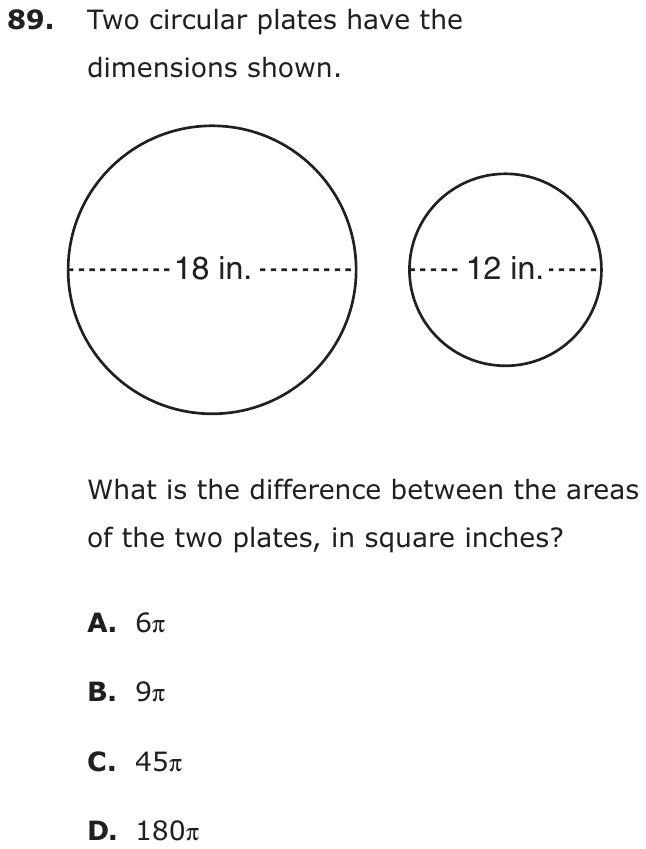
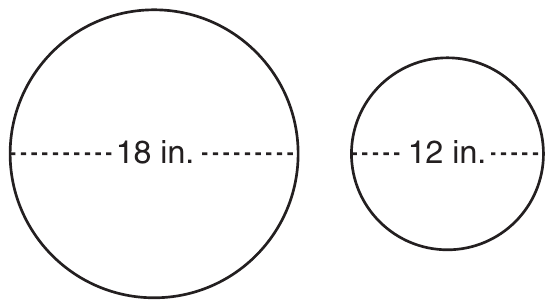
Two circular plates have the dimensions shown.
What is the difference between the areas of the two plates, in square inches?
- A
- B
- C
- D
Show the answer
Correct answer: C
First, determine the area of each circle using the formula :
A circle with a diameter of 18 inches has a radius of 9 inches, so the area is .
A circle with a diameter of 12 inches has a radius of 6 inches, so the area is .
The difference between the two areas is .
Question analysis
Two circular plates are drawn with their diameters marked in inches, and students find the difference between their areas in square inches, in terms of pi. It tests the area of a circle. The diameters, not the radii, are marked, so a step comes before the area formula, which the test does not provide.
- NYS standards
- 7.G.4 circle area and circumference
- Grade level
- Grade 7 content, by NYS standard
- Compared with grade 7
- At grade 7 Finding a circle's area is a grade 7 standard, and this asks for two areas and their difference. It matches typical classwork: the formula must be recalled and each diameter halved first, with no further twist.
- Estimated difficulty
- Straightforward: two steps or one careful reading.
- Thinking it demands
- Depth of knowledge 1, recall and reproduction · mainly apply
- What makes it hard
- Solution
- 3 steps
- Reading level
- Question and choices: about grade 5, 25 words.
- Students, last 30 days
- Not enough answers yet to show (it takes 10).
Why it is hard, traps and wrong answers (shows the answer)
Why it is hard
Two area calculations and a subtraction, kept in terms of π, make this routine for students who know the area formula. Points are lost by using the labeled diameters as radii, by subtracting circumferences, or by subtracting the radii before squaring, and each of these has a listed answer. Writing both areas, 81π and 36π, before subtracting avoids all three.
Something you must already know moderate Working it out
The area formula A = πr² is not given, and the figure labels each plate by its diameter, so 18 and 12 must be halved to radii of 9 and 6 first. (Anderson & Krathwohl, 2001)
Reading a figure, table or graph minor Understanding the question
The dashed lines run all the way across each circle, which marks them as diameters; reading the 18 in. and 12 in. as radii leads to a listed choice. (Lesh, Post & Behr, 1987; Kirsch & Mosenthal, 1990)
Strategy: Halve each diameter to get the radius, find each plate's area as pi times the radius squared, and subtract the smaller area from the larger.
Traps
- Wrong formula: Uses a related but wrong formula: perimeter for area, diameter for radius, area for volume, or a misremembered one.
- A faulty procedure: A systematic but wrong procedure: adding fractions straight across, applying an exponent to each term of a sum, dropping a sign when moving a term.
- A formula you must know: Needs a formula the test does not give: area, circumference, volume, probability rules.
The wrong answers, classified
A Wrong formula (King et al., 2004)
Subtracts the circumferences, 18π − 12π = 6π, using πd, the distance around a circle, in place of the area formula.
B A faulty procedure (Brown & Burton, 1978; Tatsuoka, 1983)
Subtracts the radii first, 9 − 6 = 3, and then squares, π(3)² = 9π, as if the difference of two squares were the square of the difference.
D Wrong formula (King et al., 2004)
Uses the labeled diameters as radii, π(18)² − π(12)² = 324π − 144π = 180π, forgetting to halve them first.
Worked solution, step by step
Formulas used
- Area of a circle
- A is the area, the flat space inside the circle. r is the radius, the distance from the center to the edge. It is half the diameter. π (pi) is a fixed number, about 3.14. r² means r × r. Use it for the space inside any circle.
Sort out the question
Each dashed line goes all the way across its circle, through the center. A line like that is a diameter. The big plate has a diameter of 18 inches. The small plate has a diameter of 12 inches.
You need the difference between the two areas. That means the big area minus the small area, in square inches.
Find each radius
The area formula uses the radius, not the diameter. The radius is half the diameter.
The radii are 9 inches and 6 inches. Watch out: If you use 18 and 12 as the radii, you get , choice D.
Find the big plate’s area
The big plate’s area is square inches. Keep π as a symbol, since all the choices use π.
Find the small plate’s area
The small plate’s area is square inches. Squaring means multiplying a number by itself, so .
Subtract the two areas
Subtract the numbers in front of π, just as 81 apples minus 36 apples is 45 apples. The difference is square inches.
Watch out: Don’t subtract the radii first. Squaring 9 − 6 = 3 gives , choice B. Subtracting the distances around the plates, , gives , choice A. That uses the wrong formula.
So the answer is C, .
Check your answer
Estimate with π about 3. The big plate is about square inches. The small one is about . The difference is about 135, and . It matches.
More questions like this
The original DOE question