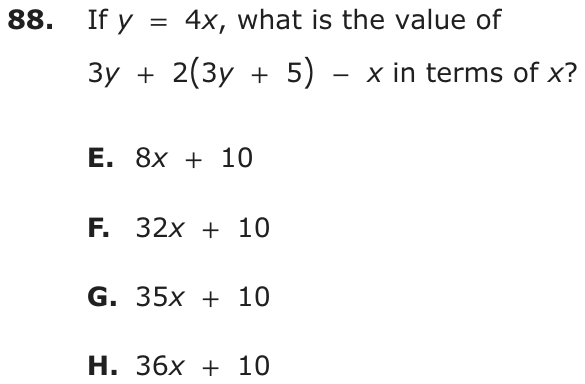
Question
If , what is the value of in terms of x?
- A
- B
- C
- D
Show the answer
Correct answer: C
First, substitute for each y in the expression:
Then simplify the expression:
The simplified expression is .
Question analysis
Given that y equals 4x, students rewrite the expression 3y + 2(3y + 5) − x using only x. It tests substitution, the distributive property and combining like terms. Errors creep in when a term is dropped or when x terms and y terms are merged before y has been replaced.
- NYS standards
- Grade level
- Grade 7 content, by NYS standard
- Compared with grade 7
- At grade 7 Substituting an expression for a variable and simplifying with the distributive property is standard grade 7 work. Putting the substitution inside parentheses calls for care, but the steps are routine for students who combine like terms fluently.
- Estimated difficulty
- Straightforward: two steps or one careful reading.
- Thinking it demands
- Depth of knowledge 1, recall and reproduction · mainly apply
- What makes it hard
- A very close wrong answer moderate
- Error-prone arithmetic minor
- Solution
- 3 steps
- Reading level
- Question and choices: about grade 7, 16 words.
- Students, last 30 days
- Not enough answers yet to show (it takes 10).
Why it is hard, traps and wrong answers (shows the answer)
Why it is hard
Substitution and distribution are routine here, so points are lost to bookkeeping rather than method. The expression has three x pieces, 12x, 24x and a lone − x, and the last is easy to overlook after the larger terms. The other two wrong choices come from collecting 3y, 6y and x as if they were like terms, a reason to replace y with 4x before simplifying anything.
A very close wrong answer moderate Choosing the answer
Every choice ends in + 10, and 36x + 10 differs from 35x + 10 by a single x, so only remembering the last − x in the expression separates them. (Embretson & Wetzel, 1987; Gorin & Embretson, 2006; Ascalon et al., 2007)
Error-prone arithmetic minor Working it out
The substitution sits inside nested grouping, 2[3(4x) + 5], so the 2 must reach both the 12x and the 5 before the x terms are collected. (Brown & Burton, 1978; Junker & Sijtsma, 2001)
Strategy: Replace every y with 4x in parentheses before doing anything else, then distribute the 2 and collect the x terms and the constant separately.
Traps
- A faulty procedure: A systematic but wrong procedure: adding fractions straight across, applying an exponent to each term of a sum, dropping a sign when moving a term.
- Stops one step early: A choice is a number from partway through the solution.
The wrong answers, classified
A A faulty procedure (Brown & Burton, 1978; Tatsuoka, 1983)
Collects 3y + 6y − x as 8 of a single variable, treating x and y as like terms, and writes the result as 8x without substituting 4x.
B A faulty procedure (Brown & Burton, 1978; Tatsuoka, 1983)
Combines 3y + 6y − x into 8y, as if x and y were like terms, and only then substitutes 4x for y, giving 32x + 10.
D Stops one step early (King et al., 2004; Gierl et al., 2017)
Substitutes and distributes correctly to reach 12x + 24x + 10 = 36x + 10, then stops before subtracting the final x.
Worked solution, step by step
Formulas used
- Distributive property
- a is the number outside the parentheses. b and c are the terms inside. Terms are the parts joined by plus or minus signs. Multiply a by each term inside. It works because 2 groups of (12x + 5) hold 2 of the 12x and 2 of the 5.
Sort out the question
means y is always 4 times x. You need to rewrite the expression with no y in it. That is what “in terms of x” means. The answer will use only x and numbers.
Replace each y with 4x
Put 4x in parentheses everywhere you see y. The parentheses keep the multiplying clear.
3(4x) means 3 times 4x, which is 12x. It shows up twice.
Multiply out the parentheses
Use the distributive property. The 2 must multiply both the 12x and the 5.
The whole expression is now:
Combine the like terms
Like terms have the same letter part. Here the x terms are 12x, 24x and −x. The −x means take away one x.
The 10 has no x, so it stays as it is. The result is .
Watch out: Don’t forget the −x at the end. Stopping at 12x + 24x gives 36x + 10, choice D. Also, swap in 4x before you combine. Adding 3y, 6y and −x as if they were all y’s mixes unlike terms. It leads to choice B.
So the answer is C, .
Check your answer
Test a number. Let x = 1, so y = 4. The original expression gives . Your answer gives . They match. Choice D would give 46.
More questions like this
The original DOE question