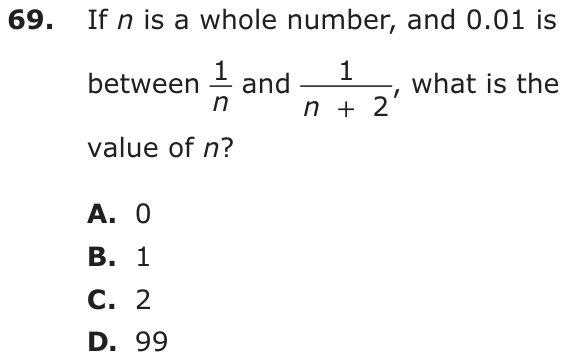
Question
If n is a whole number, and 0.01 is between and , what is the value of n?
- A0
- B1
- C2
- D99
Show the answer
Correct answer: D
, which is between and .
Therefore, and .
Question analysis
A number sense question: 0.01 lies between 1 over n and 1 over n + 2, where n is a whole number, and students find n. It tests comparing a decimal with unit fractions and knowing how a fraction changes as its denominator grows. The unusual form, with n in two denominators, is what slows students down.
- Grade level
- Grade 6 content, by NYS standard
- Compared with grade 7
- At grade 7 Grade 7 students compare fractions and decimals routinely, but not with an unknown in the denominators. The comparison is simple once 0.01 is written as a fraction; the unfamiliar setup is the main demand.
- Estimated difficulty
- Straightforward: two steps or one careful reading.
- Thinking it demands
- Depth of knowledge 2, skills and concepts · mainly apply
- What makes it hard
- Variables instead of numbers moderate
- Something you must already know minor
- Solution
- 2 steps
- Reading level
- Question and choices: about grade 9, 18 words.
- Students, last 30 days
- Not enough answers yet to show (it takes 10).
Why it is hard, traps and wrong answers (shows the answer)
Why it is hard
The setup looks unfamiliar, with n in two denominators, but one rewrite makes it routine: 0.01 is 1/100, so the two denominators must sit on either side of 100. The three small choices fail a quick check, since every fraction from 1/1 to 1/4 is far above 0.01, and 0 cannot be a denominator at all. Students who test the choices instead of rewriting the decimal spend a little longer but reach the same place.
Variables instead of numbers moderate Understanding the question
The unknown sits in two denominators, n and n + 2, so students must reason about which unit fractions lie on either side of 0.01 rather than solve an equation. (Koedinger & Nathan, 2004; Enright, Morley & Sheehan, 2002)
Something you must already know minor Working it out
Two facts are assumed: 0.01 equals 1/100, and a unit fraction shrinks as its denominator grows, so 1/99 is just above 0.01 and 1/101 just below. (Anderson & Krathwohl, 2001)
Strategy: Rewrite 0.01 as a unit fraction, recall that a larger denominator gives a smaller fraction, and test each choice in both 1/n and 1/(n + 2).
Traps
- Misunderstands the concept: A wrong belief about a concept: that percents can be added, that area grows like length, that averages can be averaged, that a bigger denominator means a bigger fraction.
- Numbers taken from the question: Combines the numbers in the question without a model of the situation, or is simply a number that appears in the question.
The wrong answers, classified
A Misunderstands the concept (Smith, diSessa & Roschelle, 1993; De Bock et al., 1998; Ni & Zhou, 2005)
Treats 1/0 as 0, so 0.01 seems to lie between 0 and 1/2; but division by zero is undefined, so n cannot be 0.
B Numbers taken from the question (Hegarty, Mayer & Monk, 1995)
Takes the 1 from 0.01 or from 1/n as the value of n, without checking that 0.01 is far below both 1 and 1/3.
C Numbers taken from the question (Hegarty, Mayer & Monk, 1995)
Takes the 2 from n + 2, or the two decimal places of 0.01, without testing 1/2 and 1/4, which are both far above 0.01.
Worked solution, step by step
Formulas used
- Comparing unit fractions
- A unit fraction has 1 on top, like one fifth. a and b are positive whole numbers on the bottom. A bigger bottom cuts the whole into more pieces, so each piece is smaller. So the fraction with the bigger bottom is the smaller number.
Sort out the question
n is a whole number: 0, 1, 2, 3 and so on. The number 0.01 is between and . Between means one fraction is bigger than 0.01 and the other is smaller. You need the value of n.
Write 0.01 as a fraction
0.01 means one hundredth.
Now all three numbers are fractions with 1 on top. That makes them easy to compare.
Find fractions on each side
With 1 on top, a bigger bottom makes a smaller fraction.
So is a little more than , and is a little less.
The bottoms 99 and 101 are 2 apart, just like n and n + 2.
Match the fractions to n
The smaller bottom is n, and the larger bottom is n + 2.
Both fit. Watch out: small choices do not work. For n = 1, the fractions are 1 and . Both are far bigger than 0.01. For n = 0, is not a number, because you can’t divide by zero. So the answer is D, 99.
Check your answer
Write the fractions as decimals. , a bit more than 0.01. , a bit less. The sign ≈ means about. So 0.01 sits right between them.
More questions like this
The original DOE question