Question
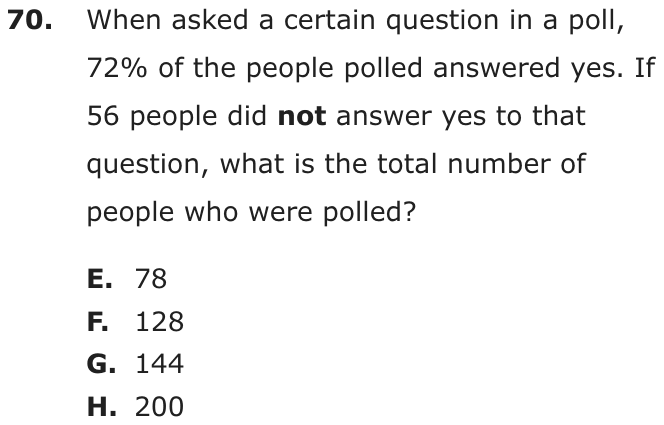
When asked a certain question in a poll, 72% of the people polled answered yes. If 56 people did not answer yes to that question, what is the total number of people who were polled?
- A78
- B128
- C144
- D200
Show the answer
Correct answer: D
72% of the people polled answered yes, so 28% of the people did not answer yes.
Therefore, 56 people is 28% of the total, x.
Question analysis
A percent word problem about a poll: 72% of the people answered yes, and 56 people did not. Students find the total number of people polled. They must first match the 56 people with the right percent and then find the whole from a part, which is where the main slip happens.
- Grade level
- Grade 7 content, by NYS standard
- Compared with grade 7
- At grade 7 Finding a whole from a part and a percent is grade 6 and 7 work. This adds one short step, finding the complementary percent first, which makes it a standard grade 7 multistep percent problem.
- Estimated difficulty
- Moderate: several steps, or a close reading with one strong distractor.
- Thinking it demands
- Depth of knowledge 2, skills and concepts · mainly apply
- What makes it hard
- Turning words into math moderate
- Error-prone arithmetic minor
- Solution
- 2 steps
- Reading level
- Question and choices: about grade 6, 33 words.
- Students, last 30 days
- Not enough answers yet to show (it takes 10).
Why it is hard, traps and wrong answers (shows the answer)
Why it is hard
The only percent printed is 72 and the only count is 56, so the first instinct is to pair them, even though the bold not says they describe different groups. Once 56 is matched with the 28% who did not say yes, a single division finds the total. The listed wrong answers come from that mismatch, from adding the two numbers, and from stopping at the yes count.
Turning words into math moderate Understanding the question
The 56 people are the ones who did not answer yes, so they match 100% − 72% = 28%, not the 72% printed in the sentence before them. (Hegarty, Mayer & Monk, 1995; Koedinger & Nathan, 2004)
Error-prone arithmetic minor Working it out
Finding the total means 56 ÷ 0.28, a division by a decimal; scaling 28% up to 100% at 2 people per percent avoids it. (Brown & Burton, 1978; Junker & Sijtsma, 2001)
Strategy: Subtract 72% from 100% to find the percent who did not answer yes, then find the total that makes 56 equal to that percent.
Traps
- Misreads the question: Misses or misreads a condition or a word in the question: "at least", "each", "remaining", "not".
- Answers a different question: A choice is right for another quantity: the other unknown, the rest instead of the part, the part instead of the whole.
- Misunderstands the concept: A wrong belief about a concept: that percents can be added, that area grows like length, that averages can be averaged, that a bigger denominator means a bigger fraction.
The wrong answers, classified
A Misreads the question (Hegarty, Mayer & Monk, 1995)
Overlooks the bold not and pairs the 56 people with the 72% who said yes: 56 ÷ 0.72 ≈ 77.8, rounded to 78.
B Misunderstands the concept (Smith, diSessa & Roschelle, 1993; De Bock et al., 1998; Ni & Zhou, 2005)
Reads the 72% as a fixed 72 people and adds the 56 who did not say yes, 72 + 56 = 128, instead of treating 72% as a share of the unknown total.
C Answers a different question (King et al., 2004; Hegarty, Mayer & Monk, 1995)
Gets 2 people per percent from 56 ÷ 28 but multiplies by 72 instead of 100, finding the 144 who answered yes rather than everyone polled.
Worked solution, step by step
Formulas used
- Percent of a whole
- The whole is the total amount, here everyone polled. p is the percent. The part is the amount that p percent stands for. Percent means out of 100, so p% is p hundredths of the whole.
Sort out the question
In a poll, 72% of the people answered yes. 56 people did not answer yes. You need the total number of people polled. Notice the bold word not. The 56 people are the ones who did not say yes.
Find the percent who did not say yes
Everyone polled makes 100%. Take away the 72% who said yes.
So 28% did not answer yes. That is the group of 56 people. Watch out: do not match the 56 people with 72%. That leads to about 78, choice A.
Set up the percent equation
Call the total number of people T. The 56 people are 28% of T.
Solve for the total
First find how many people make 1%. Divide 56 people by 28.
So each 1% is 2 people. All 100% is 100 times that.
Watch out: do not multiply 2 by 72. That gives 144, the people who said yes, choice C. So the answer is D, 200.
Check your answer
Find 28% of 200: . That matches the people who did not say yes. Also, 72% of 200 is 144 people who said yes, and , everyone.
More questions like this
The original DOE question