Question
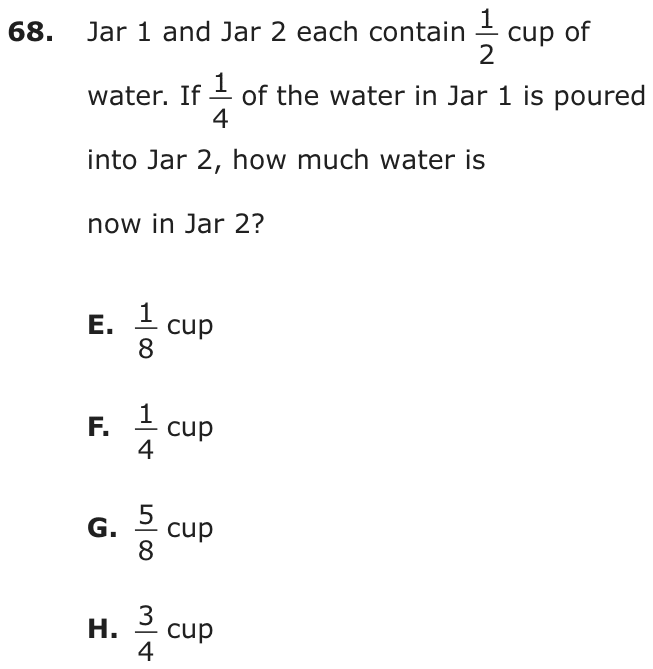
Jar 1 and Jar 2 each contain cup of water. If of the water in Jar 1 is poured into Jar 2, how much water is now in Jar 2?
- A cup
- B cup
- C cup
- D cup
Show the answer
Correct answer: C
Jar 1 starts with cup of water. If of its water is poured into Jar 2, then the amount of water added to Jar 2 is cup.
Jar 2 starts with cup of water. If cup of water is added to it, then the amount of water now in Jar 2 is cup.
Question analysis
A fraction word problem about two jars that each hold half a cup of water; a quarter of the water in the first jar is poured into the second. Students find how much water the second jar now holds. Reading exactly what the quarter is a quarter of is the detail that matters.
- NYS standards
- 7.NS.3 four operations with rational numbers
- Grade level
- Grade 7 content, by NYS standard
- Compared with grade 7
- Below grade 7 Multiplying and adding positive fractions is review by grade 7, and the problem takes two short steps. It is easier than typical grade 7 work with negative numbers or longer rational-number problems, apart from careful reading.
- Estimated difficulty
- Straightforward: two steps or one careful reading.
- Thinking it demands
- Depth of knowledge 2, skills and concepts · mainly apply
- What makes it hard
- Turning words into math moderate
- Error-prone arithmetic minor
- Solution
- 2 steps
- Reading level
- Question and choices: about grade 4, 35 words.
- Students, last 30 days
- Not enough answers yet to show (it takes 10).
Why it is hard, traps and wrong answers (shows the answer)
Why it is hard
The numbers are friendly halves, quarters and eighths, and the work is two steps. The question turns on one phrase: the quarter is a fraction of Jar 1's water, not a measured quarter cup, and reading it the second way gives a choice that looks right. Students who also remember that Jar 2 already held water finish correctly.
Turning words into math moderate Understanding the question
The phrase "1/4 of the water in Jar 1" means a quarter of Jar 1's half cup, an eighth of a cup, not a quarter cup; the word of calls for multiplying. (Hegarty, Mayer & Monk, 1995; Koedinger & Nathan, 2004)
Error-prone arithmetic minor Working it out
Adding the 1/8 cup to Jar 2's 1/2 cup needs the common denominator 8, so 1/2 becomes 4/8 before the sum. (Brown & Burton, 1978; Junker & Sijtsma, 2001)
Strategy: Find the amount poured by taking one quarter of Jar 1's half cup, then add that amount to the half cup already in Jar 2.
Traps
- Stops one step early: A choice is a number from partway through the solution.
- Misreads the question: Misses or misreads a condition or a word in the question: "at least", "each", "remaining", "not".
The wrong answers, classified
A Stops one step early (King et al., 2004; Gierl et al., 2017)
Finds the amount poured, 1/4 of 1/2 cup = 1/8 cup, and stops there instead of adding it to the half cup already in Jar 2.
B Numbers taken from the question (Hegarty, Mayer & Monk, 1995)
Picks the fraction 1/4 straight from the question, as if the share poured were the amount of water now in Jar 2.
D Misreads the question (Hegarty, Mayer & Monk, 1995)
Reads 1/4 of the water as 1/4 cup and adds it to Jar 2's half cup, 1/2 + 1/4 = 3/4.
Worked solution, step by step
Formulas used
- Fraction of an amount
- N is the whole amount, and a over b is the part of it you want. In math, the word of means multiply. For example, half of 10 is one half times 10, which is 5.
- Multiplying fractions
- a and c are the tops, and b and d are the bottoms. Multiply the tops together and the bottoms together. Taking a part of a part makes the pieces smaller, so the bottom gets bigger.
- Adding fractions with the same bottom
- a and b are the tops, and d is the shared bottom, called the denominator. If the bottoms match, add the tops and keep the bottom. If they do not match, rewrite one fraction first.
Sort out the question
Each jar starts with cup of water. You pour “ of the water in Jar 1” into Jar 2. You need how much water is in Jar 2 after that, in cups.
Find how much water is poured
Jar 1 has cup. You pour of it. Of means multiply.
You pour cup. Watch out: a quarter of the water is not a quarter cup. It is a quarter of a half cup. Adding cup gives cup, choice D.
Make the bottoms match
Now add the poured water to the cup already in Jar 2. The bottoms are 2 and 8, so rewrite the half with 8 on the bottom. Multiply its top and bottom by 4.
Add the water in Jar 2
Jar 2 now holds cup. Watch out: cup is only the water poured in. Stopping there gives choice A. So the answer is C, cup.
Check your answer
Jar 2 started with a half cup and got a little more. So it should hold just over a half cup, and is. Also, the water in both jars still adds up to 1 cup: Jar 1 has cup left, and .
More questions like this
The original DOE question