Question
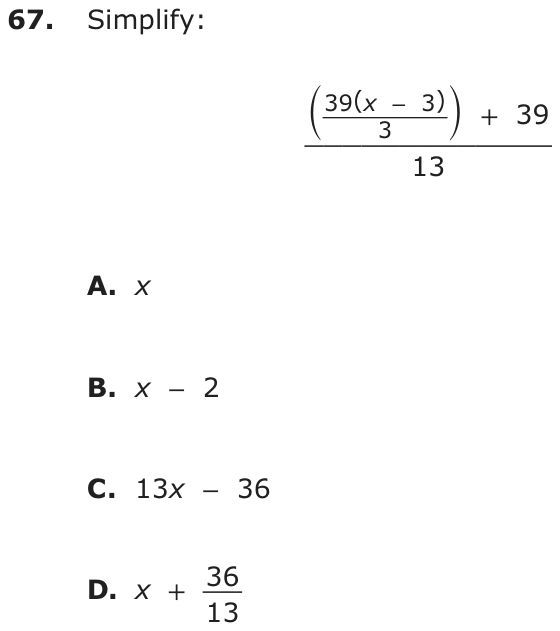
Simplify:
- A
- B
- C
- D
Show the answer
Correct answer: A
Divide the first 39 by 3.
Distribute 13 through .
In the numerator, the terms −39 and 39 cancel out.
Finally, divide the numerator and denominator by 13 to get x.
Question analysis
An algebra question that asks students to simplify a stacked fraction: 39 times (x − 3) over 3, plus 39, all divided by 13. It tests dividing, distributing and combining like terms in the right order. The nested fraction bars make it easy to divide only some of the terms or to distribute to only one.
- NYS standards
- Grade level
- Grade 7 content, by NYS standard
- Compared with grade 7
- At grade 7 Grade 7 students expand and simplify linear expressions such as 13(x − 3) + 39. This wraps that work inside two fraction bars, which adds reading load and chances to misstep but no new mathematics.
- Estimated difficulty
- Straightforward: two steps or one careful reading.
- Thinking it demands
- Depth of knowledge 1, recall and reproduction · mainly apply
- What makes it hard
- Error-prone arithmetic moderate
- Many steps minor
- Solution
- 3 steps
- Reading level
- Question and choices: about grade 16+, 6 words.
- Students, last 30 days
- Not enough answers yet to show (it takes 10).
Why it is hard, traps and wrong answers (shows the answer)
Why it is hard
The expression looks heavier than it is: every number is a multiple of 13, and the constants cancel to leave a single term. What makes it risky is scope, knowing which terms each fraction bar and each multiplier covers. Each wrong choice comes from stretching or shrinking that scope by one term, so working outward from the innermost parentheses, one line per step, is the safe way.
Error-prone arithmetic moderate Working it out
Two fraction bars are nested: 39 ÷ 3 applies only to the first term, the 13 must reach both x and −3, and only then does the whole numerator divide by 13. (Brown & Burton, 1978; Junker & Sijtsma, 2001)
Many steps minor Working it out
Four moves come in a fixed order, divide 39 by 3, distribute 13, cancel −39 with +39, divide by 13, and each is a chance to apply a step to the wrong terms. (Daniel & Embretson, 2010; Enright, Morley & Sheehan, 2002)
Strategy: Work from the inside out: divide 39 by 3, distribute through the parentheses, combine the constants in the numerator, and only then divide everything by 13.
Traps
- A faulty procedure: A systematic but wrong procedure: adding fractions straight across, applying an exponent to each term of a sum, dropping a sign when moving a term.
- Order of operations: Working left to right, or distributing a minus sign wrongly, gives a choice.
The wrong answers, classified
B Order of operations (Brown & Burton, 1978)
Reads the inner fraction bar as covering the added 39 too, so the numerator becomes 13(x − 3) + 13 = 13x − 26, and dividing by 13 gives x − 2.
C Order of operations (Brown & Burton, 1978)
Divides only the last 39 by 13, leaving 13(x − 3) + 3 = 13x − 36, as if the outer fraction bar covered a single term.
D A faulty procedure (Brown & Burton, 1978; Tatsuoka, 1983)
Distributes the 13 to x but not to −3, so the numerator becomes 13x − 3 + 39 = 13x + 36, and dividing by 13 leaves a fraction.
Worked solution, step by step
Formulas used
- Distributive property
- a is the number outside the parentheses. b and c are the terms inside. Multiply a by each term inside, and keep the minus sign between them. It works because a groups of (b − c) are a groups of b, take away a groups of c.
Sort out the expression
You need to simplify the big fraction, which means write it in its shortest form. It has a small fraction inside its top. The top is , and the bottom is 13. Work from the inside out, one step at a time.
Divide the first 39 by 3
The small fraction bar is only under . So divide just that 39 by 3.
Now the top is . Watch out: the small bar does not reach the added 39. Dividing that 39 by 3 as well leads to , choice B.
Multiply out the parentheses
Watch out: multiply the 3 by 13 too, not just the x. Leaving −3 as it is leads to choice D.
Combine the plain numbers on top
−39 and 39 add up to 0, so they cancel. The top is now just 13x, which means 13 times x.
Divide by the bottom
Now divide the whole top by 13. Dividing by 13 undoes times 13.
Watch out: the long bar is under the whole top. Dividing only the last 39 by 13 gives , choice C. So the answer is A, .
Check your answer
Try x = 5. Then and . Next, and . Last, . You get back 5, the same as x. So x is right.
More questions like this
The original DOE question