Question
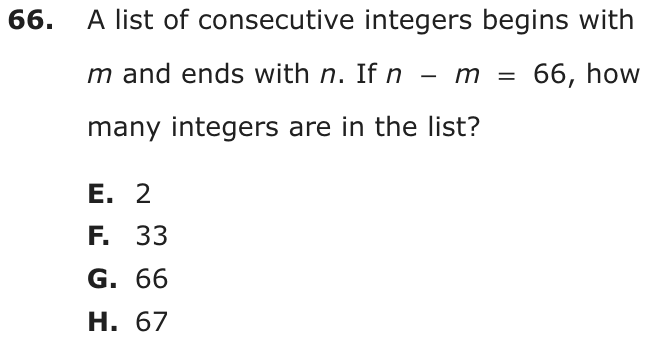
A list of consecutive integers begins with m and ends with n. If , how many integers are in the list?
- A2
- B33
- C66
- D67
Show the answer
Correct answer: D
Consider the case where .
The list of integers from 1 to 67 contains 67 numbers.
Question analysis
A number question about a list of consecutive integers that starts at m and ends at n, where n minus m is 66. Students decide how many integers the list contains. The tricky part is relating the difference between the two ends to the number of integers in the list.
- Grade level
- Grade 7 content, by NYS standard
- Compared with grade 7
- At grade 7 Consecutive integers and differences are familiar grade 7 ideas, and the arithmetic is trivial. What keeps this at grade 7 rather than below it is the counting trap, which needs a moment of careful reasoning.
- Estimated difficulty
- Moderate: several steps, or a close reading with one strong distractor.
- Thinking it demands
- Depth of knowledge 2, skills and concepts · mainly apply
- What makes it hard
- A very close wrong answer moderate
- Variables instead of numbers moderate
- Solution
- 2 steps
- Reading level
- Question and choices: about grade 7, 21 words.
- Students, last 30 days
- Not enough answers yet to show (it takes 10).
Why it is hard, traps and wrong answers (shows the answer)
Why it is hard
The arithmetic is trivial, so the question tests one idea: the number of integers from m to n is one more than their difference, because both ends belong to the list. The stem supplies 66 ready-made, and taking it as the count is the natural first reaction. A five-number list, 1 to 5, whose ends differ by 4, shows the extra one in seconds.
A very close wrong answer moderate Choosing the answer
The choices 66 and 67 differ by one, and 66 is the difference the stem hands over; only counting both ends of the list separates them. (Embretson & Wetzel, 1987; Gorin & Embretson, 2006; Ascalon et al., 2007)
Variables instead of numbers moderate Understanding the question
The list is given only by its ends, m and n, so the count has to be reasoned out in general, or checked on a small list such as 1 through 5. (Koedinger & Nathan, 2004; Enright, Morley & Sheehan, 2002)
Strategy: Try a small list you can count, such as 1 through 5, and compare its count with the difference between its first and last numbers.
Traps
- Counting the ends: Inclusive or exclusive ends, fence posts, consecutive numbers: an answer that is one too many or too few, or an endpoint drawn open where it belongs closed (or the reverse).
The wrong answers, classified
A Little reason to choose it (Haladyna & Downing, 1993; Rodriguez, 2005)
No common working counts only the two named ends, m and n, in a list said to hold consecutive integers, so 2 mostly draws guesses.
B Misunderstands the concept (Smith, diSessa & Roschelle, 1993; De Bock et al., 1998; Ni & Zhou, 2005)
Halves 66, as if consecutive integers went up by 2 like consecutive odd or even numbers, so the list held only every other integer.
C Counting the ends (Brown & Burton, 1978)
Takes the difference of the ends as the count, forgetting that a list from m to n includes both m and n.
Worked solution, step by step
Formulas used
- Counting consecutive integers
- m is the first number in the list and n is the last. n − m counts the steps from each number to the next. A list always has one more number than it has steps, so you add 1. This works for any list that goes up by 1.
Sort out the question
Integers are whole numbers and their negatives, like −2, 0 and 5. Consecutive integers come one after another, going up by 1, like 4, 5, 6. The list starts at m and ends at n. The difference is 66. You need how many integers are in the list.
Try a small list
Letters are hard to count, so try a list you can count: 1, 2, 3, 4, 5. Here m = 1 and n = 5.
But the list has 5 numbers, not 4. The difference counts the steps: 1 to 2, 2 to 3, 3 to 4 and 4 to 5. Both ends are in the list, so there is one more number than steps.
Use the counting rule
Watch out: 66 is the difference, not the count. Choosing 66, choice C, leaves out one end of the list. Also, consecutive integers go up by 1, not 2, so halving 66 to get 33 is wrong. So the answer is D, 67.
Check your answer
Try m = 1. Then . The list 1, 2, 3, and so on up to 67, plainly has 67 numbers. Any other start gives the same count, because the list just slides along.
More questions like this
The original DOE question