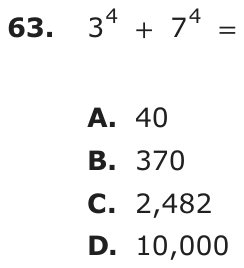
Question
- A40
- B370
- C2,482
- D10,000
Show the answer
Correct answer: C
Question analysis
This exponents question asks for the sum of 3 to the fourth power and 7 to the fourth power. Students evaluate each power separately and then add. The traps are treating an exponent as a multiplier and adding the bases before raising them to a power, and the larger power takes careful multiplication.
- NYS standards
- 6.EE.1 whole-number exponent expressions
- Grade level
- Grade 6 content, by NYS standard
- Compared with grade 7
- Below grade 7 Evaluating whole-number powers is grade 6 work, and this question asks only for two of them and a sum. The one demand beyond routine practice is computing a fourth power of 7 accurately without a calculator.
- Estimated difficulty
- Straightforward: two steps or one careful reading.
- Thinking it demands
- Depth of knowledge 1, recall and reproduction · mainly apply
- What makes it hard
- Error-prone arithmetic moderate
- Something you must already know minor
- Solution
- 3 steps
- Reading level
- Question and choices: about grade 16+, 1 words.
- Students, last 30 days
- Not enough answers yet to show (it takes 10).
Why it is hard, traps and wrong answers (shows the answer)
Why it is hard
The sum is short, but it tests exactly what an exponent means and when to apply it. The wrong choices come from three misreadings of the notation: treating the power as a multiplier, using one factor too few, and adding the bases before raising them. A size check settles it: 7⁴ alone is 49 × 49, a little under 2,500, so 40 and 370 are far too small and 10,000 far too large.
Error-prone arithmetic moderate Working it out
7⁴ means 7 × 7 × 7 × 7 = 2,401, a four-digit product built by hand, most easily as 49 × 49; 3⁴ = 81 is quick by comparison. (Brown & Burton, 1978; Junker & Sijtsma, 2001)
Something you must already know minor Working it out
An exponent counts repeated factors rather than acting as a multiplier, so 3⁴ is 3 × 3 × 3 × 3 = 81, not 3 × 4 = 12; the item assumes that meaning. (Anderson & Krathwohl, 2001)
Strategy: Compute each power on its own, squaring and then squaring again, and add the two results only at the end.
Traps
- A faulty procedure: A systematic but wrong procedure: adding fractions straight across, applying an exponent to each term of a sum, dropping a sign when moving a term.
- Order of operations: Working left to right, or distributing a minus sign wrongly, gives a choice.
The wrong answers, classified
A A faulty procedure (Brown & Burton, 1978; Tatsuoka, 1983)
Multiplies each base by its exponent, 3 × 4 + 7 × 4 = 12 + 28 = 40, instead of using each base as a factor four times.
B A faulty procedure (Brown & Burton, 1978; Tatsuoka, 1983)
Uses each base as a factor three times instead of four, 27 + 343 = 370, so both powers stop one factor short.
D Order of operations (Brown & Burton, 1978)
Adds the bases before applying the exponent, treating 3⁴ + 7⁴ as (3 + 7)⁴ = 10,000, though powers come before addition.
Worked solution, step by step
Formulas used
- A power
- a is the base, the number being multiplied. The small 4 is the exponent. It tells how many times the base is used as a factor, a number being multiplied. So the exponent counts factors. It does not mean multiply by 4.
- Powers come before adding
- a and b are any two positive numbers. The sign ≠ means is not equal to. Powers come before adding. So raise each number to its power first, then add. Adding the bases first gives a much bigger number.
Sort out the question
You need the value of . Each number has a small 4 above it. This 4 is an exponent. Work out each power on its own. Then add the two results.
Find 3 to the fourth power
3⁴ means four 3s multiplied together. Pair them up to make it easier.
Watch out: 3⁴ is not 3 × 4 = 12. Doing that to both powers gives 12 + 28 = 40, choice A.
Find 7 to the fourth power
7⁴ means four 7s multiplied together. Pair them up the same way.
To find 49 × 49, do 49 × 50 = 2,450. Then take away one 49. That gives 2,401. Watch out: count four 7s, not three. Three 7s make 343. Using three factors in both powers gives 370, choice B.
Add the two powers
Watch out: don’t add 3 and 7 first. That gives , choice D. Powers come before adding. So the answer is C, 2,482.
Check your answer
Estimate. 7⁴ is 49 × 49, a little less than 50 × 50 = 2,500. Adding 81 keeps it near 2,500. Only 2,482 is close. 40 and 370 are far too small, and 10,000 is far too big.
More questions like this
The original DOE question