Question
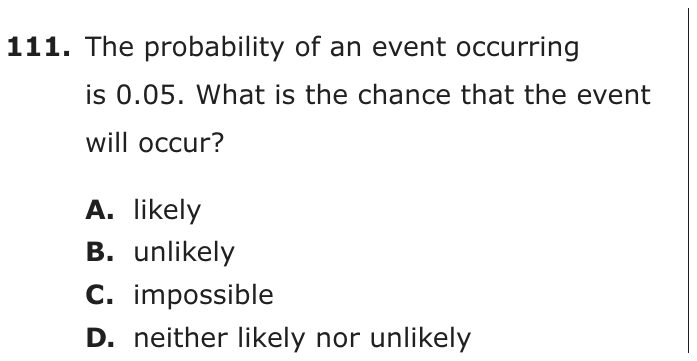
The probability of an event occurring is 0.05. What is the chance that the event will occur?
- Alikely
- Bunlikely
- Cimpossible
- Dneither likely nor unlikely
Show the answer
Correct answer: B
The probability of the event is 0.05, which equals 5%, which is less than 50%.
Option A:
An event that is likely has a probability over 50%.
Option B:
An event that is unlikely has a probability less than 50% but greater than 0%.
Option C:
An event that is impossible has a 0% probability.
Option D:
An event that is neither likely nor unlikely has a 50% probability.
Question analysis
This probability question gives an event a probability of 0.05 and asks how likely the event is to occur, described in words. Students place the decimal on the scale from 0, impossible, to 1, certain. Reading the place value of the decimal correctly is the only real hurdle.
- NYS standards
- 6.SP.6 probability from 0 to 1
- Grade level
- Grade 6 content, by NYS standard
- Compared with grade 7
- Below grade 7 Describing in words how likely an event is from its probability between 0 and 1 is a grade 6 standard. This is one quick judgment with no computation, well below grade 7 probability work with compound events.
- Estimated difficulty
- Routine: one familiar step, little to misread.
- Thinking it demands
- Depth of knowledge 1, recall and reproduction · mainly understand
- What makes it hard
- Solution
- 1 step
- Reading level
- Question and choices: about grade 10, 23 words.
- Students, last 30 days
- Not enough answers yet to show (it takes 10).
Why it is hard, traps and wrong answers (shows the answer)
Why it is hard
One judgment answers the question: 0.05 is a small probability, but it is not zero. The two tempting errors are treating a small chance as no chance at all and misreading 0.05 as 0.5, an even chance. Writing the probability as 5% or as 1 in 20 makes its size plain.
Something you must already know minor Working it out
The probability scale, 0 for impossible, 1/2 for an even chance and 1 for certain, is assumed, and 0.05 has to be placed near its low end. (Anderson & Krathwohl, 2001)
Strategy: Picture the probability scale from 0 to 1, with 0 for impossible, 1/2 for an even chance and 1 for certain, and see where 0.05 falls.
Traps
- Misunderstands the concept: A wrong belief about a concept: that percents can be added, that area grows like length, that averages can be averaged, that a bigger denominator means a bigger fraction.
- An arithmetic slip: The right method with a plausible arithmetic error: a digit, a place value or a times-table fact.
The wrong answers, classified
A Little reason to choose it (Haladyna & Downing, 1993; Rodriguez, 2005)
No common reading makes 0.05 likely, which would need a probability above one half, so it mostly draws guesses.
C Misunderstands the concept (Smith, diSessa & Roschelle, 1993; De Bock et al., 1998; Ni & Zhou, 2005)
Treats a probability close to 0 as exactly 0, as if an event with a 1 in 20 chance could never happen.
D An arithmetic slip (Junker & Sijtsma, 2001)
Reads 0.05 as 0.5, a place-value slip, which would mean an even chance of happening or not.
Worked solution, step by step
Formulas used
- Probability scale
- P is the probability of an event, a number that tells how likely it is to happen. It is always from 0 to 1. 0 means impossible, and 1 means certain. One half, or 0.5, means an even chance. The closer P is to 0, the less likely the event.
Sort out the question
Probability is a number that tells how likely an event is. An event is something that might happen. Here the probability is 0.05. You need the word that best describes that chance.
Change 0.05 to a percent
So 0.05 is 5 out of 100, or 5%. That is the same as 1 chance in 20. Watch out: 0.05 is not 0.5. A probability of 0.5 would be an even chance, choice D.
Place it on the scale
Probability Chance 0 impossible more than 0, less than 0.5 unlikely 0.5 neither likely nor unlikely more than 0.5, less than 1 likely 1 certain 0.05 is more than 0 but much less than 0.5. So the event is unlikely.
Rule out the other choices
Watch out: a small chance is still a chance. 0.05 is more than 0, so the event can happen. It is not impossible, choice C. Likely, choice A, would need more than 0.5.So the answer is B, unlikely.
Check your answer
Picture 20 tries. With a 5% chance, the event would happen about once, since 5% of 20 is 1. It would not happen about 19 times. That is rare but possible, so unlikely fits.
More questions like this
The original DOE question