Passage Ode to Fireworks
Ode to Fireworks
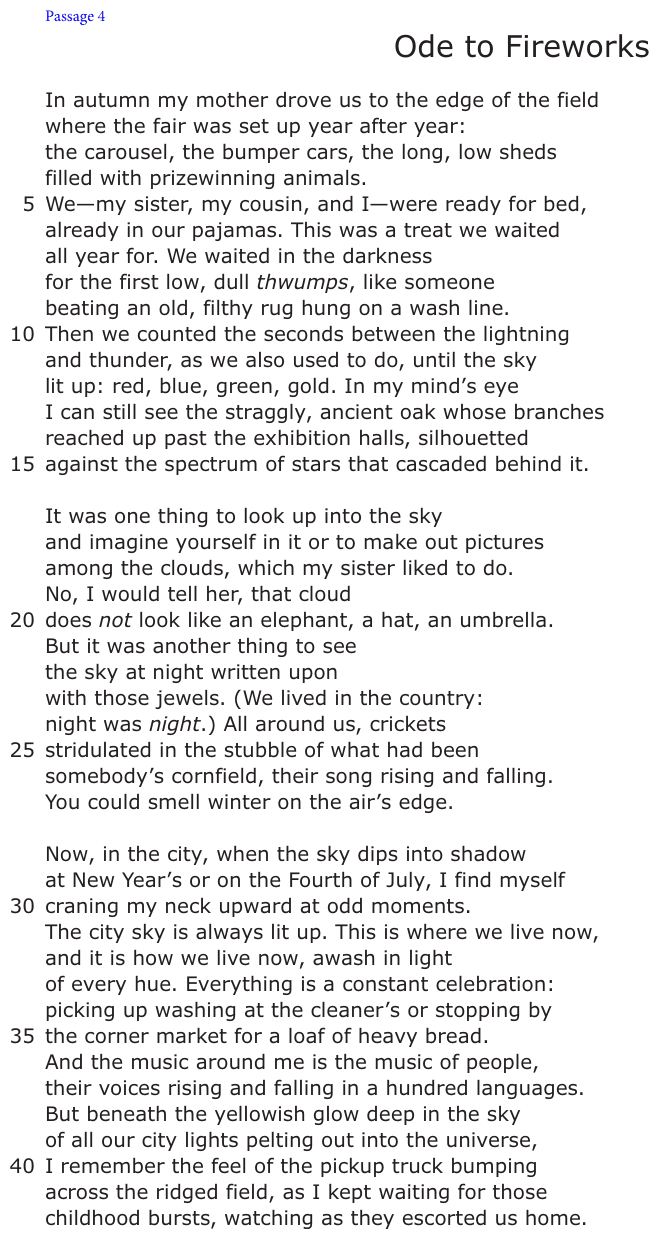
In autumn my mother drove us to the edge of the field
where the fair was set up year after year:
the carousel, the bumper cars, the long, low sheds
filled with prizewinning animals.
We—my sister, my cousin, and I—were ready for bed,
already in our pajamas. This was a treat we waited
all year for. We waited in the darkness
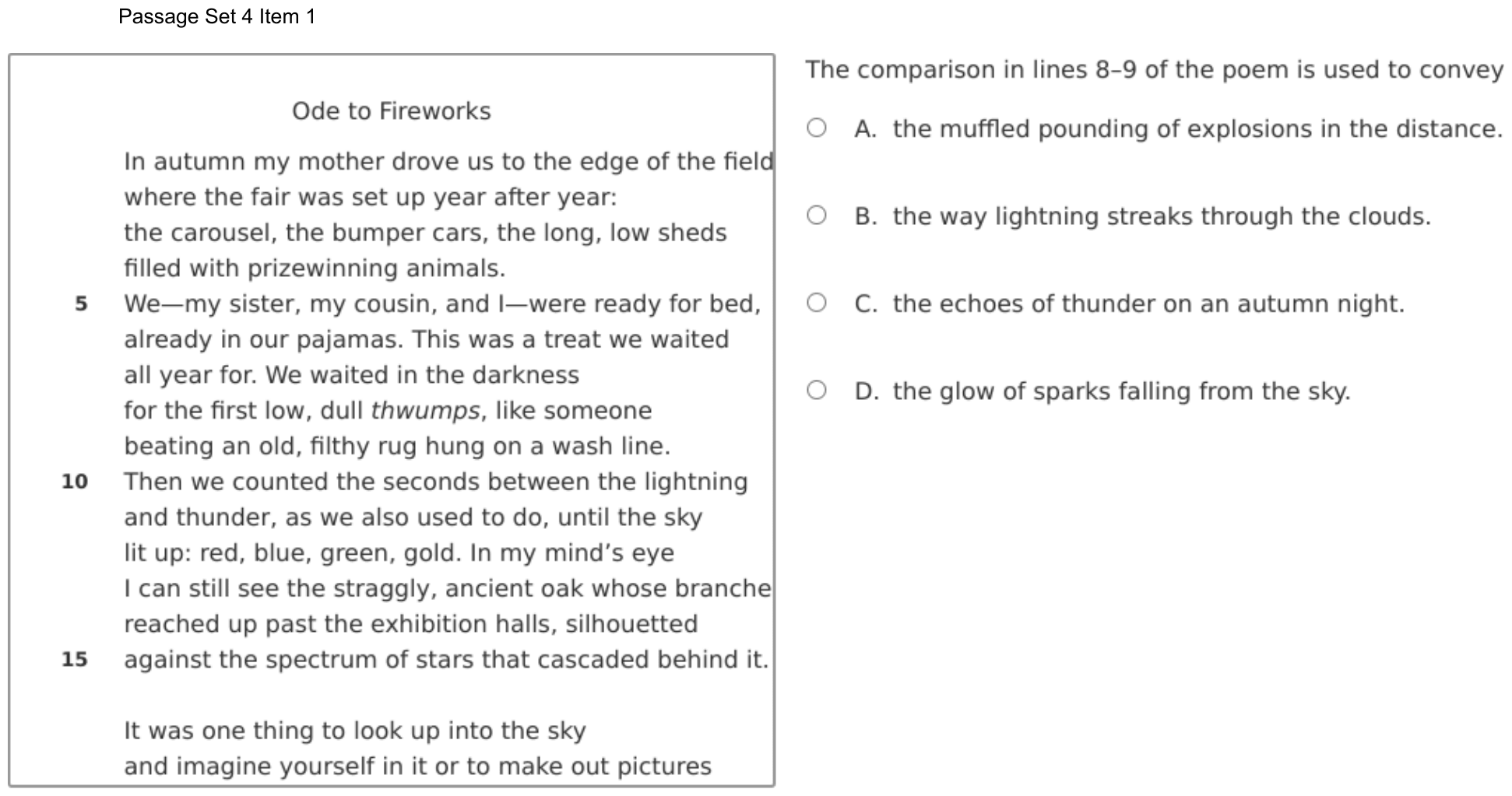
for the first low, dull thwumps, like someone
beating an old, filthy rug hung on a wash line.
Then we counted the seconds between the lightning
and thunder, as we also used to do, until the sky
lit up: red, blue, green, gold. In my mind’s eye
I can still see the straggly, ancient oak whose branches
reached up past the exhibition halls, silhouetted
against the spectrum of stars that cascaded behind it.
It was one thing to look up into the sky
and imagine yourself in it or to make out pictures
among the clouds, which my sister liked to do.
No, I would tell her, that cloud
does not look like an elephant, a hat, an umbrella.
But it was another thing to see
the sky at night written upon
with those jewels. (We lived in the country:
night was night.) All around us, crickets
stridulated in the stubble of what had been
somebody’s cornfield, their song rising and falling.
You could smell winter on the air’s edge.
Now, in the city, when the sky dips into shadow
at New Year’s or on the Fourth of July, I find myself
craning my neck upward at odd moments.
The city sky is always lit up. This is where we live now,
and it is how we live now, awash in light
of every hue. Everything is a constant celebration:
picking up washing at the cleaner’s or stopping by
the corner market for a loaf of heavy bread.
And the music around me is the music of people,
their voices rising and falling in a hundred languages.
But beneath the yellowish glow deep in the sky
of all our city lights pelting out into the universe,
I remember the feel of the pickup truck bumping
across the ridged field, as I kept waiting for those
childhood bursts, watching as they escorted us home.
Question
The comparison in lines 8–9 of the poem is used to convey
- Athe muffled pounding of explosions in the distance.
- Bthe way lightning streaks through the clouds.
- Cthe echoes of thunder on an autumn night.
- Dthe glow of sparks falling from the sky.
Show the answer
Correct answer: A
The question asks what the comparison in lines 8–9 of the poem is used to convey.
A. CORRECT. In lines 8–9 the speaker compares the deep thumping noises at the start of a fireworks show to the muffled thumping sound made when beating a rug to clean it. The imagery of “low, dull thwumps” (line 8) (onomatopoeia) describes a sound that is not clear or powerful. To the speaker, these low, distant explosions are the signal that the fireworks display is starting and that the loud, cracking sound of fireworks will be heard soon (“Then we counted the seconds between the lightning / and thunder” [lines 10–11]).
B. Incorrect. The comparison in lines 8–9 deals with the low sound of the first fireworks shooting off rather than the streaks of light they emit. To the speaker, the low thwumps (onomatopoeia) are the signal that fireworks are about to explode overhead, much like the way a streak of lightning during a storm indicates that a crash of thunder will follow in a few seconds.
C. Incorrect. The thwump (onomatopoeia) sounds are the start of the fireworks show, not thunder. As a comparison, the speaker says the initial thwumps of the fireworks signal anticipation for the full explosion that will come, much like the way the speaker would watch for lightning and count the seconds before an impending thunderclap (lines 10–11).
D. Incorrect. The muffled thwump (onomatopoeia) sounds occur before the dazzling explosion of lights and before sparks start to fall from the sky. The comparison focuses on the sounds of the experience, not the sight of the experience.
Question analysis
This figurative language question asks what the comparison in lines 8–9 of “Ode to Fireworks” conveys. In the poem an adult speaker remembers waiting with family, already in pajamas, for the fireworks at a country fair. Students must interpret an old-fashioned household image and decide what part of the show it describes, since the nearby lines mention sights as well as sounds.
- Grade level
- Grade 6 reading and task
- Compared with grade 7
- Below grade 7 Interpreting a simile is taught from grade 6, and this one takes up two lines of concrete words. The household chore it pictures may be unfamiliar, but the task is a single step, lighter than typical grade 7 poetry work.
- Estimated difficulty
- Straightforward: two steps or one careful reading.
- Thinking it demands
- Depth of knowledge 2, skills and concepts · mainly understand
- What makes it hard
- Evidence
- Answered from one sentence or line
- Reading level
- Passage: 379 words (a poem; reading level not measured); question and choices: about grade 3, 42 words.
- Students, last 30 days
- Not enough answers yet to show (it takes 10).
Why it is hard, traps and wrong answers (shows the answer)
Why it is hard
The comparison is about sound, and once students notice that, the sight-based choices about lightning and sparks fall away. The pull comes from the next lines, where the children count “the seconds between the lightning / and thunder,” a storm game that makes thunder seem like the thing being described. The question rewards staying inside lines 8–9, where “low, dull” and the beaten rug describe the first faint booms of the show.
Figurative or literary language moderate Understanding the question
Lines 8–9 pair the made-up sound word “thwumps” with a simile, someone beating an old rug on a wash line, so students must hear a dull, distant thud in an image about housework. (Graesser, Singer & Trabasso, 1994; Kintsch, 1998)
Something you must already know minor Working it out
The simile works only for readers who can imagine the flat whack of a rug being beaten clean on a line, a chore many students have never seen or heard. (Anderson & Krathwohl, 2001)
Strategy: Reread lines 8–9 slowly and ask which sense the comparison appeals to, sight, sound or touch, then pick the choice that describes that same experience.
Traps
- Taking figurative language literally: A choice reads a figure of speech or image at face value.
- Wrong part of the text: A choice is true of another paragraph, stanza or speaker than the one asked about.
The wrong answers, classified
B Wrong part of the text (Kirsch & Mosenthal, 1990)
Jumps to the “lightning” of line 10, but lines 8–9 come before the sky lights up and describe something heard in the darkness, not a streak of light.
C Taking figurative language literally (Graesser, Singer & Trabasso, 1994)
Takes the “lightning / and thunder” of lines 10–11 as a real storm and hears the thwumps as thunder, though the counting game only likens the fireworks to one.
D Wrong part of the text (Kirsch & Mosenthal, 1990)
Pictures the colors of lines 12–15, “red, blue, green, gold,” but the rug-beating image describes a dull sound heard before any sparks appear in the sky.
Working it out, step by step
Figure out what the question asks
This asks what a comparison helps you picture. Lines 8–9 compare one thing to another using “like.” That kind of comparison is called a simile. First ask which sense it describes: sight, sound or touch.
Find the comparison
The family waits in the dark. Lines 8–9 say they wait “for the first low, dull thwumps, like someone / beating an old, filthy rug hung on a wash line.” Thwumps is a made-up word that sounds like the noise it names. So the comparison is about a sound. It comes before the sky lights up.
Picture the rug
People used to hang a dusty rug on a line and hit it with a stick. Each hit makes a flat, soft thud, not a sharp bang. The words “low” and “dull” say the same thing. So the first fireworks sound like soft booms far away. Muffled means soft, as if wrapped in cloth.
Check each choice
- A is right. Dull thuds heard in the dark are the muffled pounding of explosions far off.
- B is wrong. Lightning is something you see. Lines 8–9 describe a sound heard before anything lights up.
- C is wrong. The thunder in lines 10–11 is part of a counting game. It compares the show to a storm. The rug image is about the fireworks.
- D is wrong. Sparks are something you see. The colors don’t come until line 12.
Watch out: Lines 10–11 mention “lightning” and “thunder.” That can make C look right. But the rug comparison comes first and is about the fireworks.
Choose the answer
The rug-beating simile makes the first fireworks sound like soft, faraway thuds. So the answer is A, “the muffled pounding of explosions in the distance.”
Why this answer and not the closest wrong one
C is the closest wrong answer, because thunder is a low boom too. But lines 10–11 only compare the show to a storm in a counting game. The rug image in lines 8–9 describes the fireworks themselves: dull, muffled thuds from far away. That is A.
More questions like this
The original DOE question
The passage “Ode to Fireworks” as printed (page 32)