Question
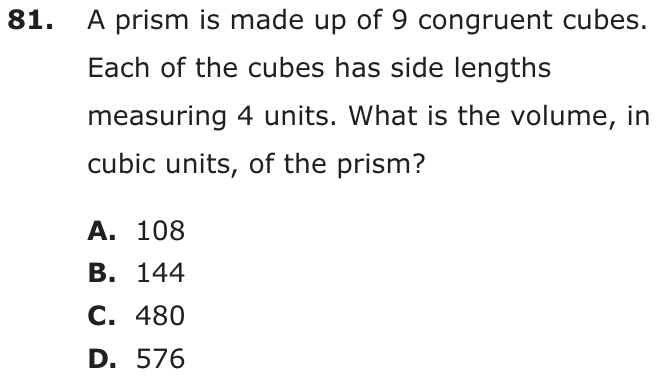
A prism is made up of 9 congruent cubes. Each of the cubes has side lengths measuring 4 units. What is the volume, in cubic units, of the prism?
- A108
- B144
- C480
- D576
Show the answer
Correct answer: D
First, determine the volume of each congruent cube. All the side lengths of the cubes are equal, so the length, width, and height of each cube is 4 units. To determine the volume of each cube, multiply :
So, the volume of each cube is 64 cubic units.
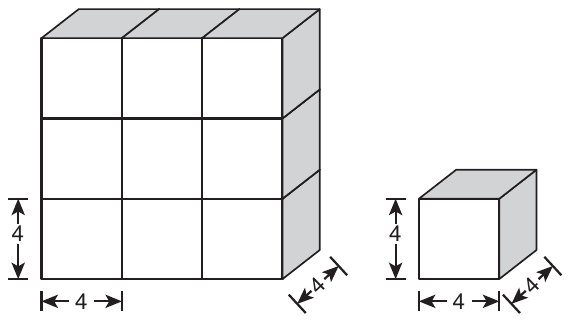
The prism is comprised of 9 of these cubes, so multiply the volume of each cube (64) by the total number of cubes (9) to determine the volume, in cubic units, of the prism:
Question analysis
A prism is built from 9 identical cubes, and each cube has edges 4 units long. Students find the volume of the prism in cubic units. It tests the volume of a cube and how volumes add when solids are put together, and it rewards keeping area, surface area and volume apart.
- Grade level
- Grade 6 content, by NYS standard
- Compared with grade 7
- Below grade 7 Volume of cubes and rectangular prisms is grade 5 and 6 content. This item needs one cube's volume and a multiplication by 9, two short steps, so it is below typical grade 7 work.
- Estimated difficulty
- Routine: one familiar step, little to misread.
- Thinking it demands
- Depth of knowledge 1, recall and reproduction · mainly apply
- What makes it hard
- Solution
- 2 steps
- Reading level
- Question and choices: about grade 3, 27 words.
- Corrected from the DOE handbook
- A letter x printed in place of a multiplication sign in the explanation was corrected.
- Students, last 30 days
- Not enough answers yet to show (it takes 10).
Why it is hard, traps and wrong answers (shows the answer)
Why it is hard
The question needs one formula and one multiplication, and the stem does not even say how the cubes are arranged, because the volume does not depend on it. The wrong choices come from mishandling the cube’s volume: the exponent multiplied instead of applied, the area of one face, or a surface area. Writing the volume out as edge times edge times edge, in cubic units, rules all three out.
Something you must already know minor Working it out
A cube’s volume, edge × edge × edge, is not given; with it, each 4-unit cube holds 64 cubic units, and the arrangement of the 9 cubes does not matter. (Anderson & Krathwohl, 2001)
Strategy: Find the volume of one cube by multiplying its three edges, then multiply by the number of cubes; how the cubes are arranged does not matter.
Traps
- Wrong formula: Uses a related but wrong formula: perimeter for area, diameter for radius, area for volume, or a misremembered one.
- A faulty procedure: A systematic but wrong procedure: adding fractions straight across, applying an exponent to each term of a sum, dropping a sign when moving a term.
The wrong answers, classified
A A faulty procedure (Brown & Burton, 1978; Tatsuoka, 1983)
Takes 4³ as 4 × 3 = 12, multiplying the edge by the exponent, so each cube seems to hold 12 cubic units and 9 × 12 = 108.
B Wrong formula (King et al., 2004)
Uses the area of one face, 4 × 4 = 16 square units, as each cube’s volume, so 9 × 16 = 144.
C Wrong formula (King et al., 2004)
Pictures the 9 cubes as a 3-by-3 slab, 12 by 12 by 4 units, and finds its surface area, 480 square units, instead of its volume.
What was corrected from the DOE handbook, and why
- Explanation: The handbook gives the volume of a cube as “length x width x height”, with the letter x where it means “times”. In a math explanation the letter x reads as a variable, so the site writes length × width × height, the sign the handbook itself uses on the next line (4 × 4 × 4 = 64). Nothing else changes: each cube is 64 cubic units, and the 9 cubes make 64 × 9 = 576.
Worked solution, step by step
Formulas used
- Volume of a cube
- V is the volume, the space inside a solid, in cubic units. s is the length of one edge. All the edges of a cube are equal, so its length, width and height are all s. Multiplying them counts how many unit cubes fit inside.
Sort out the question
A prism, a solid with flat faces, is made of 9 congruent cubes. Congruent means exactly the same size and shape. Each cube has sides of 4 units. You need the volume of the whole prism, in cubic units.
The question doesn’t say how the cubes are stacked. You don’t need to know. Volume is the space inside, and 9 cubes fill the same space however they are arranged.
Find the volume of one cube
Each cube has a volume of 64 cubic units. Watch out: means , not . That slip leads to 108, choice A. Also, is only the area of one face. It leads to 144, choice B.
Multiply by the number of cubes
The prism is 9 of these cubes, so its volume is 9 times as big.
The prism’s volume is 576 cubic units.
Give the answer
Watch out: volume counts the space inside, not the outside faces. Suppose the cubes formed one flat 3-by-3 layer. Adding up the areas of its outside faces gives 480, choice C. That is surface area, not volume. So the answer is D, 576.
Check your answer
Estimate: , and one cube fewer is . You can also test one arrangement. A flat 3-by-3 layer is 12 by 12 by 4 units, and . Same answer.
More questions like this
The original DOE question