Also in 2026 Practice Test B Math, question 50; 2025 Practice Test A Math, question 57.
Question
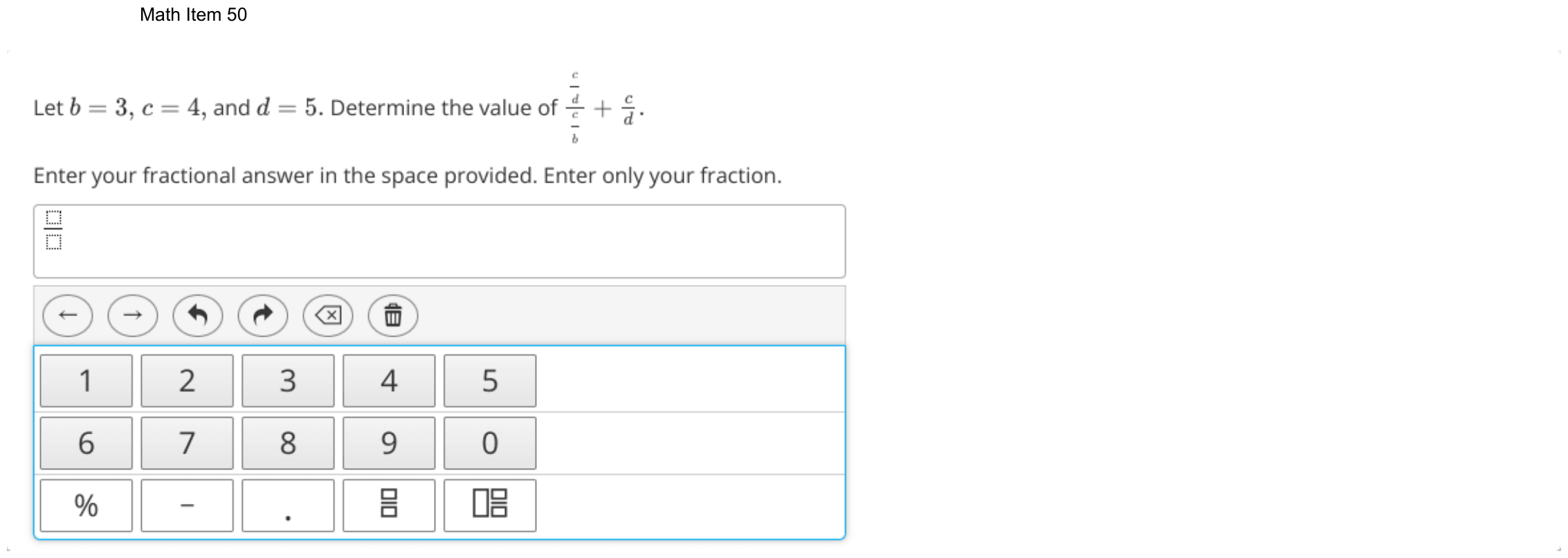
Let , , and . Determine the value of .
Enter your fractional answer in the space provided. Enter only your fraction.
On the test you build the answer on an on-screen keypad; here, type it. Use ^ for a power, sqrt( ) or √ for a root, pi for π, and <= or >= for ≤ and ≥.
Show the answer
Correct answer: 7/5
Solution:
Substitute , , and in : .
Then simplify the complex fraction by multiplying the complex fraction by a form of 1, : .
Simplify after multiplying by a form of 1: .
Then simplify again and add the two fractions: .
Question analysis
This substitution question gives values for b, c and d and asks for the value of an expression made of a fraction divided by a fraction, plus another fraction. Students substitute, simplify the complex fraction and add, then type the result. Dividing fractions in the stacked form is the main hurdle, and the item wants a fraction, not a decimal.
- NYS standards
- Grade level
- Grade 7 content, by NYS standard
- Compared with grade 7
- At grade 7 Grade 7 students evaluate expressions and divide and add fractions. A fraction stacked over another fraction looks unfamiliar and there are no choices to check, but with these values the work is three short steps.
- Estimated difficulty
- Moderate: several steps, or a close reading with one strong distractor.
- Thinking it demands
- Depth of knowledge 1, recall and reproduction · mainly apply
- What makes it hard
- Error-prone arithmetic moderate
- Something you must already know minor
- An answer in an unexpected form minor
- Solution
- 3 steps
- Reading level
- Question and choices: about grade 9, 22 words.
- Students, last 30 days
- Not enough answers yet to show (it takes 10).
Why it is hard, traps and wrong answers (shows the answer)
Why it is hard
Once the values are in, the work is one fraction division and one addition, but the division is printed as a fraction over a fraction, in small type. Multiplying the two fractions, or flipping the top one, gives a sum in fifteenths that looks as finished as the right one. Noticing that the 4s cancel, so the stacked part is simply 3/5, turns the last step into adding fifths.
Error-prone arithmetic moderate Working it out
Dividing 4/5 by 4/3 means multiplying by 3/4, giving 3/5, which is then added to 4/5; multiplying straight across or flipping the top fraction instead both lead to fifteenths. (Brown & Burton, 1978; Junker & Sijtsma, 2001)
Something you must already know minor Working it out
Nothing on the page says that a fraction over a fraction is a division, or that dividing by 4/3 means multiplying by its reciprocal, and the stacked form is rare in grade 7 work. (Anderson & Krathwohl, 2001)
An answer in an unexpected form minor Choosing the answer
The value is typed into a fraction box with no choices to check against, and the item asks for a fraction, so the equal decimal 1.4 is not accepted. (Enright, Morley & Sheehan, 2002)
Strategy: Substitute the values, rewrite the stacked fraction as the top fraction times the reciprocal of the bottom one, where the 4s cancel, then add the last fraction and leave the result as a fraction.
Traps
- Wrong operation: Adds instead of multiplying, divides the wrong way round, turns a ratio or rate upside down, or undoes a step in the wrong direction (subtracts what should be added back).
- A faulty procedure: A systematic but wrong procedure: adding fractions straight across, applying an exponent to each term of a sum, dropping a sign when moving a term.
- Misreads the question: Misses or misreads a condition or a word in the question: "at least", "each", "remaining", "not".
The wrong answers, classified
28/15 Wrong operation (Hegarty, Mayer & Monk, 1995; King et al., 2004)
Multiplies 4/5 by 4/3 instead of dividing, getting 16/15, then adds 4/5, or 12/15, to reach 28/15.
37/15 A faulty procedure (Brown & Burton, 1978; Tatsuoka, 1983)
Flips the top fraction instead of the bottom one, so the stacked part becomes 5/4 × 4/3 = 5/3, and 5/3 + 4/5 = 37/15.
1.4 Misreads the question (Hegarty, Mayer & Monk, 1995)
Finds the right value but works in decimals, 0.6 + 0.8 = 1.4, and enters that, though the item asks for a fraction.
Worked solution, step by step
Formulas used
- Dividing fractions
- a, b, c and d are numbers that are not zero. To divide by a fraction, multiply by its reciprocal, the fraction flipped upside down. Flip only the fraction you divide by. It works because a fraction times its reciprocal is 1, so the reciprocal undoes the fraction, just as dividing does.
- Adding fractions with the same bottom
- d is the denominator, the bottom number, which tells the size of each piece. a and b are the numerators, the top numbers, which count the pieces. When the pieces are the same size, add the tops and keep the bottom.
Sort out the question
You know , and . You need the value of:
The first part is a fraction on top of a fraction. A fraction bar means divide, so this part is . The answer must be typed as a fraction.
Put in the numbers
Replace each letter with its value. Look closely: the bottom fraction has b under the c, not d.
So the expression becomes:
Divide the two fractions
Use the rule for dividing fractions. The reciprocal of 4/3 is 3/4. To multiply fractions, multiply the tops and multiply the bottoms:
To simplify 12/20, divide its top and bottom by 4.
Watch out: flip only the bottom fraction. Multiplying without flipping gives 16/15 and a total of 28/15. Flipping the top one gives 5/3 and a total of 37/15.
Add the last fraction
Both fractions are now fifths, so add the tops and keep the bottom:
The value is 7/5.
Enter it as a fraction
The item asks for a fraction. 7/5 equals the decimal 1.4, but 1.4 is not accepted. On the test, the answer box already holds a fraction template, a small box over a small box. Type 7 in the top box. Then click the bottom box and type 5. On this site, type 7/5.
So you would enter 7/5.
Check your answer
Check with decimals. , and 4/3 is about 1.33. Then is about 0.6, which is 3/5. Last, , and 1.4 is the same as 7/5.
More questions like this
The original DOE question