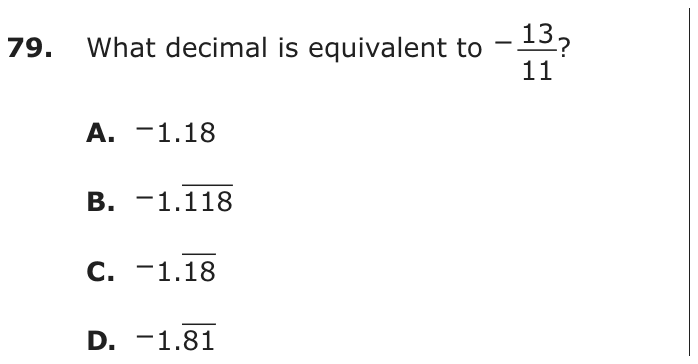
Question
What decimal is equivalent to ?
- A
- B
- C
- D
Show the answer
Correct answer: C
Calculate the decimal equivalent of :
Question analysis
A fractions and decimals question asks which decimal equals negative 13/11. The choices differ in which digits repeat and how the repetition is marked. Students divide 13 by 11, spot the block of digits that repeats, and read the bar notation carefully.
- NYS standards
- 7.NS.2d fractions to decimals by long division
- Grade level
- Grade 7 content, by NYS standard
- Compared with grade 7
- At grade 7 Converting a fraction to a repeating decimal by long division is a named grade 7 skill. This is one short division, typical of grade 7 work, with care needed only in reading the bar notation.
- Estimated difficulty
- Straightforward: two steps or one careful reading.
- Thinking it demands
- Depth of knowledge 1, recall and reproduction · mainly apply
- What makes it hard
- A very close wrong answer moderate
- Something you must already know minor
- Error-prone arithmetic minor
- Solution
- 2 steps
- Reading level
- Question and choices: about grade 15, 10 words.
- Students, last 30 days
- Not enough answers yet to show (it takes 10).
Why it is hard, traps and wrong answers (shows the answer)
Why it is hard
Dividing 13 by 11 is quick; the question is really about reading and writing repeating decimals. Three choices differ only in where the bar goes, so students who know the digits run 1.1818… can still pick the wrong bar. Writing out each barred choice for a few digits and comparing it with the quotient is a fast, sure check.
A very close wrong answer moderate Choosing the answer
The bars over 18 and over 81 cover the same two digits, so only checking which digit comes right after the decimal point, 1 before 8, tells them apart. (Embretson & Wetzel, 1987; Gorin & Embretson, 2006; Ascalon et al., 2007)
Something you must already know minor Working it out
Reading bar notation is assumed: the bar marks exactly the block of digits that repeats, and the whole-number 1 never belongs under it. (Anderson & Krathwohl, 2001)
Error-prone arithmetic minor Working it out
The long division 13 ÷ 11 has to run until the remainder 2 comes back, which is where the repeating pair is confirmed. (Brown & Burton, 1978; Junker & Sijtsma, 2001)
Strategy: Do the long division of 13 by 11 until a remainder comes back, note which digits repeat from that point, and match that block to the bar in each choice.
Traps
- A faulty procedure: A systematic but wrong procedure: adding fractions straight across, applying an exponent to each term of a sum, dropping a sign when moving a term.
- Rounds too early: Rounds a value partway through, or rounds the wrong way, so the final answer drifts from the exact one.
- Answer in another form: The right answer is written differently from the way you worked it out.
The wrong answers, classified
A Rounds too early (King et al., 2004)
Stops the division after two decimal places and treats −1.18 as exact, missing that the digits 1 and 8 go on repeating.
B A faulty procedure (Brown & Burton, 1978; Tatsuoka, 1983)
Counts the whole-number 1 into the block, seeing 1, 18, 18 … as 118 repeating, and bars 118, which means −1.118118… rather than −1.1818….
D A faulty procedure (Brown & Burton, 1978; Tatsuoka, 1983)
Bars 81, the pair in the wrong order, which gives −1.8181…, equal to −1 9/11 rather than the −1 2/11 that −13/11 is.
Worked solution, step by step
Formulas used
- Fraction as division
- a is the top number, the numerator. b is the bottom number, the denominator. A fraction bar means divide. To turn a fraction into a decimal, divide the top by the bottom.
- Bar for repeating digits
- The bar sits over the digits that repeat forever, in the order they repeat. The dots mean the pattern goes on and on. Digits that are not under the bar show up only once.
Sort out the question
You need the decimal equal to . The fraction is negative, so the decimal will be negative too. Work with first. Then put the minus sign back.
Divide 13 by 11
Use long division for .
- 11 goes into 13 once, with 2 left over. Write 1 and a decimal point.
- Bring down a 0 to make 20. 11 goes into 20 once, with 9 left over. Write 1.
- Bring down a 0 to make 90. 11 goes into 90 eight times, with 2 left over. Write 8.
So far you have 1.18.
Spot the repeating pattern
The remainder (the amount left over) is 2 again. That is where you were after the first step. So the same digits come back: 1, 8, 1, 8, and so on forever.
Watch out: −1.18, choice A, stops too soon. The digits never end.Write it with a bar
A bar goes over only the digits that repeat. Here 18 repeats, starting right after the decimal point. The whole number 1 does not repeat, so it is not under the bar. Put the minus sign back.
Watch out: a bar over 81, choice D, means −1.8181…. A bar over 118, choice B, means −1.118118….So the answer is C, .
Check your answer
Multiply back: . That is almost exactly 13, and more 18s bring it even closer. Also, 13/11 is a bit more than 1, so a decimal between 1 and 2 makes sense.
More questions like this
The original DOE question