Question
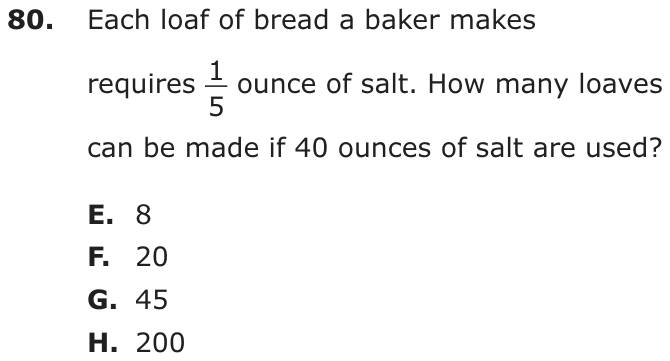
Each loaf of bread a baker makes requires ounce of salt. How many loaves can be made if 40 ounces of salt are used?
- A8
- B20
- C45
- D200
Show the answer
Correct answer: D
Each loaf of bread requires ounce of salt. Therefore, the baker can make 5 loaves of bread with 1 ounce of salt. Multiply to find the number of loaves that can be made with 40 ounces of salt:
Question analysis
A baking word problem: each loaf of bread needs 1/5 ounce of salt, and the baker uses 40 ounces. Students find how many loaves that much salt makes, working with a whole number and a unit fraction. Deciding whether to multiply or divide is the whole question.
- NYS standards
- 6.NS.1 dividing fractions by fractions
- Grade level
- Grade 6 content, by NYS standard
- Compared with grade 7
- Below grade 7 Dividing a whole number by a fraction in a word problem is a grade 6 standard. This takes one step with a unit fraction, simpler than typical grade 7 rational number problems.
- Estimated difficulty
- Routine: one familiar step, little to misread.
- Thinking it demands
- Depth of knowledge 2, skills and concepts · mainly apply
- What makes it hard
- Turning words into math minor
- Solution
- 1 step
- Reading level
- Question and choices: about grade 3, 24 words.
- Students, last 30 days
- Not enough answers yet to show (it takes 10).
Why it is hard, traps and wrong answers (shows the answer)
Why it is hard
The only decision is whether to multiply or divide, and thinking about one ounce first settles it: one ounce holds five fifths, so it makes five loaves. Students who multiply 40 by 1/5 get a small number, but a tiny amount of salt per loaf should give many loaves, not few. That reasonableness check leaves a single choice.
Turning words into math minor Understanding the question
“How many loaves” from 40 ounces at 1/5 ounce each asks how many fifths fit in 40, a division that many students turn into multiplying by 1/5. (Hegarty, Mayer & Monk, 1995; Koedinger & Nathan, 2004)
Strategy: Work out how many loaves one ounce of salt makes, then scale up to 40 ounces; dividing 40 by 1/5 gives the same count.
Traps
- Wrong operation: Adds instead of multiplying, divides the wrong way round, turns a ratio or rate upside down, or undoes a step in the wrong direction (subtracts what should be added back).
- An arithmetic slip: The right method with a plausible arithmetic error: a digit, a place value or a times-table fact.
- Numbers taken from the question: Combines the numbers in the question without a model of the situation, or is simply a number that appears in the question.
The wrong answers, classified
A Wrong operation (Hegarty, Mayer & Monk, 1995; King et al., 2004)
Multiplies 40 by 1/5 instead of dividing, finding a fifth of the salt rather than how many fifths of an ounce it holds.
B An arithmetic slip (Junker & Sijtsma, 2001)
Knows to multiply 40 by 5 but drops a zero, writing the product as 20 instead of 200.
C Numbers taken from the question (Hegarty, Mayer & Monk, 1995)
Adds the 5 from 1/5 to the 40 ounces, combining the numbers in the problem without a model of the situation.
Worked solution, step by step
Formulas used
- Number of equal groups
- Total is the whole amount you have. Size of one group is how much each one uses. Dividing tells how many groups fit into the total. Here one group is the salt for one loaf.
- Dividing by a unit fraction
- a is any number. 1 over n is a unit fraction, a fraction with 1 on top. Dividing by it asks how many nths fit into a. Each whole holds n of them, so you multiply by n.
Sort out what you know
Each loaf uses ounce of salt. The baker uses 40 ounces of salt. You need how many loaves that makes. That means how many fifths of an ounce fit into 40 ounces.
Decide to divide
You are splitting the salt into equal groups of 1/5 ounce. Each group makes one loaf. So divide the total salt by the salt for one loaf.
Watch out: do not multiply by 1/5. , choice A, is a fifth of the salt, not a number of loaves.Divide by the fraction
Each ounce holds 5 fifths, so 1 ounce makes 5 loaves. Dividing by 1/5 is the same as multiplying by 5.
The salt makes 200 loaves. Watch out: keep both zeros. 20, choice B, drops one.
So the answer is D, 200.
Check your answer
Multiply back. 200 loaves at ounce each use ounces. That is all the salt. Also, each loaf uses less than 1 ounce, so there should be more loaves than ounces. 200 is more than 40.
More questions like this
The original DOE question