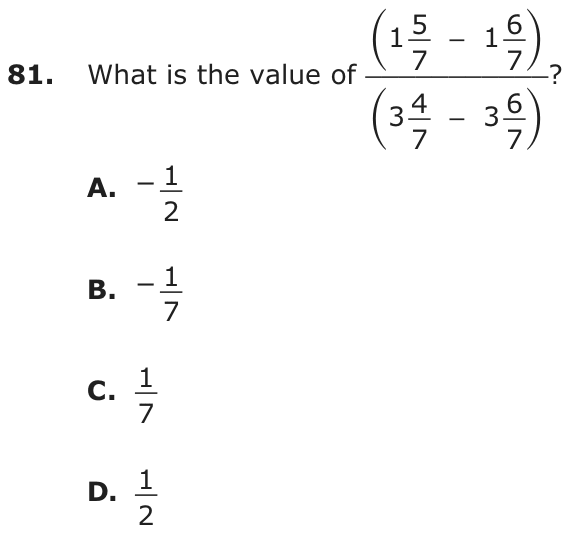
Question
What is the value of ?
- A
- B
- C
- D
Show the answer
Correct answer: D
First, subtract to simplify.
Follow the process for dividing fractions:
Question analysis
A fractions question: find the value of a quotient whose top is 1 5/7 minus 1 6/7 and whose bottom is 3 4/7 minus 3 6/7. Students subtract mixed numbers that share a denominator and then divide one difference by the other. Keeping track of positive and negative signs through both steps is the main hurdle.
- Grade level
- Grade 7 content, by NYS standard
- Compared with grade 7
- At grade 7 Grade 7 students subtract and divide rational numbers, including negatives, and use the sign rules for quotients. This item chains three such operations with easy sevenths, a typical grade 7 exercise.
- Estimated difficulty
- Moderate: several steps, or a close reading with one strong distractor.
- Thinking it demands
- Depth of knowledge 1, recall and reproduction · mainly apply
- What makes it hard
- Error-prone arithmetic moderate
- Many steps minor
- Solution
- 3 steps
- Reading level
- Question and choices: about grade 10, 10 words.
- Students, last 30 days
- Not enough answers yet to show (it takes 10).
Why it is hard, traps and wrong answers (shows the answer)
Why it is hard
The mixed numbers look heavy, but the whole parts cancel and only sevenths remain. What decides the question is sign handling: each difference is negative, and one negative divided by another is positive. Students who stop after the top, subtract instead of divide, or keep a minus sign each find their result among the choices.
Error-prone arithmetic moderate Working it out
Both differences are negative, 1 5/7 − 1 6/7 = −1/7 and 3 4/7 − 3 6/7 = −2/7, and dividing them needs both the sign rule and a reciprocal. (Brown & Burton, 1978; Junker & Sijtsma, 2001)
Many steps minor Working it out
Two subtractions must be finished before the division, and a sign lost in either one carries into the final quotient. (Daniel & Embretson, 2010; Enright, Morley & Sheehan, 2002)
Strategy: Work out the top and the bottom separately, writing each difference as a signed fraction in sevenths, then divide by multiplying the top by the reciprocal of the bottom and apply the sign rule.
Traps
- Negatives and direction: Arithmetic with negative numbers, the order of a subtraction, or direction on a number line. (Moving a term across the equals sign without changing its sign is a faulty procedure.)
- Stops one step early: A choice is a number from partway through the solution.
- Wrong operation: Adds instead of multiplying, divides the wrong way round, turns a ratio or rate upside down, or undoes a step in the wrong direction (subtracts what should be added back).
The wrong answers, classified
A Negatives and direction (Brown & Burton, 1978)
Finds −1/7 and −2/7 correctly but keeps a negative sign when dividing, forgetting that a negative divided by a negative is positive.
B Stops one step early (King et al., 2004; Gierl et al., 2017)
Works out the top, 1 5/7 − 1 6/7 = −1/7, and stops there without dividing it by the bottom difference.
C Wrong operation (Hegarty, Mayer & Monk, 1995; King et al., 2004)
Subtracts the bottom difference from the top one, −1/7 − (−2/7) = 1/7, instead of dividing the two.
Worked solution, step by step
Formulas used
- Dividing fractions
- a over b is the number you divide. c over d is the number you divide by. To divide by a fraction, multiply by its reciprocal, the fraction flipped upside down. Only the second fraction flips.
- Dividing two negative numbers
- a and b are positive numbers, and b is not zero. A negative number divided by a negative number gives a positive answer. The two minus signs cancel. Multiplying two negatives works the same way.
Sort out the problem
The long fraction bar means divide. So you need the top difference divided by the bottom difference. A difference is the answer to a subtraction. Work out the top and the bottom first, then divide.
Work out the top
Both numbers on top have the same whole number, 1. So the wholes cancel, and you only need . You take away more than you have, so the answer is negative.
Work out the bottom
Both numbers on the bottom have the whole number 3, so those cancel too.
Watch out: do not stop after the top. , choice B, is only part of the problem.Divide the top by the bottom
Both results are negative. The two minus signs cancel.
Now flip the second fraction and multiply.
Avoid the traps and answer
Watch out: keeping a minus sign gives , choice A. Subtracting the bottom from the top, instead of dividing, gives , choice C.So the answer is D, .
Check your answer
Think in sevenths. The top is −1 seventh and the bottom is −2 sevenths. That is like . Or multiply back: , which is the top.
More questions like this
The original DOE question